Reviews of products for scale automotive models, including motorcycles and motorized vehicles.

Review Author
Doug Hamilton
Published on
Company
M & S Hobbies
MSRP
$12.50

The Porsche 962 was one of the most successful race cars ever produced. Being a customer based car, there were many teams that raced them at all the major tracks in Europe and the US. Every superlative fits this amazing car, and M & S Hobbies has chosen it as the basis for a series of decal sheets that will fit the Tamiya 962 kit. M & S also produces a transkit for the 962 that will enhance and accurize this kit, but that’s the subject of another review!

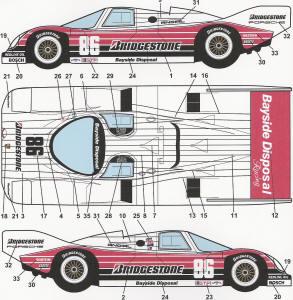
I received three decal sheets in the series. There are two sheets for the #86 Bayside Disposal car, One in Budweiser markings and the other in Bridgestone markings. The third sheet is in #16 Dyson Racing livery. Produced by UMI for M & S Hobbies these sheets contain all the markings for the featured car. Theses decals are about the finest I’ve ever seen. They’re extremely well printed and in perfect register. The colors are spot on to the actual cars according to my references and observations.
Review Author
Doug Hamilton
Published on
Company
M & S Hobbies
Scale
1/24
MSRP
$11.95

Produced to fit the Tamiya Porsche 962 kit, this set contains four turned and polished aluminum wheels, cast white metal inserts, and a fret of photo-etched trim rings. Assembly is a very straightforward affair that involves installing the centers into the rims, and attaching the trim ring to the center. I recommend painting the center insert gold before installing them on the rims. After the photo etched trim ring is added, a dark wash was used to give a little added depth. The tires pressed on, and they were complete. The center lug nut could be polished, or painted depending on the car you’re modeling. Check your references when deciding what to do with the nut.

Review Author
Robert Merz
Published on
Company
Tameo
Scale
1/43
MSRP
$65.00

Introduction

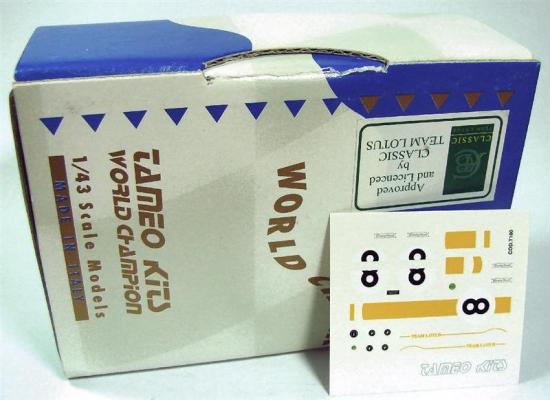
Tameo Models is an Italian firm, and their kits are arguably the best 1/43 scale models in the world. From their earliest days these kits have featured fine, white metal castings, delicate photo-etched details, machined aluminum parts, rubber tires, vacuform windscreens, and superb decals. They have led the 1/43rd world, and have never looked back.

Tameo is best known for its extensive line of Formula One cars. Taken all together, by my count there are over 475 kits offered by this prolific firm in 1/43 scale… and this does not include their extensive line of detail parts! Best of all, ALL of their kits are kept in production at all times!

The Kit

This kit is from their World Championship line (their most detailed offerings, with some kits containing over 300 parts). The kit contains finely cast white metal components for the body, chassis, engine, some strut elements, engine, instrument panel and wheel hubs.

Review Author
Jack Kennedy
Published on
Company
Fujimi
Scale
1/20
MSRP
$49.95

When I wrote the first part of this review, I briefly outlined the story behind this unusual race car. In this part I'll actually build the kit.

Upon opening the box I found 144 parts. All molded very crisply with fine detail. I didn't follow the instructions step by step as I was anxious to build the engine. This consisted of 44 parts. Assembly went very quickly with a terrific fit on all parts. Basically no cleanup was needed. When completed I primed it with Duplicolor Automotive light grey primer and then airbrushed with Duplicolor Silver. When this was dry, I gave the engine dark washes and a light drybrushing with bright silver. This really popped out the detail.

Review Author
Jack Kennedy
Published on
Company
Fujimi
Scale
1/20
MSRP
$49.95

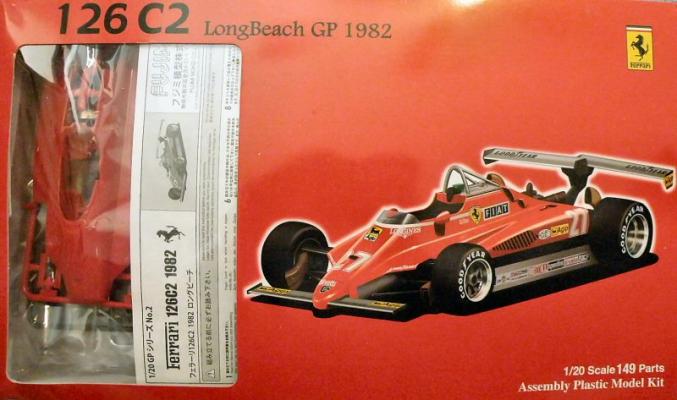
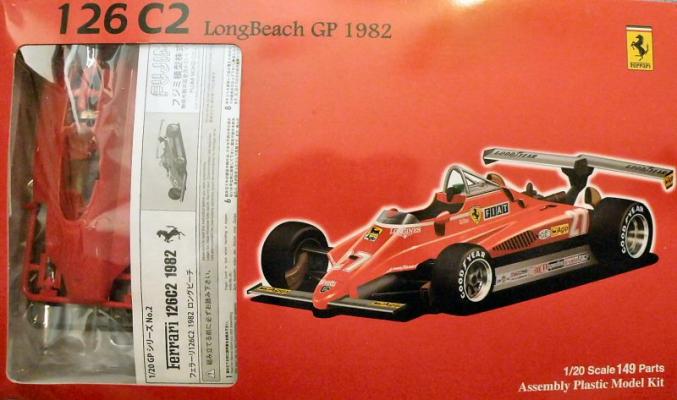
This kit is Fujimi's second 1:20 scale Formula One Grand Prix racer. Their first was also a Ferrari 126C2 but from a different race in 1982. This particular car ran at the U.S. Grand Prix held at Long Beach, CA. The thing that makes this car different is the rear wing.

The G.P. at Long Beach required a high down force wing for the street circuit. The rules at the time stated that any piece of bodywork (wings included) behind the rear axle could be a maximum of 110cm wide but did not specify that this be measured from the center of the car, so Ferrari fitted two individual wings, one slightly ahead of the other, each 110cm. In the race Gilles Villenueve finished 3rd on the road but the race stewards later declared that this wing was illegal and the results didn't stand.

Review Author
Chris Smith
Published on
Company
Fujimi
Scale
1/20
MSRP
$57.98

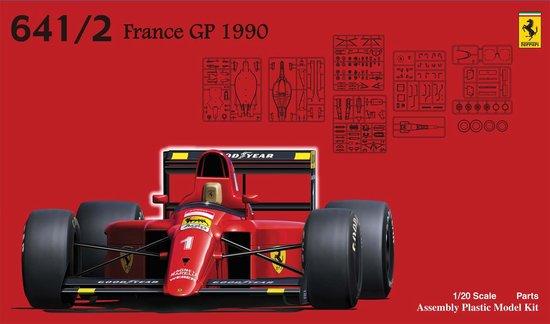
Background

The 1990 F-1 Grand Prix series turned out to be one of the most exciting and controversial in history. After driving for McLaren, Alain Prost was hired by the Ferrari team to drive their new F-1 car powered by a 3.5 liter V12 packing 685 horsepower and mated to a seven speed transmission. In 1990 he would drive this car to one race win and five podium finishes. But it was the end of the season that made it memorable. For the second season in a row, Alain and his arch rival Ayrton Senna would decide the championship with a crash. In 1989, it was Prost who came out on top. At the second to last race of the 1990 season in Japan, Senna made contact (some think intentionally) with the rear wing of Prosts' car as they raced for position into the first turn from a side by side start. The crash took them both out of the race but Senna would win the championship based on points. The Ferrari involved in that famous incident is the subject of this build.