On May 1, 1960, an ex-USAF turned CIA pilot named Francis Gary Powers flying a Lockheed U-2 at 70,000 feet 800 miles east of Moscow felt and saw the results of a Soviet SA-2 missile removing the tail of his aircraft. Thus ended the first round of U-2 overflights over the Soviet Union and the time frame covered in this volume. Despite the international incident that resulted, the information gained about the state of Soviet bomber and nuclear weapon capabilities more than justified the risks taken. The author, Kevin Wright is a university professor specializing in the Cold War. This book outlines the first phase of U-2 operations from 1956 to 1960. The book opens with a brief history of how the U-2 came to be and examines the various equipment packages that the aircraft could carry. Contrary to the public perception of the U-2 only being a camera platform, it carried nuclear fallout sampling equipment as well as receivers for the collecting electronic intelligence.
Valiant Wings Publishing was founded in 2010 under the guidance of Richard A. Franks and Mark Peacock. Valiant Wings has released several series of primarily airplane monographs [Airframe & Miniature, Airframe Album and Airframe Detail series] with the first Airframe Album dedicated to the Heinkel He 219 ‘Uhu’ released in 2012.
Volume 2 of the Medal of Honor series documents the 6 aviators who earned the Medal of Honor during the interwar years 19191939. This book of 80 pages has 215 photos and color profiles of 10 aircraft relating to this period.
Only 1 of the 6-aviation related Medal of Honor awarded in this period was for action that involved combat by USMC Lieutenant Christian Frank Schilt in Nicaragua in 1928. 3 of the other 5 men awarded the Medal of Honor were presented for exploration including Admiral Byrd (North Pole flight) and the other 2 awarded were for lifesaving efforts.
It is very interesting that Charles Augustus Lindbergh, Jr received the army designed Medal of Honor for his solo flight across the Atlantic 20-21 May 1927 even though he was no longer on active US Army duty. Authorized by a special act of Congress in December 1927 Lindbergh was presented the medal by President Coolidge in 1929.
This book is from their Orange Series that specializes in particular aircraft types, in this case the Gloster Javelin. There are 208 pages of mixed text, photos, line drawings, charts and tables of info about the aircraft starting with a rather detailed recounting of the conception and initial design of the aircraft and how that design evolved into the final version. It then goes on to discuss the various armaments it carried, including the air-to-air missiles which also includes a brief run down on how the Firestreak missile was developed. Next is a mark-by-mark description of every variant of the aircraft with many illustrations to show the differences. Included in this chapter is a rather detailed technical description of all the various systems in the aircraft, such as landing gear, electrical and hydraulic systems, 12 annotated photos of various marks’ cockpits and cutaway photos, diagrams, line drawing and charts about the engines.
Background
This book provides a very complete history of the development of the Polikarpov I-16 fighter series. It actually goes further than that, as it also explains the political and economic conditions in the Soviet Union after the 1917 Revolution, when the Tsarist Russian government was replaced by Trotsky’s Communist regime in the twenties and thirties. The author goes into extensive detail explaining how the Soviet economy was going through very severe changes, with violent repression of anyone who was even suspected of disagreeing with the system. Hundreds of thousands of innocent people were slaughtered during this process, and many more were imprisoned for extended periods, but some were still allowed to work on whatever projects they had been working on.
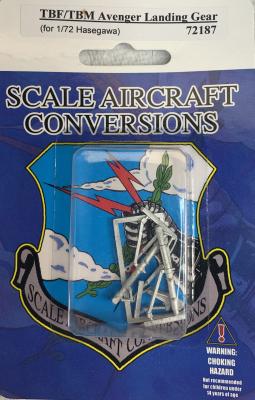
One of SAC’s (Scale Aircraft Conversions) latest gear is set 48402 for the wonderful Tamiya F-4B in 1/48th scale. The set has wonderfully cast metal parts to replace all the gear struts, retractions cylinders and other parts. They are drop in replacements and was I ever glad to get them for review and here’s why. I recently moved for work including 400 built models. During the move, my F-4B took a hit and broke off one gear leg. SAC to the rescue!
To start, I removed the tire from the broken gear leg and cleaned out the hole in the bottom of the fuselage making sure the new leg fit which it did with no issues. A quick clean up with sandpaper and then I primed with Tamiya fine primer, let it dry and painted the leg white. I added the tire, gave everything a quick gray wahs and glued it in place paying attention to angle and the like. Once dry, you would never know it was broken.
Federico Anselmino is the author of several books dealing with modern Italian Air Force aircraft.
Introduction - Page 1
The F-16 was chosen by the Italian Air Force as a "gap filler" until the F-2000 Typhoon became available as a replacement for the aging Fleet of F-104 Starfighters. Initially a lease was signed to acquire 20 single seat Tornado F.3 and four F.3T Tornados to supplement 60 F-104S/ASA.. This decision was motivated by logistical, economical and political reasons. Although a superior aircraft to the F-104 the Tornado was a more costly aircraft to fly and maintain. In order to conserve funds the Itialian Air force ended the contract with the RAF and chose the F-16 "Fighting Falcon; ADF to protect Italian skies.
Translator: Claudio Col
Background
This book tells the story of the Grumman SA-16A Amphibian as used by the Italian Air Force after World War II. It is NOT a study of all users of the type, as the Wayne Mutza book on the Albatross, published by Shiffer in 1996, was. This book gives a very brief account of the service life of the plane, and then shifts to Italian service exclusively. It therefore fills a gap, as Mutza’s book has very little coverage of Italian service.
One feature of the book is that the text is printed side-by-side in Italian and English, but the typeset is different, which I thought made the English text a little harder to read. Another problem is that the translation from Italian to English is a little bit strange grammatically, as words like “aircrafts” appear frequently. But it is understandable, and there is a lot of information in this book that is not available elsewhere.
“It all started with few maps and an innocent German rafting expedition.” (Chapter 4, page 20). The war for the Siachen glacier sounds like something from a historical fiction book. One pundit called it two bald men fighting over a comb, but Operation Meghdoot was a 36-year-long shooting war fought at the highest elevations ever (up to 22,000 feet or ~6700 meters) between two bitter, next-door neighbors with nukes fighting over the largest ice mass on Earth outside of the polar regions. Where the weather killed many times more men than the enemy, and where China was ever a threat to intervene at the top of the world. Warfare rules were rewritten for constant cold weather and elevation, and helicopters were absolutely essential. This “operation” was mostly ignored by the rest of the world, and still has very large geopolitical aftershocks. Meghdoot is Sanskrit for Cloud Messenger, an apt moniker.
Historical Background
The MMP/Casemate Single series of publications has developed into a very useful tool for modelers to add authentic details to their models. The books usually take one type of aircraft, and in this case, one particular airplane, and provides extensive detail, including accurate view drawings in two scales, photos of the actual aircraft in service, copies of maintenance manual pages showing specific details of components, photos of details of surviving examples, and colorful four view general arrangement drawings.