Reviews of products for scale aircraft models.

Review Author
Greg Wise
Published on
Company
Eduard
Scale
1/48
MSRP
$24.95

Ok, the boys from Eduard have another offering for this famous French kite. In this newest boxing we find 78 plastic parts; a photoetch fret; an express mask, and a beautiful set of decals. These cover the six options which include French, RFC and Italian services. I will omit a history lesson and go on to the build.

The construction is straightforward; my only gripe is that part A25 is too long and the instruction sheet seems vague in regards to it. Right or wrong, I just cut off the nub it left and sanded the bottom side flush. Everything else was smooth sailing adding the photoetch bits along the way. I added the decals early on in the build simply for the ease of doing them while the areas were still accessible.

I really enjoy the Eduard kits and consider them to be outstanding in fit and detail. I finished the build completely out of box without adding any embellishments for the review.

Review Author
Andy Renshaw
Published on
Company
Aires Hobby Models
Scale
1/32
MSRP
$109.99

The F-8 Crusader has always been one of my favorite aircraft. I personally tend to model in 1/48 scale, however when the opportunity came up to review Aires 1/32 detail set for the Trumpeter F-8E/H, I could not resist. The set showed up, and I found an F-8 kit with a few other goodies shortly after, so I was all set.

Aires has always been a leader in the realm of aftermarket resin sets. I am used to their 1/48 line and the level of detail found on those, but was blown away with their treatment in 1/32. First, the set is large, and comes in a sturdy cardboard box with lid and clear picture of the contents. Opening the box you are greeted with several bags of large resin parts, a small photo-etch fret, and instructions.

The main areas covered by this set are:

Book Author(s)
Jake Melampy
Review Author
Unknown Modeller
Published on
Company
Reid Air Publications
MSRP
$41.95

Everything you ever wanted to see on an F-4 Phantom II. When the author tells you “exposed”, that’s exactly what he means. This, no doubt, will be the definitive publication when it comes to detail shots of the F-4. Included are descriptions and details for the following: RF-4C, F-4C, F-4D, F-4E, F-4EJ, F-4F, RF-4E, F-4G and the QF-4. The Hellenic DIAS Phantom is also included.

If you’re a Phantom buff, as am I, this book is truly the best collection of information (for super detailing purposes) I have seen to date. I thought his (the author's) “Viper Exposed” book was super, but I believe this one surpasses it.

Many thanks to Reid Air Publishing and Jake Melampy for the review sample.

Book Author(s)
Steve Ginter
Review Author
Ed Kinney
Published on
Company
Ginter Books
MSRP
$44.95

Soft cover, 192 pages of black and white detail drawings and photographs covering both of these aircraft and their varying roles in Naval as well as civil service.

This book starts by covering the aircraft’s beginnings with the predecessor Lockheed (Electra) 10s, (Electra Junior) 12s and (Super Electra) 14s, and segues on to its wartime role as a patrol bomber used not only in England, but in the U.S. Navy as well.

As with most Ginter books, the research touches on all serial numbers manufactured, and traces them to their assignments. This was a particular interesting read for yours truly, in that I hold a type rating in this venerable old bird. In the closing pages of this book, I was able to trace, by registration number, the two birds I had the pleasure to fly. I was surprised to see just how many of these post-war relics made their way to Cleveland, Ohio.

Review Author
Greg Wise
Published on
Company
Eduard
Scale
1/48
MSRP
$24.99

On a first look you find the reboxed plastic along with a photo etch fret and a masking set. You also have 5 decal options that I will get to shortly. Removing the plastic from the resealable bag you’ll see all the hard work paid off for the Eduard crew. The level of detail is incredible and the offering is just as nice today as it was 10 –11 years ago when first released.

The only detectable blemishes to note are a few minor sink marks that are easily repaired. The first ones are four dimples located on the empennage two on top and two on bottom. The others are under the cockpit opening.

I began the straightforward construction as set forth in the instruction with no difficulties. Adding the photo etch details when called for. The cockpit turned out to be a little gem of sorts and will mostly be hidden.

Review Author
Chris Smith
Published on
Company
Cyber-Hobby
Scale
1/48
MSRP
$48.00

The Bf 110 was envisioned by Hermann Goering as a heavily armed fighter-destroyer escort for the Luftwaffe’s bombers. With its four machine gun and two cannon armament it was a deadly opponent as long one could position the aircraft to take advantage of it. Problem was, as so many other countries found out, the idea of a heavy twin engine fighter competing against smaller single engine fighters of equal or greater horsepower just didn’t pan out. Physics simply did not allow it. Early successes against inferior aircraft were soon reversed when the Bf 110s met their match in the Battle of Britain. In spite of being what many could argue was an obsolete design, the Bf 110 soldered on in various versions until the end of the war. It proved especially effective in the night fighter role which capitalized on its multi crew seating and ability to carry a lot of firepower. The Bf 110 D-3 in this kit was designed for long range escort/patrol.

Review Author
Stephen Bierce
Published on
Company
Master Model
Scale
1/72
MSRP
$4.99

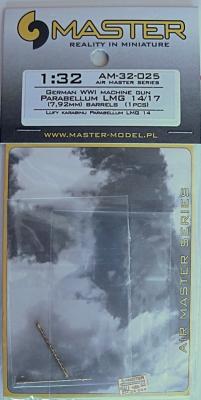
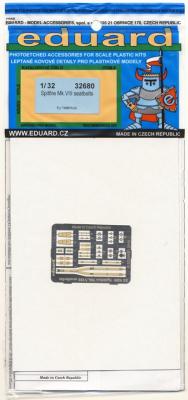
I'll admit to being a little confused when I requested this assignment. I was expecting something else. Still, these are very welcome components as I have two 1/72nd scale Spitfire Mk.V’s in my “to-build” pile.

The Spitfire was among the earliest production fighter aircraft to adopt a 20mm cannon as armament; with the “B” arrangement for the cannon being introduced in the Mk.I and Mk.II models that fought the Battle of Britain. While the success of the armament was spotty at that time, it became the standard on the Mk.Vb [the same guns also found their way into the initial production Sea Fury]. The earliest Mk.Vc Spitfires also used this pattern of gun barrels before going to the “beefier” barrels as standard (parts that Master also offers separately). So these parts are not only compatible with the Spitfire Vb, as advertised.

Review Author
Roger Carrano
Published on
Company
Kagero Publishing
MSRP
$26.25

Since the 70th anniversary of the Battle of Britain is upon us, many companies of interest to the modeling community will be coming out with all sorts of items. The company that this review will encompass is the Kagero Publishing Company. Among their many products are books, magazines, calendars and paintings.

This review is of the new series, “Battle of Britain Part 1”, which covers the Luftwaffe aircraft involved in the Battle. In the beginning of the book is a generalized three page article of the Battle of Britain and information on the Luftwaffe color schemes and how to translate what the color bars painted on the aircraft designate. This is in English text with captions next to each aircraft in English and Polish, explaining the details of each aircraft.

Book Author(s)
Steve Ginter
Review Author
Doug Hamilton
Published on
Company
Ginter Books
MSRP
$29.99

There were many different types of aircraft needed to win World War II. The Grumman Duck was certainly one of them!! Designed and built before the war, these biplanes performed many specialized missions. Rescuing downed aircrew, and spotting for those huge guns on the battleships were only a few of the many jobs it did, and it seemed every squadron had a Duck hanging around as a hack. Unglamorous to a fault, and tough and rugged, the perfect combination!!

Book Author(s)
Tommy H. Thompson
Review Author
Perry Downen
Published on
Company
Ginter Books
MSRP
$21.95

Crusader III (Naval Fighters # 87) is a paperback book measuring 8-1/2” X 11” and consists of 92 pages. The cover and pages are printed on polished paper. The book is full of sharp black and white photographs only with accompanying text. Also included are 3-view drawings, comparison tables, line drawings and performance charts.

The author begins by setting the stage for one of the closest aircraft selection competitions the Navy ever experienced. It began in 1953 when Vought’s F8U-1 Crusader beat out McDonnell’s entry for a high-performance day fighter. When the Navy went looking for an all-weather (night) fighter, the competition began.

Thompson states, “The Navy also preferred to deploy two different carrier-based fighters with complementary attributes…” In addition, having different fighters with different engines in a carrier group ensured a degree of safety in case one engine or aircraft type had a problem.