The Focke-Wulf FW-200 first achieved fame as one of the world’s first modern, four-engine airliners, although its early career with Lufthansa and Danish Air Lines was relatively brief. Two were exported to Brazil, where they lasted longer than any others, finally being scrapped in 1950. Its airline career was cut short by the outbreak of war, when most FW-200’s were impressed into the Luftwaffe, and most subsequent production aircraft were intended for long range maritime reconnaissance and bombing missions rather than their original transport role.
The Aircraft
In the early 1930s there was a general consensus, particularly among the bomber cadre that Giulio Douhet was right, and that the bomber would always get through to the target, no matter what. On the other side of this discussion were the fighter jocks, who KNEW that shooting down bombers would be simple, and that their superior aircraft, skill and airmanship would always overcome whatever stratagems and defenses the bomber barons could devise. The answer to these arguments was a compromise, a fighter with enough range to accompany the bombers and enough firepower to defeat the enemy fighters.
Most major air forces came to this conclusion also. The results were:
I was very excited to have the opportunity to review this title. I am very fortunate to have two of these featured Lancasters in my own back yard. I drive past the Calgary Aerospace Museum every day to and from work, I often stop in to view FM136 found on page 33. Also my inlaws live in southern Alberta and we visit them once or twice a month, highway 2 takes me thru the heart of Nanton and the Nanton Lancaster Society's FM159 (page 41) almost fully operational Lancaster MK X. As well my local club RMMC (Rocky Mountain Model Club, IPMS) holds its annual regional contest in the Nanton Lancaster Hangar usually the last weekend in May or the first Weekend in June (next contest June 4, 2011). So I have had the opportunity to climb inside and see the inside of this magnificant beast. Also during the contest the Society rolls the Lanc outside and fires up the two starboard engines (hopefully on June 4 the inner port will also be running).
Years ago in SAM Volume 21 Number 2 April 1999 Dave Neale built a beautiful I-153 in Finnish Markings. In his build article he reworked the kit cowling making the needed corrections to depict the proper exhausts. The Heller kit simply comes with dimples for the exhaust ports that surround the cowling. Dave removed these dimples and drilled out holes in the cowling and made his own exhausts. For years I have wanted to make this kit but have chickened out in favor of less involved projects, because I would need to do as Dave did to do the kit justice.
The subject of this Datafile may seem somewhat eclectic to model builders who don’t have access to a mainstream kit that matches the subject. But this publication fills a significant void in aviation research and documents the history of an aircraft that has been generally ignored by most model companies (although one limited run 1/72 resin kit is currently available from Omega. Datafile 140 will be of value to anyone willing to tackle a most interesting conversion of one of the many mainstream Fokker D VII kits however, as the C.1 was actually a stretched D VII.
This sheet of markings is for the F/A-18Bs belonging to VFA-125, The Rough Raiders. They are one of the U.S. Navy and Marine Corps aggressor squadrons whose mission is to teach other fighter squadrons the tactics and skills they need to stay alive in a real dog fight.
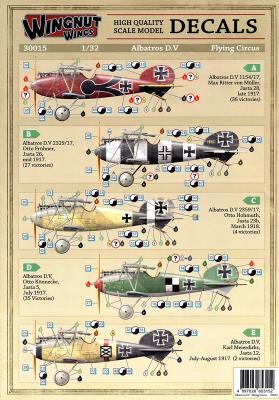
This set of markings comes with decals for 5 separate aircraft. They are:
I have collected and built a few Hasegawa P-51B/C's over the years. The Hasegawa exhausts are adequate but do not have the flanges and are not hollowed out on their ends. I like my exhausts drilled and find this task very tedious. Quickboost solves this issue. This set is cast in light grey resin with no molding flaws, and is designed as direct replacements for the kit exhausts with no modifications needed.
The Quickboost exhaust fit perfectly to into the Hasegawa cowl (see photo). I also test fitted these exhausts into the Academy and Revell Mustangs, but they were not very good fits for either so they cannot be substituted for the kit parts. Perhaps in time the good folks at Quickboost will make exhausts to fit these kits as well. The MRSP is very reasonable and really will dress-up this area. I recommend this latest Quickboost update for the Hasegawa P-51B/C family of kits without reservation.
The Aircraft
If you aren’t at least familiar with the F-4 Phantom II, you have either lived in a cave or a monastery for the last 50 years. Or you might be a WW2 fanatic. The Phantom was produced in huge numbers (5195) and sold to many countries (11). The US Air Force, Navy and Marines used the F-4. The last of the Phantoms are now flying with the Turkish Air Force, Japan and South Korea.
This kit is the F-4E, an Air Force version with the internal 20 mm cannon. If you’re interested in less well known air forces, the F-4E has been used by Australia, Egypt, Greece, Iran, Israel, South Korea, and Turkey. Germany also had some F-4Es, but they were based at Holloman in New Mexico with the Luftwaffe training group.
- Intake Covers Type A or B
- Part No. : 32088 / 32091
- MSRP: $ 8.95
- Exhaust Covers Type A or B
- Part No. : 32087 / 32090
- MSRP: $ 8.95
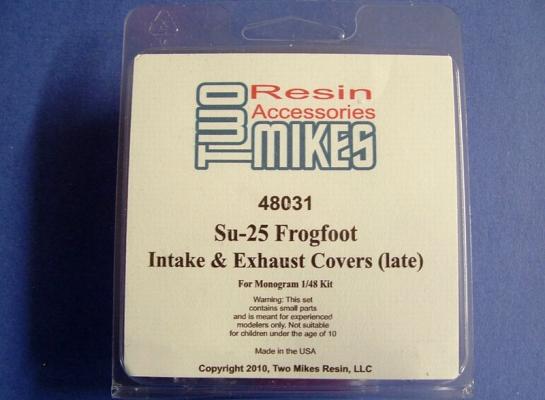
I love building jets but there are two things that are a pain on most of them and that is getting the ejector pin marks out of the intakes and exhausts. Besides that, almost all jets have covers on them as soon as possible to prevent FOD damage so if you want to pose a parked jet, it should have these covers on them- engines are expensive!
Quickboost has issued two sets each for exhaust and intake covers which are as simple as they sound and yet can make the diorama pop to life. The intake covers are one piece for each side with two delicate handles for each cover that can be detached and added. The difference between type A and B is the raised pattern on them. I trimmed one set, painted them red and tested the fit on my Trumpeter MiG-29. The fit was perfect.
The Typhoon was the primary close ground support aircraft for the British and Canadian land forces in the European theater of World War II. Twenty squadrons flew this aircraft in the 2nd TAF, who were also instrumental introducing the use of controversial rocket armament. The aircraft may not be pretty but has a listed history of successful land supported engagements. This Osprey book brings the Typhoon to life in a very condensed ninety-six pages. Since the author’s father was a pilot of these aircraft, I imagine there must have been many conversations between them.