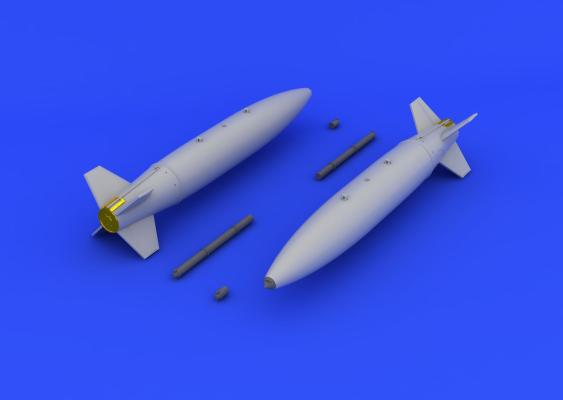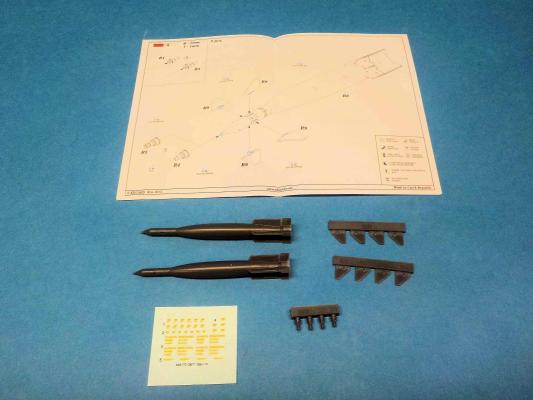
The AGM-88 HARM (High-speed Anti-Radiation Missile) was developed to replace the AGM-45 Shrike and the AGM-78 Standard ARM. Unlike the Shrike and the Standard ARM, the HARM was designed from the outset as a SEAD (Suppression of Enemy Air Defenses) weapon, not an adaption of an existing weapon. The HARM system includes the missile, the LAU-118 launcher and HARM specific avionics in the launch aircraft. HARM has the ability to detect, acquire and select a radiating threat and once launched operates in a “fire and forget” autonomous capacity, freeing the launch aircraft to maneuver or to attack another target. The HARM proved its lethality during operations over Iraq during both Desert Storm and Desert Fox. It was used by the F-4G, A-6, A-7, Tornado and the EA-6B and is currently carried on the F-16CJ, F-18A/C/D/E, EF-18G and other aircraft.
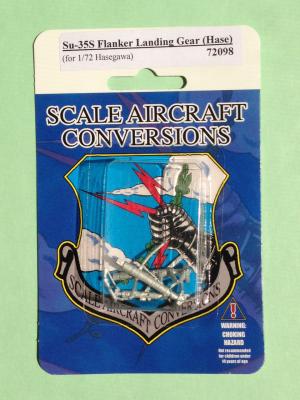
Tamiya’s Wildcat has been around for a while and it is an excellent kit. Scale Aircraft Conversion has produced a set of metal landing gear to use on the kit. The set includes all the gear parts including the portions up inside the nose. A new tail wheel is also included. The metal parts are well made and are drop in replacements for the kits parts, but are made of metal. The metal is stiff but retains its malleability. Some cleanup will be needed to free it from the molding sprues and I recommend a razor saw for this work.
Several modelers have asked me “why metal gear”? I agree, that this kit is not particularly heavy and my answer is twofold. First, have you ever lost a part? I have and while you can get the parts for most kits, getting these sturdier parts is much easier and it may be cheaper that the alternative of buying an entire sprue to get a part or two.
The GBU-10 weapons system consists of a Mk.84 2,000 lb. bomb coupled with a laser guidance system. The Paveway II guidance system replaced the Paveway I system beginning in the early 1970’s and features a simpler but more reliable seeker and pop-out wings in the tail fins to increase the bomb’s performance.
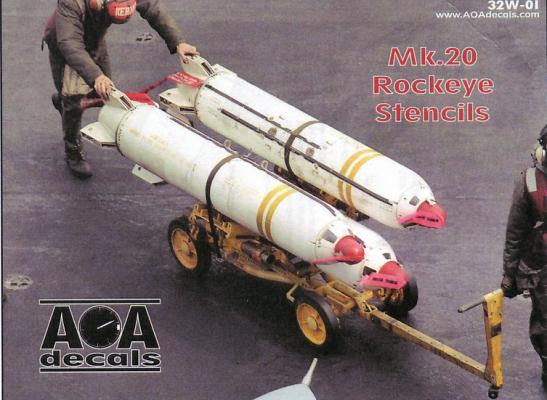
The Mk. 20 Rockeye II (also known as the CBU-100 cluster bomb) is an American designed cluster bomb. The Rockeye II is intended for use against armored targets and each canister includes 247 anti-armor bomblets. The Rockeye was first used in Vietnam and has been steadily modified and improved over the years since. The Rockeye was used extensively by American forces in Desert Storm to attack Iraqi vehicles.’
Thank you to Bert Kinzey and Rock Roszak for bringing back a tremendous resource for the modeler, this time in digital format. Thank you to the IPMS Reviewer Corps for allowing me to test out this new and exciting method of researching colors and markings of my favorite jet of all time, the F-14 Tomcat. A very significant plus of this updated version is that the entire history of the Atlantic F-14 squadrons through Tomcat Sunset is now available in a single publication.
When the United States first started its bombing campaign in North Vietnam, it discovered that its ability to combat the sophisticated air defense system was very limited and early on it became apparent that the AGM-45 Shrike anti-radiation missile had a number of serious limitations, particularly in its range, small warhead and limited seeker. In effort to overcome some of these limitations, the Navy worked with General Dynamics to develop an air-launched version of the Navy’s RIM-66 Standard surface-to-air missile. By using an existing missile platform, development proceeded fairly quickly and the result was the AGM-78 Standard ARM (anti-radiation missile). Early versions of the AGM-78 were actually outfitted with the same seeker head as the Shrike, but as the Standard ARM had a much larger warhead, a larger engine and a gimbaled seeker head, it was more flexible and effective than the Shrike.
Aviaeology out of Canada produces decals specific to many Canadian themed subjects. The research going into these decals is second to none. This set includes markings for four different aircraft in a variety of schemes and is meant for Revell’s beautiful 1/48 scale Ventura kit (but they are available in other scales too. Here’s a list of the planes represented:
Caracal Models has scaled down their 1/48 T-45 series into 1/72, which can fit the Testor’s/Italeri version of the kit. The decal set comes with five options, which are:
I don’t usually build aircraft which do not have propellers but I like Airfix models and I like the Harrier. It’s an incredible bit of engineering that allows a jet to hover like a helicopter! So, when Hornby-Airfix provided this kit as a review sample to IPMS/USA, I jumped (no pun on the phrase Jump-Jet intended) at the opportunity build an Airfix Harrier.
Thank you very much to the wonderful folks at Osprey Publishing for providing this new publication for review. Thanks are also due to the IPMS Reviewer Corps for allowing me the opportunity to explore a fascinating historical documentation and description of the enigmatic SR-71. The book was particularly interesting to me, since the time I stood nose-to-nose with a Blackbird at Beal AFB during IPMS Nationals in Sacramento in the 80’s. This volume follows previous Osprey releases describing the SR-71 and the A-12.