HK Models has released a 1/32nd scale D0-335 A and B single seat versions of the Pfeil and continues their 1/32nd scale DO-335 releases with this variant, the B-6 Night Fighter. The B-6 was a two-seat version and included radar for use in night fighting American bombers. This was a proposed variant and never built. HK has taken their initial kit and added a second cockpit and the needed radar antennas along with all the existing detail.
Amigo Models from Russia is producing some wonderful after-market resin products for 1/72 and 1/48 aircraft. This particular set is for the Mig-21bis and Mig-21-93 which both use the R25-300 engine. The box contains five resin pieces secured in bubble wrap. These pieces make up the afterburner/exhaust sections of the engine and exhibit excellent detail both inside and out.
This is volume one in the Yellow Series from MMP. The DB-605A engine powered the majority of Bf-109G variants from the dash 1 through the dash 8 and including the dash 14 and two seat trainer variant converted from earlier G models, the dash 12. Many modifications were made over the G series production after its introduction in 1942. The Bf-109G served in Romania, Finland, Italy, Bulgaria, Switzerland and Hungary besides Germany during WWII.
The book is laid out into 19 sections with coverage for each main production variants, tropical conversions, factory and filed modifications, reconnaissance versions and those assembled in Romania. A brief three page technical description and flight performance follows the main text body. The G models maximum speed at altitude varied from 347MPH to 405MPH. These speeds are compared with other fighters showing the 109G to be faster than theYak-3, A6M and Spitfire MK.IX and slower than the P-71 and P-47.
Airfix has released two 1/72 Blenheims, a Mk I and a Mk IV, and Eduard makes several detail and masking sets for both. The subject of this review is their exterior detail set for the Mk IV. Most of the “true” exterior parts are mostly access hatches and panels that are glued to the exterior skin of the aircraft. These are simple to deal with; however, they do stand proud of the surface, which is probably not accurate. The only way to avoid this would be the route out the appropriate space under each and inlay the PE part but unless you have a teeny-tiny router, that’s not going to happen, so you have to live with it.
There are also a few parts to detail the crew hatch on the top of the fuselage just in front of the top turret. The next group of parts consists of detail for the landing gear and wheel wells. While the kit supplied ones are nice, the twenty-one parts Eduard supplies for each wheel well really dresses this area up.
The SAC product provides four parts to replace the Trumpeter landing gear. The kit part number for the recommended Trumpeter kit are part numbers 7, 14, 15, and 16.
Part 14 is the nose wheel strut, which is the gear strut and the starboard side of the wheel fork. This is molded as a single piece.
Part 7 is the port side of the wheel fork, which is a separate piece and must be glued to the nose wheel strut (Part 14) “trapping” the nose wheel in the wheel fork.
Part 15 and 16 are the starboard and port main gear struts. Like the gear in the Trumpeter kit, the SAC main gear struts are molded as single pieces. One needs only to attach the tires to complete the “gear”.
Of significance is the fact that the SAC gear strut locating pins are of the same shape and size as the locating pins on the Trumpeter kit. This is, of course, important so that proper fit and alignment can be easily achieved when using the SAC gear.
The Spey engined Phantom did stellar service for both the RAF and Royal Navy. Airfix finally released a new kit of the FG.1 version and while it is missing a few details, it builds into a neat model.
Once again Scale Aircraft Conversions has released a new set of landing gear specifically for the Airfix kit. The Airfix kit gives multiple options for the landing gear as the British naval Phantom had an extended nose gear to help it get airborne off of the smaller decked British carriers. Airfix’s design breaks the nose gear into two parts. Normally SAC does direct replacements for the landing gear based on the kit parts but in this set they cast the nose gear so it is one main piece. The extended gear will need the scissor added which might be a bit tricky. This should make for a stronger option.
As usual there are no instructions included but their website does have a nice section on how to use white metal and mentions there is no lead included in the metal.
This decal set is a release from Iliad Design. It originally only came with decals for 4 Hurricanes, not the 5 that this release comes with.
The instruction sheet also doubles as the cover image, folded in half with the decals in the center to keep from possible damage in the standard Ziploc bag. The instructions come in full color for each aircraft in the standard Hurricane colors, dark earth and dark green with ether aluminum underbelly or white and black. Also, some interesting information on each aircraft is included to make a more period correct plane.
This set provides enough decals to use on all 5 pre-war aircraft:
Upfront, I want to thank Aires and Quickboost for providing these fine aftermarket bits for our beloved models, and to the IPMS USA a big thank you for allowing me to review this Quickboost product.
Admittedly I have a few passions in modeling and the past few years I’ve focused on Japanese subjects and recently I added the Airfix B5N1 Kate to my stash. Seeing the Quickboost exhaust resin for review, I snagged the exhaust parts up before even looking at the kit plastic parts. In all honesty, the original parts look pretty good but I believe you will see how much improved the Quickboost resin is compared to the kit plastic. To my eye the nicely faired exhaust exit, not to mention the hollow exhaust is certainly worth the minimal cost for this accessory.
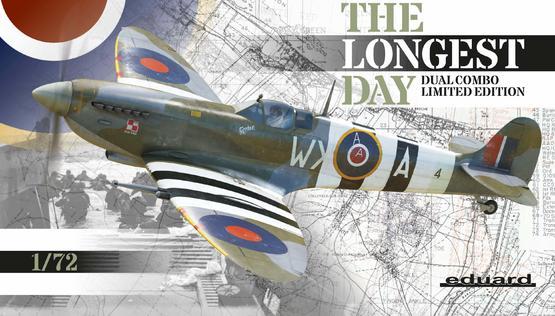
When you hear the name Eduard in modeling circles you immediately think of their superb photo etch parts, or maybe their mask sets or even their top of the line plastic kits. But you don’t usually think of Art. Oh sure, they have some great looking box tops but actual art?
Yep, some of those box tops are actually available as large size posters such as this one.
The overall size of the poster is 23 3/8” long by 16 ½” wide while the image itself is 21 5/8” x 11 ½”. A nice size to put up on your model room wall and would look good in a nice matt and frame.
Print quality is first rate with the colors looking like the box art. One thing I was interested to see is the swastika as it is missing from the box top but is on the poster.
If you like to collect aircraft art you would do well to take a look at Eduard’s growing line of posters.
Thanks to Eduard and IPMS/USA for the review kit.
IPMS/USA extends extreme gratitude to Paul and Susy Fisher for sending us this excellent item to upgrade the Hasegawa 1/72 legacy kit B-47 into a combat-ready aircraft with RATO. And thanks to Phil and John, our leaders in the IPMS reviewer corps, for graciously allowing me to review this set…
It’s not every day I look at a resin upgrade and go “I wonder what else I can do with this?” Fisher’s 1/72 B-47 RATO Horse Collar and bottles are one of these items. First, it’s a really simple upgrade. One world-famous Fisher single-piece resin casting that fits on the model without major cursing and sanding, and add-ons that make the final product look really great, in the form of 27 RATO Bottles.