This is a replacement canopy for Sweet’s 1/144 Hurricanes. The Sweet kit is a really great Hurricane, very nice to build, with great fit. The kit canopy is molded as a solid piece, very thick. Well, for a 1/144 kit it’s very thick. There’s no hollow part inside the canopy, it’s just a chunk of nicely molded clear plastic. But that’s not why I really, really appreciated this review item. When I got the canopies in the mail, I got out a kit I bought at a local swap meet. The kit comes with two complete aircraft. Except this box only had ONE CANOPY!! That’s when I really knew I owed Phil Peterson and John Noack a big thank you for this one.
The Douglas A-1 series of aircraft (known as the AD prior to 1962) was designed as an attack aircraft that could carry a heavy load of ordinance.
Quickboost’s A-1J Tailwheel brings an improvement to the Hasegawa A-1 kit. This part replaces only the bottom part of the strut, and not the entire strut. The wheel itself is separate from the strut.
I cut the bottom portion of the tailwheel strut where indicated in this kit’s instructions, and then glued the replacement strut piece into place using cyanoacrylate glue. Once the glue was dry, I painted the strut, installed the wheel onto the strut, and installed the strut onto the model.
I highly recommend this detail set for the Hasegawa kit. My thanks to Quickboost for the review sample.
The Douglas A-1 series of aircraft (known as the AD prior to 1962) was designed as an attack aircraft that could carry a heavy load of ordinance.
Quickboost’s A-1H Tailwheel brings an improvement to the Hasegawa A-1H kit. This part replaces only the bottom part of the strut, and not the entire strut. The wheel itself is separate from the strut, and you have a choice of two wheel designs, one being spoked and the other is a solid wheel design.
I cut the bottom portion of the tailwheel strut where indicated in this kit’s instructions, and then glued the replacement strut piece into place using cyanoacrylate glue. Once the glue was dry, I painted the strut, installed the wheel onto the strut, and installed the strut onto the model.
I highly recommend this detail set for the Hasegawa kit. My thanks to Quickboost for the review sample.
The Douglas A-1 series of aircraft (known as the AD prior to 1962) was designed as an attack aircraft that could carry a heavy load of ordinance. Both the U.S. Navy and U.S. Air Force flew the A-1H in the Vietnam War. The kit represents two aircraft flown off of the U.S.S. Ticonderoga aircraft carrier during that war.
Hasegawa’s A-1H kit has petite, engraved panel lines. The fit of most parts is excellent, except for the bottom aft wing-to-fuselage joint. That joint requires careful fitting, along with some putty to smooth it out. Most of the other seams required little more than sanding.
The cockpit is sparse in detail, consisting of a seat, an instrument panel, and a control column. Instruments and consoles are represented by decals. With the engine, you have the choice of having the cooling flaps open or closed.
The CASA-212 Aviocar is a versatile transport aircraft that was manufactured in Spain since the ‘60’s, and Indonesia until 2012. The C-41A is a military version used by the US, Mexico and many other countries within Central and South America. It exhibits excellent short field takeoff and landing (STOL) abilities, and is able to operate from unprepared airstrips.
This model is a re-release of various other versions of the aircraft. It comes in a very sturdy top opening box with a nice painting of the US military C-41A. All sprue trees were contained in one bag, with the clear parts and decal sheet in their own bags. The clear plastic bags are closed with sticky strips, so be careful when removing the decal sheet, and that you don’t allow the sticky strip to attach itself to the decals. I did, somehow, and had a heart stopping minute separating them! The instruction manual is printed on good quality glossy paper, and each step is clear, accurate and in color where needed.
Christmas came early this year for me when I received the email that this beastie was available for review. I am incredibly thankful to Kinetic Models for providing this kit for review and to the review corps higher-ups for trusting someone brand new to the group for having faith in me to not only build this thing, but in a timely manner to boot. It is a re-kitting of the Vintage Fighter Series kit released in 2008. I won’t say the ride was completely smooth…but it was a fun ride regardless.
The Kit
The kit consists of five light grey styrene sprues and one clear unit. Many parts, especially on Sprue D, are listed as not to be used. Some bombs and racks are also provided on Sprue G, but there is no reference in the instructions as to which variants carried them. More good fodder for the spares box.
The parts are well molded with very little flash, although the window openings required a little bit of trimming. Concerning the window arrangement, there is apparently another version of this kit with a straight row of rectangular windows, but this one had four square and four round windows, plus some oddly shaped windows by the cockpit, and, of course, the pilot’s windshield. There is adequate interior detail, including a complete cockpit, some rear cargo compartment detail, including radios, a seat, and several cameras. There is even a machine gun mounted in a ventral position. I can’t imagine why this was installed, but I included it in my model
The latest journal of Cross & Cockade International - Autumn 2018, features a front cover photograph of Jean Chaput in front of his Nieuport 11, N940. This color 1916 photograph was based on the Autochrome technology developed by the brothers Auguste and Louis Lumière. The inside rear cover features color illustrations by Juanita Franzl of Lt. Dawson’s and Lt N. E. Williams’ Ship’s Camels. The outside rear cover features color illustrations by David Méchin of Jean Chaput’s aircraft. If you check out the web site link above, you can get additional sample pics of the current issue.
History
The PZL P-23 Karas was one of the most important combat aircraft in the inventory of the Polish Military Aviation prior to the outbreak of World War II. Designed as a three place light bomber and reconnaissance type in the early thirties, and powered by the Polish-built Bristol Pegasus radial engine, the p-23 was placed in production in time to be available during the German invasion in 1939. Numerous units were equipped with the P-23A and P-23B versions, and these operated in the light bomber and reconnaissance role during the time that Poland was defending itself against the Germans. Later, when the Russians issued their “stab in the back” invasion, most of the surviving P-23’s were flown to Romania, where some of them soldiered on until the end of the war. A few were also exported to Bulgaria before the war, and these were redesignated P-43A due to a change in engines.
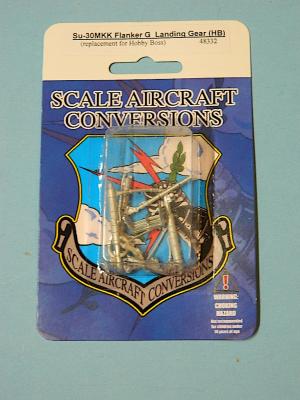
Scale Aircraft Conversions (SAC) produces white metal replacement parts for kits in a variety of scales. Some of their landing gear sets are for a variety of kits and some sets are designed for a specific model. The white metal sets are designed to support the weight of a specific model without warping that can be seen with kit styrene landing gear.
The parts are for the Airfix Me-262 are well cast and had no flash or other area that needed to be sanded. I bent one of the struts when removing from the sprue but could straighten it out easily. I had to put heavier weight in the front of the jet than anticipated so it would not be a tail sitter and the SAC landing gear stood up to the weight very well.
When gluing the landing gear to the aircraft I used CA and the parts fit perfectly without any modifications to the join areas.
The landing gear would be a great addition to the model kit and is a recommendation for purchase.