Graham M. Simons is an English professional aviation writer, publisher and historian. Graham M Simons is one of the founders of the world famous aviation museum at Duxford near Cambridge. His interest in aviation was piqued watching the making of the ‘Battle of Britain’ film and from the days when you could go ‘aircraft spotting’ at London Heathrow and local airports. Graham’s engineering background led him to membership of a number of aviation societies, including sitting on the British Aviation Preservation Council. He was responsible for overseeing the restoration of a De Havilland DH89 Dragon Rapide airliner to flying condition and placing this aircraft - with official approval — in the colors and markings of the first aircraft of what was then the Kings Flight. It was during this period that he was contacted by Ian Allen Ltd to write the first ever history of this classic De Havilland type.
Contents
This book is a compilation of the 4-view colour profile, scale plans and photo details of the single variant of the Messerschmitt Me 410 A-1. Scale plans in 1/72 ( the Italeri kt is available) and 1/48 (Meng and Revell kits are available) scales plus drawings from wartime technical manuals. Also included are photos of the aircraft details in black and white and colour.
The first three pages are dedicated to 1/72 scale line drawings, including right and left sides, plus top and bottom views. These pages include wing details without airbrakes and the forward fuselage details of the BK-5 (50mm cannon) equipped Me 410 A-1/U4.
Next several pages including a foldout section for the 1/48 scale drawings. Excellant detail included therein. I especially appreciated the fact the illustrators included the antenna wires layout in the profiles.
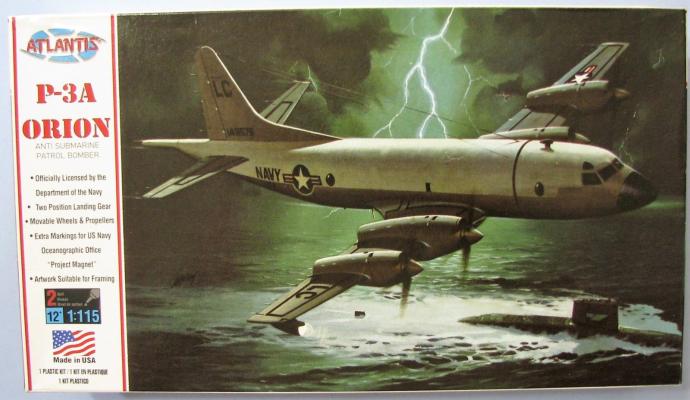
Following the changes with Revell USA over the last few years, Atlantis Model Co. has acquired molds of classic Revell and Monogram kits. Some have not been released in quite a long time.
The Allison 501 D13 (civilian), or T56 (military) engine entered service in 1954 and is still in production under the Rolls Royce name and designated T56. It was originally developed to power the C-130 Hercules and has since been used in aircraft like the P3-C Orion, Electra, E2C Hawkeye and many others.
I understand Atlantis worked to improve the molds. I could see that the molds in this kit had either held up really well, or had some work done to improve and clean them up.
The F-86 D was built as a stop gap interceptor while the U.S. developed more sophisticated and mission specific aircraft for that purpose. At the same time, the European NATO operators realized they needed the same type of aircraft and the F-86K was the result. The F-86K differed from its U.S. built examples by installing cannons in lieu of the rockets on the US version. Some plugs were added into the fuselage to maintain the center of gravity. Italy’s Fiat company produced license-built versions of the F-86K. Also of note, was the capability of some of these aircraft to carry sidewinder missiles.
The F8U Crusader (later re-designated as F-8) was the first operational supersonic carrier aircraft serving for the United States Navy and Marine Corps in the late 1950s. Often considered the last gunfighter, it was well loved by pilots for exceptional performance. One interesting feature was the movable wing assembly. While it’s often believed that the purpose of the raised wing was to improve lift, the fact is that raising the wing allowed the fuselage of the aircraft to assume a lower angle of attack on landing, permitting greater visibility for the pilot, while maintaining optimal aerodynamic performance of the wing, slats and flaps.
Kit
The Douglas A-26 Invader was an American twin-engine light bomber / ground attack aircraft. From 1948 -1966 it was re-designated as the B-26 and served in the Korean War from 1950-1953.
ICM has produced a fine decal set specifically to be used with ICM kit no. 48281, B-26-50 Invader. The decal set includes markings for four aircraft, the most notable of which is B-26B-61-DL “The 7th Chadwick” piloted by Lt. Col. R. Fourtney, CO of the 13th BC 3rd BG in Korea of Spring, 1953. Other markings are included for B-26C-30-DT “Marth Ann” of the 3rd BG, B-26B-55-DL of the 95th BS, 17th BW and B-26C-45-DT of the 3rd BG.
Reviewer’s Comments
Each of the four options are intended for black-painted aircraft. A double-sided, full-color instruction guide is provided. Only side views of the aircraft are given. Placement markings are fairly understandable; however, cross-referencing is recommended.
Masterpiece Models has provided a useful aircraft building jig for 1/32 to 1/24 scale aircraft.
The Jig is designed for use in assembly of models, Painting and transporting.
There is no instructions included but the assembly of the jig is simple and the photograph on the box is enough to allow you to build it with ease. Peeling the protective paper off the acrylic sheet parts was not very easy. I suggest pulling it off very slowly works best. The black plastic vertical mounting parts need slow cleaning up of flash.
It is made from a clear acrylic sheet and comes with four adjustable supports that can be adjusted vertically and in and out.
The paints were provided by Tru-Color Paint. https://trucolorpaint.com/
This is a combined review of the 1/48 Italeri Mirage F.1 “Bye-Bye Mirage” and a selection of Tru-Color paints provided for the build review.
When you open the box you find a total of 5 sprues (one clear) with many parts marked as “not for use” -weapons for the most part. The overall look of the plastic parts is good. No flash, smooth surface, finely recessed panel lines and the transparent parts are free of scratches. You also get an excellent decal sheet with markings for 3 airplanes, all of them in the retirement scheme of the Mirage F.1
IPMS/USA welcomes the proprietors of Masterpiece models back, and serious appreciation for supporting the IPMS USA reviewer corps with yet one more of their newest releases, in a scale never before attempted: 1/35th! A perfect diorama subject, we certainly will see some of these in a D-Day or Market Garden setting… And my personal thanks to IPMS leadership for sending it to me to be reviewed.
Sometimes I wonder at my sanity; then my wife reminds me that I really am over the edge and I know…
Resin kits are a case in point; requiring truly radical and different skill sets for a project. Rare (Usually) subjects or subjects which economically do not make sense to cut a mold for injection molding. Resin is rarely forgiving, and on occasion makes you question why you are in the hobby.