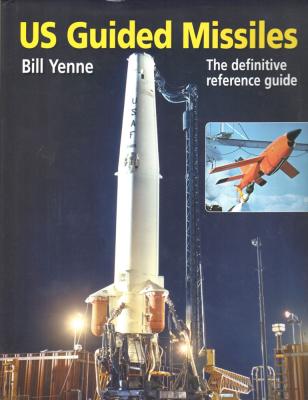
Thank you to Andrea Lindell of Specialty Press and the IPMS Reviewer Corps for allowing me the opportunity to review this truly definitive resource. Author Bill Yenne does not disappoint in the least; rather,he provides a veritable gold mine of data, photographs, and narrative. He provides a wonderful introduction defining what a guided missile is, but also covers early guided missile concepts and development, the evolution of naming conventions, and, of course, the usual inter-service rivalries and territory disputes. For example, the Air Force and Navy viewed themselves as global projectors of air-power, which guided missiles are part of. The Army, on the other hand, viewed such missiles as a logical extension of artillery, whereas the Air Force thought of missiles as bombers! It didn’t stop there either, with surface-to-air missiles considered by the Army as antiaircraft weapons and the Air Force calling them interceptors.
all 2013
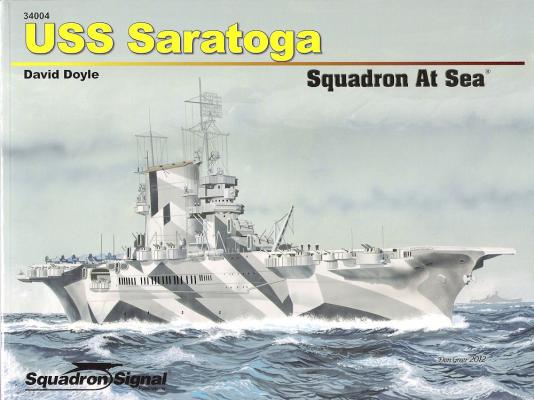
A new item recently sent to the IPMS/USA for review by the folks at Squadron is the fourth release in their Squadron at Sea series, and this edition covering the USS Saratoga (CV-3). The book is dedicated to “the crew of the Saratoga – the Ship of Happy Landings – who helped pioneer naval aviation in peacetime, fought valiantly in wartime, and who brought many of the comrades safely home…” The publication is 160 pages long, and as one would expect from the publishers at Squadron, it is filled with many black-and-white photographs as well as a few color pictures and some color drawings. Author David Doyle once again does an outstanding job of telling the story of the Saratoga, from her beginnings in New York Shipbuilding in Camden, New Jersey, to her current resting place at the bottom of the Bikini Atoll. I would highly recommend this book as both a reference and, as well, as a historical telling of the life of the third aircraft carrier of the US Navy.
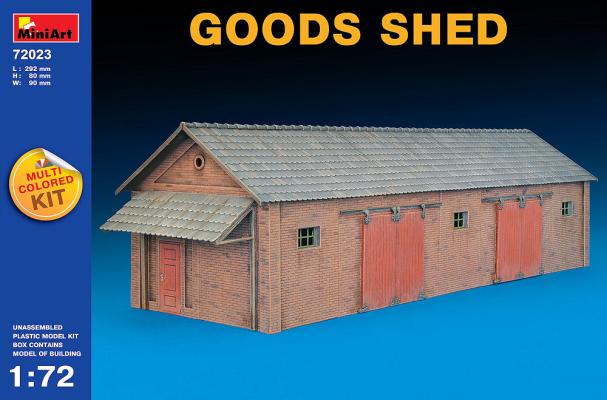
The Kit
The kit is standard injection-molded plastic, molded in four colors across 78 parts. Wall sections are molded in a brick-red coloration; wooden objects, such as doors, are molded in brown; window frames are molded in white; and the roof shingles are curiously molded in blaze orange. All parts are cleanly molded with very little flash evident anywhere.
It seems as if MiniArt uses a standard set of sprues across all their building kits, as this one yielded quite a few extra parts that were not needed for this build.
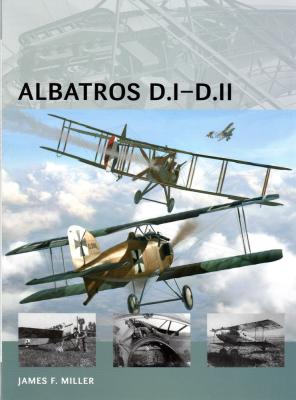
Osprey Publishing provides many different lines of aircraft information books for the enthusiast. These include the Aces series, the Elite series, the Dual series, and others. This latest series, Air Vanguard, seems to combine the best of the other series and really seems to be aimed at the modeler as well as the aviation enthusiast.
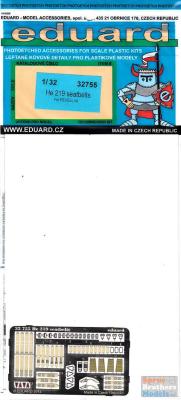
- 32755 HE 219 Seatbelts, $20.00
- 32325 He 219 Undercarriage, $43.00
- 32757 He 219 Interior SA, $30.00
Eduard continues to produce their prolific, super-detailed PE sets for upgrading already good kits into great kits; thanks to Jan Zdiarsky at Eduard for providing IPMS/USA these three sets. Your support of our organization is more than appreciated…and thanks to Dick and Steve at IPMS/USA for passing these on to me to review!
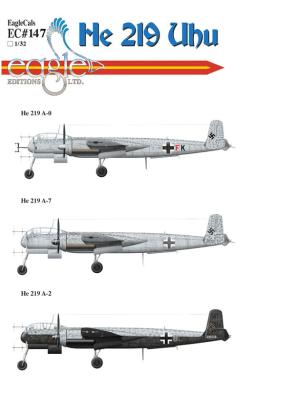
Thanks first to Judy and Jerry Crandall of Eagle Editions for providing IPMS USA these great decals; as fellow IPMS members, we always appreciate your support by providing us review items!
If you have never used Eaglecal decals before, now is your opportunity. The Revell Uhu is an absolutely fantastic build, and the kit decal sheet is comprehensive. However, Eaglecals has decided to provide more options, as usual…and very well done indeed they are!
Three aircraft are included in this decal sheet: an He-219A-0 (which will require a bit of antenna scratchbuilding on the Revell kit to depict the additional radar array), an He-219A-7 with a bit of different camo on the upper side (RLM 76 mottling over RLM 75, with RLM 76 lower surfaces), and an He-219A-2 with RLM 76 uppersurfaces, RLM 75 mottling, and satin black undersurfaces.
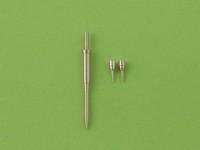
Three parts are included in this set: the pitot tube and two angle of attack probes. The parts are packaged in a small zip-lock bag, stapled in a folded, heavy paper stock display hanger. The parts are also further sealed in a small envelope of clear plastic film taped to a heavy card stock stiffener inside the bag.
A small instruction sheet is also included that shows the installation.
Application
This pitot tube is designed for the Tamiya F-16. Installation is a simple matter of drilling out the opening in the kit nose part, applying a touch of super glue, inserting the pitot tube – and it is ready for paint. That simple, but what an improvement over the kit pitot tube! Same goes for the AOA probes mounted on either side of the nose, except here the probes fit within pre-formed openings in the sides of the nose. These particular parts are tiny!! Care will be required during installation to avoid loss.
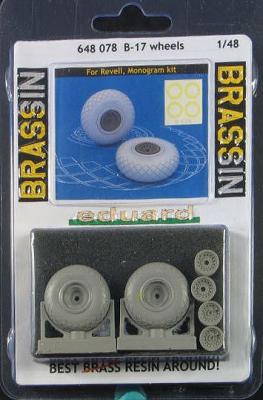
No introduction is needed for the subject that would carry these wheels! The B-17 has long been a favorite among modelers, and many remember Shep Pane’s diorama using the Monogram B-17G. Revell also released the B-17F, and now both molds have long been reissued many times. Needless to say, it’s still the only game in town for a quarter-inch scale B-17, and overall is still accurate in shape. However, the finer details show their age.
Eduard has been releasing lots of very useful resin upgrades that can add a little extra life to some older kits. These new resin wheels for the B-17 are no exception, and are little jewels to support your detailed B-17 project properly.
History
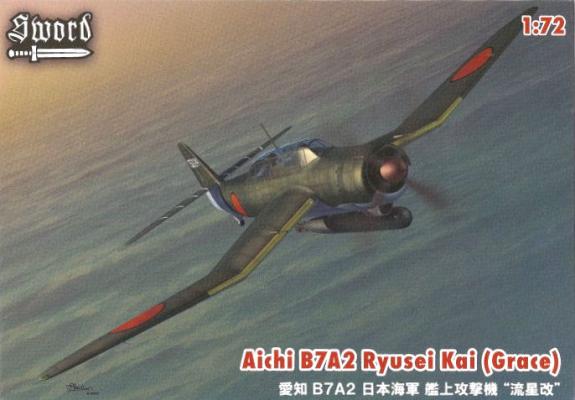
The Aichi B7A torpedo bomber was an attempt by the Japanese Navy to provide a state-of-the-art general purpose carrier-based bomber to replace the Nakajima B6N “Jill” torpedo bomber and the Yokosuka D4Y “Judy” dive bomber with a single type capable of both roles. It was planned to operate these aircraft from the IJN’s largest carriers, the Taiho and the Shinano. Powered by the new Nakajima Homare 1800 hp. radial engine, the first prototype was built and flown in 1942, but development problems, mainly concerning the engine, slowed the aircraft’s path to service introduction. By the time production started in 1945, an earthquake had destroyed the plant, and only a few were actually allocated to units.
History
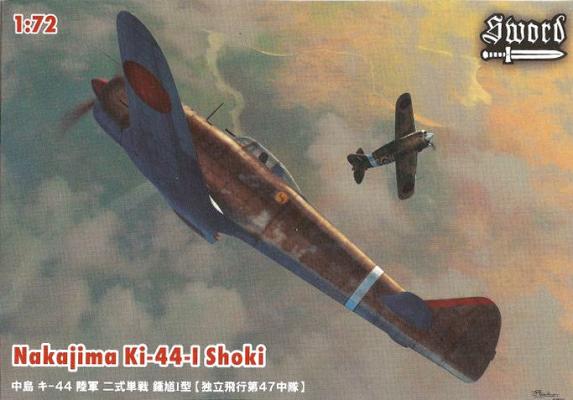
The Nakajima Ki-44 “Shoki”, code named “Tojo” by Allied intelligence during World War II, was rather unusual by Japanese standards, since it violated the traditional Japanese design emphasis on maneuverability at the expense of nearly every other performance attribute. Appearing shortly after the Ki-43 “Oscar”, the Ki-44 stressed speed, heavier armament, and rate of climb over other factors, and was intended as a high speed interceptor. The first flight was in 1940, and by 1941 several prototypes had been tested, these eventually being sent to China and later Southeast Asia for combat evaluation. Initial response by Japanese Army pilots was negative, but after they became familiar with the type, they achieved some successes, resulting in further production of the type. Production models were equipped with more powerful engines, and the type entered service as the Type 2 Single Seat Fighter, Model 2, or Ki-44-II Otsu, with four 12.7 mm machine guns.
Thank you to Riich Models, Dragon Models USA, and the IPMS Reviewer Corps for the chance to review this intriguing product. This is really one review of 2 different diameters, and there are 2 other smaller sizes available. Each package contains 5 pieces of soft pipe in about 800 mm (7.75 inches) lengths.
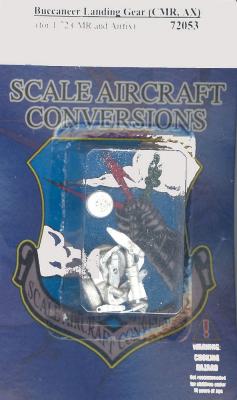
Scale Aircraft Conversions makes various landing gear sets out of lead-free white metal. Some come with the wheels attached if needed, like this set for the Buccaneer, where the kits wheels are molded onto the struts. Others might have the wheel bay included to help with added weight, but most only come with the new landing gear struts. I had the Airfix model so I don’t know how the CMR wheels are molded.
The detail of the metal parts is much crisper and looks flawless. The advantage to these parts is their strength and that they won’t warp under the kit’s weight over time. They will also hold up well while you work with them – no accidentally snapping them apart. To attach the new landing gear, you will need to use CA glue. On their web site they recommend a thicker gap-filling CA glue so that you can position them the way you want and then use an accelerator to bond the parts instantly.
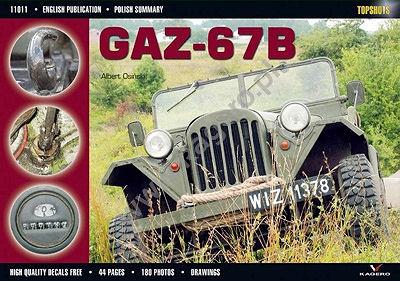
Kagero has been publishing for as many years as I can remember. Their books (the ones that I have) are dog-leafed and spine-flattened from pulling them out often to look over their pictures. Kagero’s Topshot series is designed explicitly for the model builder. These books are usually about 44 pages and filled with pictures of the vehicles covered. This particular tome is 44 pages long and contains 180 pictures (all in color), several line drawings, and a set of Techmod decals for the GAZ-67B (in both 1/35 and 1/72).
Introduction
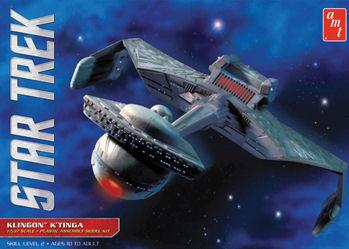
As a long time fan of the original Star Trek TV series (I watched it during its original run on NBC), I remember anxiously waiting for the release of Star Trek: The Motion Picture in 1979. After seeing how far Hollywood had come with special effects on the Star Wars series, I thought The Motion Picture (TMP, in fan lingo), with its great story lines and history, had the potential to be a great movie. Then, there in the opening sequences, were the three Klingon K'T'inga ships on the big screen with all the additional hull detail, approaching the big, unknown cloud-ship. Shoot first, ask questions later, right? Klingons...
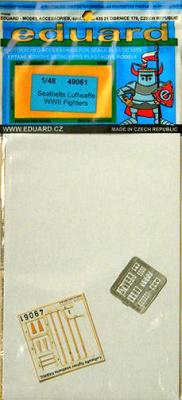
In this detail set, Eduard provides modelers with a unique way to add detailed seat belts to any 1/48 scale WWII Luftwaffe fighter. Unlike previous Eduard seatbelt sets, this one does not include solely painted photo-etch parts. Instead, the photo-etch components in this set are for the buckles and other hardware, and the belts are provided in a flexible, pre-printed fabric that comes on a paper backing. This multi-media combination promises realistic looking results because of the flexibility of the belt material.
The drawings on the front of the small instruction sheet illustrate the somewhat complex assembly process, and the step-by-step instructions on the back describe how to do it. These cryptic instructions describe a process that proved to be more tedious than I had expected.
The steps read:
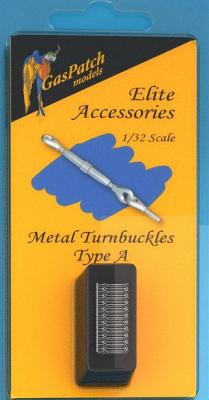
This product review will begin with a general introduction to GasPatch Models. GasPatch Models is located in Athens, Greece. GasPatch was founded in 2011 and produces plastic model kits and an excellent array of aftermarket parts intended for WWI aircraft subjects. One gets a sense of the professional nature of this enterprise by visiting the GasPatch website. The website is first-rate in appearance, navigation of the site is intuitive, and finding specific items is simple, easy, and quick. In a word…the site is an excellent site and reflects well on GasPatch as a company.
At the time of this writing, GasPatch has three variants of the Salmson 2A2 in the planning stages, all in 1/48th scale. This review, however, focuses on some GasPatch products that are already available. GasPatch produces a line of turnbuckles and air speed indicators in 1/48th and 1/32nd scales. This review focuses on these turnbuckle accessory packs.
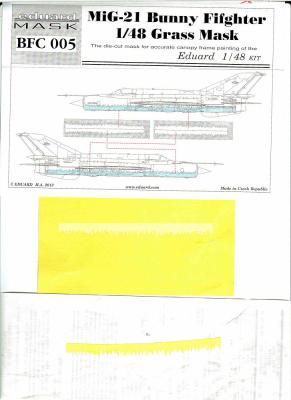
For those who might have missed it, Eduard has launched the Bunny Fighter Club, a membership club from Eduard which will have special kits and aftermarket available to members only. To join, you need to purchase their excellent 1/48 MiG-21MF kit which has Bunny Club markings. The markings for the kit include the 2 Czech planes and the MiG-21MF flown by Lt. C. Bunnyfield. This colorful character has a light blue and green plane with orange details, with a large bunny on the tail wielding a missile.
All kidding aside, Bunny Club members receive some great perks:
A Brief History
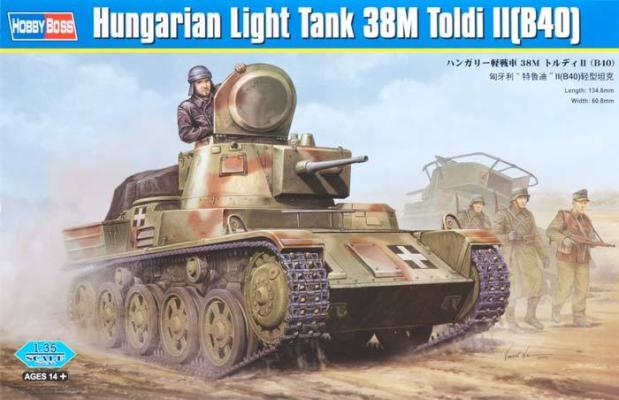
Had someone come to me even 5 years ago and said that in the near future, we modelers would be seeing kits of relatively obscure WW2 Hungarian tanks on the market from main stream injection manufacturers, I would have asked him what happy juice he’d been drinking. I would have demanded to be given a glass! We are, indeed, living in a Gold Age of modeling!
The 38M Toldi light tank was derived from the Swedish Stridsvagn L-60, produced in Hungary by the Hungarian Weiss Company under a licensing agreement from AB Lansverk. Three versions of the 38M Toldi were produced, with total production reaching 202 vehicles from 1939 to 1942. The tanks were first used by the Hungarian Army during fighting against Yugoslavian forces in 1941, and later saw action against Soviet forces during Operation Barbarossa. They were utilized mainly in reconnaissance, as the tank was no match in tank vs. tank battles against the likes of the Soviet T-34.
History
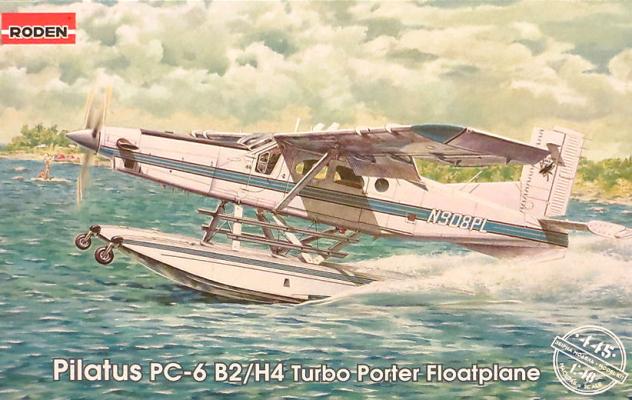
The Pilatus was a widely exported Swiss (STOL) turboprop utility aircraft floatplane variant, powered by Pratt Whitney of Canada. The aircraft began its career in 1959. It had been modified with several different engines. The aircraft ended its military career in the mid 1990’s. It then started a new career, or second life, in the private sector with some modified as floatplanes.
Items in the Box
The model is made of injection molded plastic, gray in color. The instructions were made up in book form, printed on both sides of the pages. Other parts were made up of clear plastic windows and landing lights.
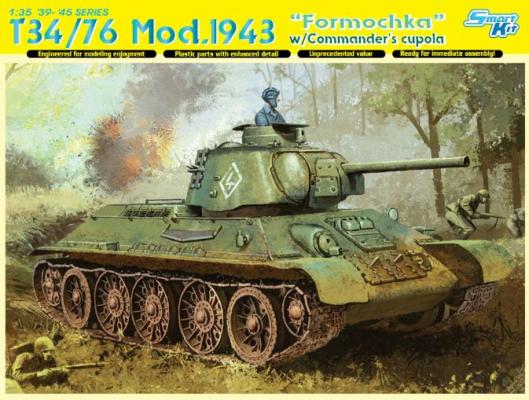
The Russian T-34 was the mainstay of the Red Army during World War II, with about 50,000 produced. The Russians produced numerous variants of the T-34 throughout the war. This Dragon offering is the T-34/76 (for 76mm gun) with the pressed steel turret. This turret was made out of 45mm steel, which actually had better protection then the 52mm turret it was based on. The commander’s cupola was added in the summer of 1943, so this kit falls into that variant timeframe. Many of the sprues are from earlier Dragon T-34 kits and we only use about half the parts. We get 24 sprues with 644 parts, including 85 photo etched parts, three clear parts, a wire tow cable, and two bags of Magic Track links. The joy of stocking your parts box is included with this kit.
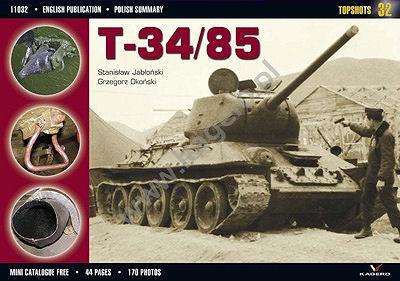
The T-34/85 is one of the most widely recognized tanks in the world. Over 18,000 were built before the end of WWII. Then, in 1951, Poland received marketing approval and continued production, re-manufacturing, and improving the T-34/85 series.
Kagero has done a great job on this book. Like most of their Top Shot series, this book is only 44 pages long and contains 180 color pictures. Also included, free of charge, is a four-page folded Top Shot catalogue. The pictures are great and definitely designed with the modeler in mind. The color pictures (180 of them), are nice, crisp, and provide a wealth of useful ideas. An example would be the one picture that shows a station-keeping light mounted at the rear deck where the electrical wires for the smoke cans exit the rear. I am not sure if this was a production modification or something required to have on a Museum runner.
- Hobbyboss F4U-4 Corsair, # 80387, $55.99
- True Details Propeller and Cowling Set, #48552, $12.99
Huge thanks as usual go to our friends at MMD Squadron for providing us these great kits and manufacturing the accessories to improve them. We at IPMS USA appreciate your support (and thanks, Dick and Steve, for trusting my questionable skills to execute a review!).
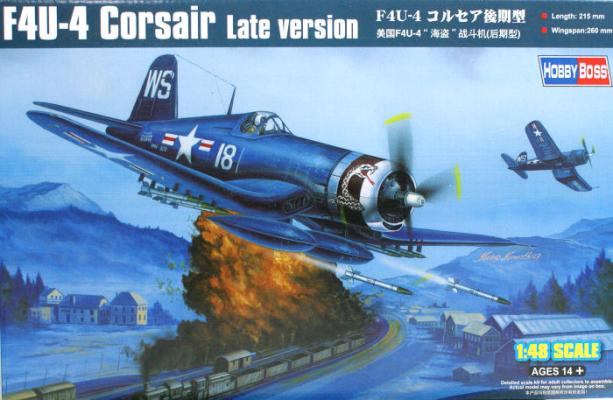
This kit brings yet another Corsair to the stable. In the box is, of course, an excellent F4U-4 kit with minute, delicate surface detail. Multiple options such as antennas, folded or extended wings, and an open canopy are offered. A decal sheet with two Korean War marking options is provided, and a full-color “here’s what it should look like” paint leaflet is also there. All parts are individually bagged and protected; the cowl and clear parts are separated from the main parts by a cardboard divider.
Items in the Box
The model is made of injection molded plastic, gray in color. The instructions were made up in book form, printed on both sides. Other parts were clear plastic, such as windows and headlights; also included are two small sheets of photo etch details (brass).
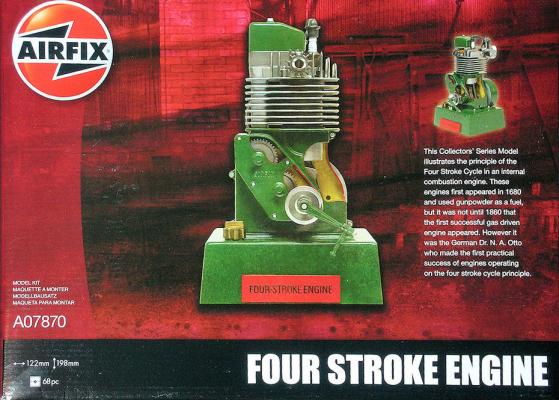
Airfix is releasing all sorts of interesting/strange subjects in their current burst of productivity and this is one of them. It's an old kit that originally dates from 1972, at one point was motorized, and is now billed as part of their Museum Collection. I selected it thinking it would be a fun diversion from my more "intense" projects. Wrong. This is not a simple build. You need to pay attention to what's going on and what goes where and, because it's a cutaway, what needs to be painted before you do anything. There are leftover parts when you're done that I can only assume were once part of the motorization, and some of the rest of the parts are similar to each other, so you need to pay attention to parts' numbers. Be careful during assembly, as some parts need to go together in a certain order and in particular orientations.
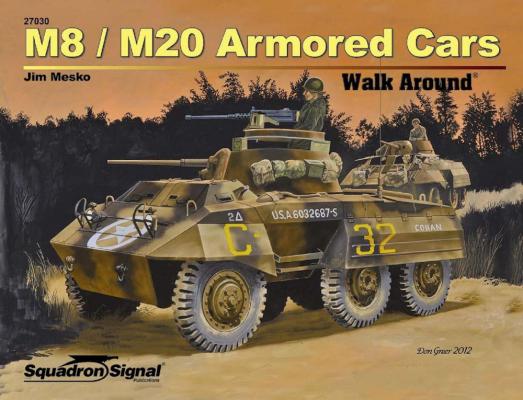
I have always admired armored cars crews. I think their vehicles are fast enough to get themselves in trouble, but not armored enough to get themselves out of trouble.
The M8 started its life as a “tank destroyer” vehicle. Very quickly, it was realized that the 37mm cannon wasn’t enough to take out a tank, and the vehicle got re-assigned mainly to cavalry and reconnaissance units. The M20 is a spin-off of the M8, based on the same hull but with a different top and used, for the most part, as a command vehicle, fitted with different radios and a folding map board.