I enjoy 72nd scale armor kits; they're usually easy to build without a zillion parts. Also, I've built mainly aircraft and cars over the last 15 years, so a fresh subject helps to get the modeling juices flowing again. This kit fits the bill. It's well cast with crisp moldings and excellent details for the scale, and the finished model certainly looks like the real-life subject (though I'm not counting the rivets).
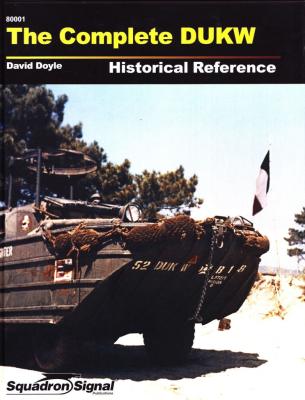
This is the first book to be released by Squadron Signal Publications in their Historical Reference series. As explained in the front of the book, this series is written by using in depth research of primary documents, giving a very detailed look at the subject matter. It appears that there may other books in the works covering aircraft and vessels. In my opinion this book is like a Walkaround or an In Action series book on steroids.
To me, this book starts off in an unusual manner. It starts by covering the people and the committee who were involved in the development of the DUKW and not the actual vehicle. This really helps give a good understanding both to how this vehicle was developed and the background of the people involved. Doyle then takes you through the different processes that led to the production of the duck, its wartime usage, post-war usage, variants, and its use in the civilian world even today.
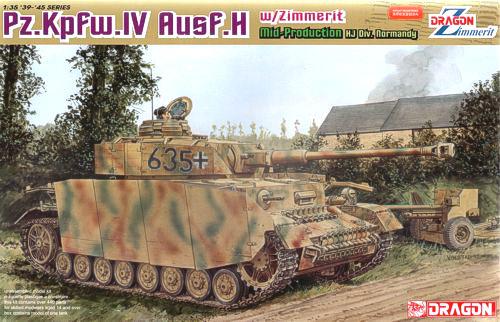
Dragon Models offers a complete lineup of the Pz.Kpfw. IV family tree in 1/35 scale. Following on the footsteps of their (Late Production) H released four years ago, their new (Mid Production) H represents a specific vehicle in the 12th Panzer Hitlerjugend Division, fighting in the defense of Caen, June, 1944.
Like the earlier release, the Mid-Production H comes with molded-on Zimmerit and one-piece DS tracks. New to this kit, however, are turret side skirts with Zimmerit as well as a brand new frontal armor plate containing the steering-brake hatches. The only other change is that Dragon has replaced the aluminum barrel in the original kit with a slide-molded one in the update. For fit and finish, I prefer the latter, so that’s also a welcome replacement.
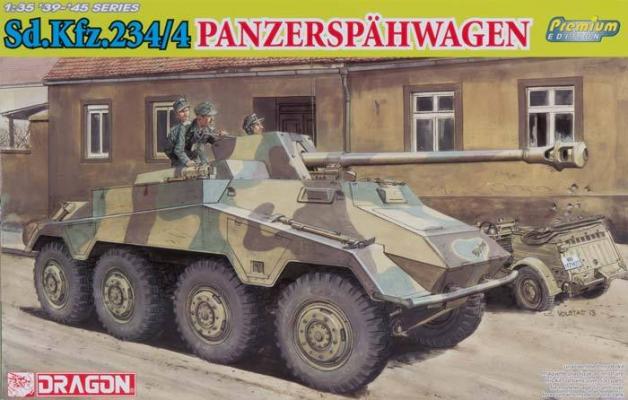
Dragon Models has released an updated version of their original (excellent) Sd.Kfz. 234/4 armored, anti-tank wheeled vehicle produced five years ago (#6221). This update replaces the eight large wheels and spare with newly engineered sandwich-style wheels that are magnificent. Each highly visible wheel is made up of eight thin disks that are assembled to produce accurate and stunning tread, with separate two-part hubs that simplify painting and weathering.
The only other change is that Dragon has replaced the aluminum barrel in the original kit with a slide-molded one in the update. For fit and finish, I prefer the latter, so that’s also a welcome replacement.
History
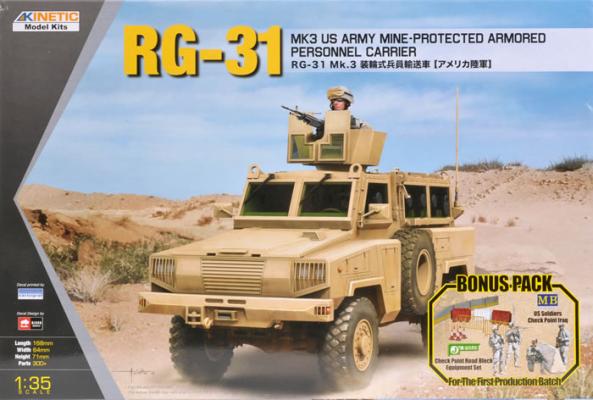
The RG-31 is a 4x4 mine-protected, all-terrain armored personnel carrier(APC) first manufactured in South Africa. It is able to withstand mine blasts and small arms fire due to the V-shaped, all-steel welded armor monologue hull and high suspension. As a multi-purpose vehicle, the RG-31 assumes a wide range of roles, such as APC, ambulance, and surveillance vehicle, but is mostly used during peacekeeping missions for its non-aggressive appearance. The RG-31 has served in Iraq & Afghanistan.
Kit
Inside the box, there are 5 tan plastic sprues, 1 clear sprue, 1 black rubber sprue, 5 black hard rubber tires, a PE fret, a decal sheet, and a 24-page instruction booklet. Also included in the kit box is a bonus "Check Point" set. The set consist of four figures and barricades (both water & concrete). I did not build this set for this review, but after looking it over, I think this set would build into a very nice diorama featuring the RG-31.
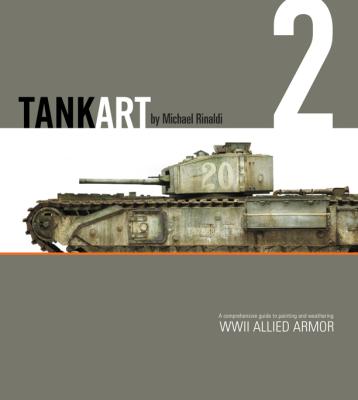
“How the heck did he do that?” A polite version of one of the most often-asked questions in the scale modeling culture. With the proliferation of modeling blogs and videos available on the internet, as well as generations of printed reference material, it seems a rare occurrence when a scale modeling reference in print form hits the market with such great impact and acclaim.
It’s déjà vu all over again – Michael Rinaldi’s TANKART Vol. 2 WWII Allied Armor is just such a work, following close on the heels of the amazing TANKART Vol. 1 WWII German Armor. Batting 2-for-2, the author seems to be on quite a roll, with TANKART Vol. 3 Modern Armor’s forthcoming release eagerly anticipated.
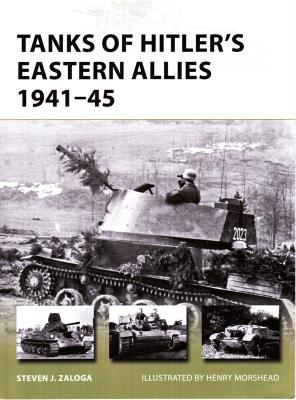
Much has been written in regard to the tank battles that happened on the eastern front with heavy emphasis on either the Germans or the Russians. This book looks into the smaller countries and the vehicles that were used during this campaign. By reading the book, you find out that some of these countries were not true allies to Germany. Many were forced to side with Germany and some tried to get out of this "alliance" but were drawn back in through kidnappings of their family members and other strong-arm tactics.
This book is clearly written and easy to follow. There are many black and white period photographs, color artwork, line drawings, cut-away drawings, and charts of the vehicles.
The Kit
This is Bronco Models’ version of the M1114 HMMWV. This version includes the XM153 CROWS mount.
Included in the top-opening box are:
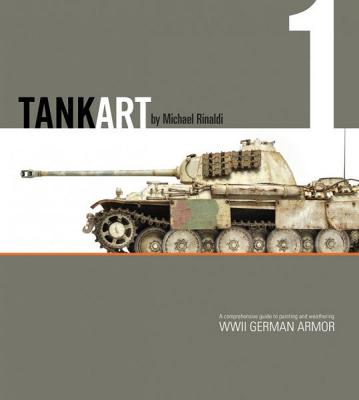
“How the heck did he do that?” A polite version of one of the most often-asked questions in the scale modeling culture. With the proliferation of modeling blogs and videos available on the internet, as well as generations of printed reference material, it seems a rare occurrence when a scale modeling reference in print form hits the market with such great impact and acclaim.
Michael Rinaldi’s TANKART Vol. 1 WWII German Armor is just such a work. For that matter, the book seems to be a work of art in and of itself. Yeah, that sounds a bit extreme, but seeing, reading, and re-reading is truly believing. So much for cliché, let’s get into the facts.
Background
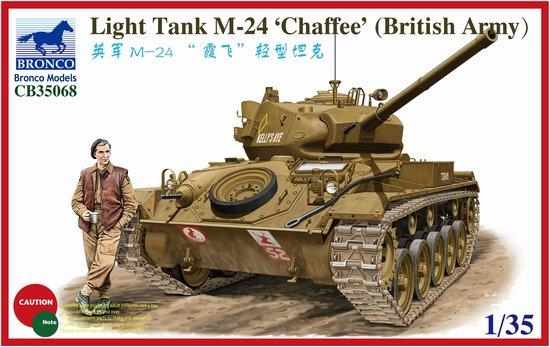
Specified in 1943 by the US Army to replace the aging and under-gunned M3 and M5 Stuart light tanks, the M24 Chaffee was a welcome addition to the armored corps of Allied armies in late 1944. Borrowing the M5’s power train, a new torsion bar suspension, a sleek new profile, and a lightweight 75mm gun adapted from the B-25H bomber, the M24 was a significant leap forward in fighting capability. With its late-war arrival in November 1944, the M24 saw limited action by US, British, and Free French forces, but was well received by the units which operated it in combat. Over 4,700 Chaffees were built by war’s end, and most saw service with the US Army through the Korean War and remained in service with other nations into the 1970’s.