Reviews of products for scale military vehicle models.

Book Author(s)
Ian Baxter
Review Author
James Kelley
Published on
Company
Pen & Sword
MSRP
$24.95

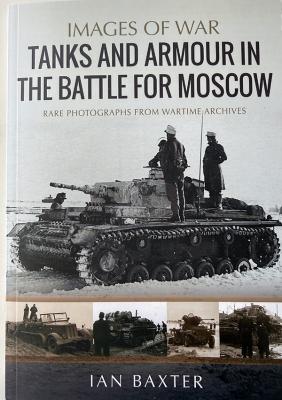
Tanks and Armor in the Battle for Moscow (Images of War series) by Ian Baxter is a photo-heavy illustrated history focused on German armored forces during the Battle of Moscow and related operations on the Eastern Front.

The book provides a visual account of the German Panzerwaffe’s advance toward Moscow, primarily covering Operation Typhoon (the 1941 offensive) and its aftermath. It draws on rare and unpublished photos with captions and a concise narrative.

Book Author(s)
Francis Edward Pulham
Review Author
Andy Taylor
Published on
Company
Fonthill Media
MSRP
$34.95

The Soviet T-34 tank is omnipresent with WWII armor. When the German blitzkrieg erupted across Soviet territory, two tanks stunned the Germans, with the primary being the T-34. Its design was robust, armor effective and carried a main gun that could hold its own. Superior German tactics and neophyte Soviet doctrine and training still prevailed, but tank warfare was forever changed in those early encounters. The T-34 gained a fearsome reputation and captured examples were soon put in use against their former owners.

The author, Francis Pulham, continues with his Introduction,

Book Author(s)
Dr Dewald Venter
Review Author
Andy Taylor
Published on
Company
Helion & Company
MSRP
$29.95

South African Armoured Vehicles, Volume 1 - A History of Innovation and Excellence is revised and expanded from an earlier book by the author, Dr Dewald Venter, South African Armoured Fighting Vehicles: A History of Innovation and Excellence, 1960-2020 (Africa@War No. 36). The author notes that this updated edition is split into two editions. The author continues,

The success of the first edition, with positive reviews from numerous formal reviewers and a 4.7 out of 5-star rating on Amazon from 5 reviewers, was immensely encouraging. It is my hope this second edition will continue to serve as a definitive resource for anyone with an interest in South African armoured vehicles, military history, and the stories of the men and women who designed and operated these incredible machines.

Review Author
Chris Martin
Published on
Company
Pen & Sword
MSRP
$39.95

About the Author

The following is taken from the jacket cover.

Craig Moore has had a passion for military history since he was a child. He is chiefly interested in the two world wars, in which eight of his close relatives fought, and two died. One of his uncles lost a leg in Normandy in 1944 when his Sherman tank was hit by a shell. In 2010 Craig retired from London’s Metropolitan Police after 30 years of service. He lives in south-west London where he makes regular contributions to military history magazines. He also often visits museums and military events around the world. This is his tenth book on topics pertaining to the world wars.

What You Get

This is a hard bound edition in standard 7⅛ by 10 format with 182 semi-glossy pages. The book contains Acknowledgements, Introduction, 10 Chapters, and a Bibliography.

Review Author
Ben Morton
Published on
Company
ICM
Scale
1/35
MSRP
$75.99

The “Stuka zu Fuss” was the name given to WWII Germany's Multiple Launch Rocket System (MLRS) that was commonly mounted on the Sd. Kfz. 251/1 Ausf B half-track. This was an effort to give German armored units some mobile artillery support, particularly in urban environments. The MLRS was employed on captured French (Renault Chenillette's) and American (M3 half-tracks) vehicles as well.

The MLRS consisted of from four to six launch crates draped over the side of the carrier vehicle. These disposable crates were also the shipping container for the projectiles. These projectiles came in three versions:

  • 280 mm high-explosive (HE) rockets
  • 300 mm HE rockets
  • 320 mm incendiary (napalm) rockets

These rockets were spin stabilized and had a range of 2300 meters, or about 1-1/2 miles. All of that brings us to a review and assembly of ICM Holding's “Stuka zu Fub” Sd. Kfz. 251/1 ausf. B.

Review Author
Bill O'Malley
Published on
Company
Agora Models
Scale
1/8
MSRP
$1,737.00

Agora Models

Agora Models is a UK company based in London, England that specializes in high-quality large-scale models. This is the third part of the review of Agora Models’ Jeep Willys SAS, describing assembly and finishing of the Jeep. Agora distributes the Jeep kit monthly in 12 Packs.

Summary

Agora’s Willys SAS Jeep is a fantastic kit that will please Jeep lovers and fans of large-scale modeling. Assembly of the big kit is straightforward with detailed, clear instructions. There are many tiny screws used in the build, which is the only challenging part of the assembly. Pre-finishing of the parts allows building the kit without additional painting steps and even less experienced modelers will find the build enjoyable.

Review Author
Jason Boggans
Published on
Company
Academy Models
Scale
1/72
MSRP
$16.50

Box Art / Packaging / History

Academy have produced a newly boxed iteration of the 1999 Revell Leopard 1A5, parts are well molded and very little flash was observed. The box art is glossy and depicts artwork of a Leopard in German Markings and NATO Camouflage scheme. The instructions did not give any history of the MBT, but briefly, the Leopard 1A5 was the main service version of the Leopard 1 post 1987 when some 1800 Leopard 1’s were converted to the new variant. The newer variant improved on fire control systems, gun stabilization and night fighting capabilities adding a laser rangefinder and enhanced thermal imaging. Some are indeed in service today in Ukraine.

Review Author
Andy Taylor
Published on
Company
AOA Decals
Scale
1/35
MSRP
$15.99

AOA Decals has a good reputation for quality decals, and I was thrilled to have the opportunity to review another one of their newest releases, JLTV (1) - M1279

US Marines (35-013). The decals come in two sheets, one of stencils and the other of markings for nine options.

In October 2008, Oshkosh won the contract for the American military Joint Light Tactical Vehicle (JLTV) program to replace the US military’s High Mobility Multi-Purpose Wheeled Vehicles (HMMWV). The contract specified combining the mobility of a HMMWVS combined with the protection and survivability of a Mine Resistant Ambush Protected Vehicle (MRAP). The JLTV has three base models: the 2-door Combat Support Vehicle (CSV)/Utility Vehicle (UTL), the 4-door General Purpose Vehicle (GP) and the 4-door Close Combat Weapons Carrier (CCWC). The platforms can then be fitted with specific mission packages to fulfill many roles and complete many different tasks. The CSV/UTL JLTV is now known as the M1279.

Review Author
Paul Bradley
Published on
Company
ICM
MSRP
$18.99

Another in ICM’s range of paint sets, this time for use with any WWII British armoured vehicles.

The set contains the following 12ml paint pots from their range of generic colours; I have listed what I believe to be their intended uses:

  • 1041 Buff – Light Stone/Portland Stone
  • 1027 Gun Metal Metallic – tracks
  • 1054 Chocolate – possibly SCC.2 Brown, but this paint is too dark
  • 1059 Green Ochre – Middle Stone/Dark Stone
  • 1069 Extra Dark Green – Deep Bronze Green
  • 1071 Camouflage Green – SCC. 15 Olive Drab or Khaki Green No.3

The back of the box has a couple of drawings showing suggested uses for each color. The Camo pattern on the Churchill is like nothing I have seen before on a British tank, though it’s quite possible it was a special scheme in Italy.

Book Author(s)
Ian Baxter
Review Author
James Kelley
Published on
Company
Pen & Sword
MSRP
$24.95

Images of War: Tanks and Armour at Leningrad 1941–1944 is a photographic military history by Ian Baxter, published by Pen & Sword Books⁠ as part of its long-running Images of War series. The book is a 144-page paperback containing roughly 150–200 black-and-white photographs, many of them rare or previously unpublished.

The book focuses on the armored warfare surrounding the Siege of Leningrad, beginning with the opening of Operation Barbarossa in June 1941 and ending with the German retreat in early 1944. It concentrates primarily on the German side of the campaign, especially the armored units of Army Group North and their advance toward Leningrad.

Among the formations discussed are: