
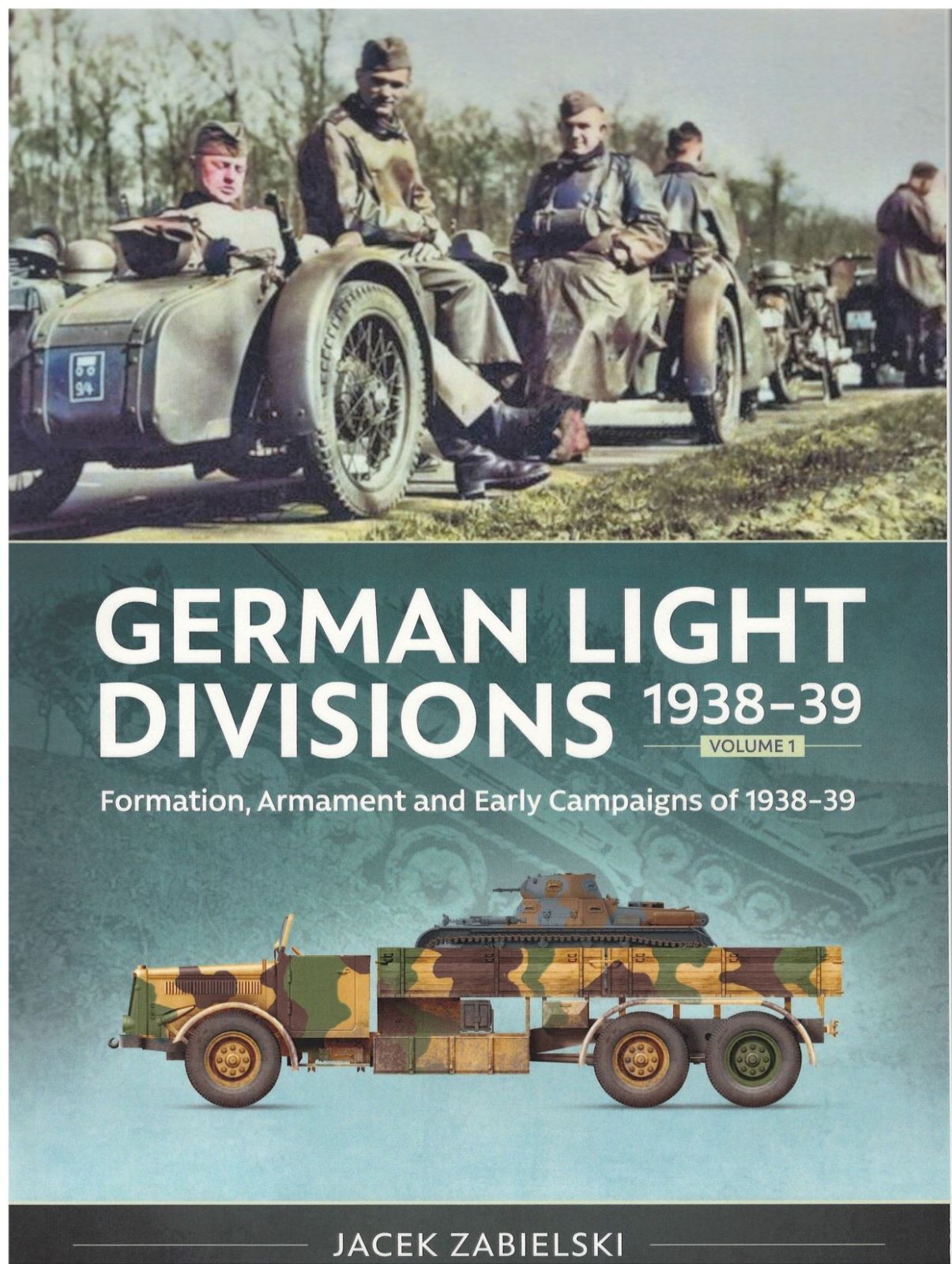
German Light Divisions 1938-39 Volume 1: Formation, Armament and Early Campaigns 1938-39
Helion is a prolific publisher of military history based in the United Kingdom. This two-volume set provides an overview of the formations, equipment, and actions of German light divisions from 1938 through the end of the Polish campaign. As with all Helion offerings, they are paperback but professionally produced. Each volume is full of beautifully reproduced black and white photographs, campaign maps, drawings of tables of equipment and organization, as well as several color profiles of German vehicles in this time. The first volume covers the formation, armament, and pre-war deployment. The second volume is devoted to the Polish campaign with additional information on camouflage, markings, and the continued evolution and ultimate dissolution of the light divisions.
This book is divided into short chapters with Volume 1 covering the origins, formations, equipment and the pre-war campaigns the divisions took part in. Each of the chapters is richly illustrated with very sharp contemporary black and white photographs. The origins of the light divisions paralleled what occurred in other western armies. With mobility at a premium and seen as the answer to the stationary warfare that dominated the opening years of the First World War, the Germans turned to the cavalry. While the debate over how to use the tank was not settled, the light divisions emerged as a combined arms force with a mix of tanks, infantry, and specialized units organic to the division. The book covers the commanding general of each division as well as its tables of organization and equipment. Following the chapter on divisions is a brief overview of the equipment including some color profiles. The profiles and photographs show the two-tone camouflage of the pre-war era. The final chapter of Volume I covers the ‘flower campaigns’ – the reduction of the Sudetenland in October 1938, the invasion of Czechoslovakia in March 1939, and preparations for the invasion of Poland.
For the modeling community, these richly illustrated volumes, full of contemporary photographs provide precise information on the markings and camouflage of early war German tanks and vehicles. From a story telling perspective I would have liked to see more space devoted to the parallel development of light, mechanized forces in Western Europe, but that is a minor quibble. I highly recommend these volumes. Thank you to Casemate Publishing in providing these volumes to the IPMS-USA for review.


Comments
Add new comment
This site is protected by reCAPTCHA and the Google Privacy Policy and Terms of Service apply.
Similar Reviews