As 1941 dawned, the British were mopping up the last Italian strongholds in Libya after seven months of fighting. The outnumbered British Western Desert force of 30,000 men had effectively defeated an Italian force of 250,000. The British had captured hundreds of thousands of Italian soldiers, plus hundreds of tanks and artillery pieces, and several thousand valuable trucks, and pushed the Italians out of Egypt and then across the coastline of Libya until they controlled only a small section of western Libya.
This is part of a series of books by FlightCraft on aircraft and I have a few of these and are truly indispensable when building a model of the subject matter.
This book goes into great detail on the F-35 fifth Generation fighter. There are a few versions of this aircraft all covered in this book.
The contents of the book are as follows:
- Introduction
- Design and Development
- Key Technical Systems
- Power Systems
- In Service
- Camouflage and Markings
- Modeling the F-35 Lightning
- Showcase Products
I found the Key Technical Systems section most interesting section to me and learned a lot about the aircraft systems.
The modeling sections were also very informative. There are a few builds highlighted including the Tamiya, Academy, Italeri, and Trumpeter Kits.
Reviewer’s Comments:
TankCraft 46, Panther Medium Tank, German Army, Waffen-SS and Luftwaffe Units, Eastern Front, 1944 details the Panther tank, officially the Panzerkampfwagen V Panther (Pz. Kpfw. V, Sd. Kfz. (Sonderkraftfahrzeug) 171, during the largely defensive battles on the Eastern Front during 1944. As the author states in the Introduction,
“At the beginning of 1944, the German armies in the East had lost much of the territory that they had overrun in the spectacular advances of 1941 and 1942. In the north, Leningrad was still surrounded but was being resupplied, and the city was no longer under any serious threat. Most of modern-day Ukraine east of the Dnipro River was now in Soviet hands and in the south the Red Army had occupied the Perekop Isthmus, cutting off Generaloberst Erwin Janecke’s 17. Armee in Crimea.
Helion is a UK-based company that produces books on many aspects of Military History from the Late Medieval period through to the present day. Helion was established in 1996 by University of Warwick graduate Duncan Rogers. Since then, they have published over 1,200 books, with 100 or more new titles coming out every year, for readers around the world. Casemate markets Helion books in the United States.
The Yugoslav Air Force in the Battles for Slovenia, Croatia, and Bosnia and Herzegovina 1991–1992, Volume 2 by Aleksandar Radić is an excellent addition to any aviation or modern military history collection, especially for those with an interest in the Balkan conflicts of the early 1990s. Radić does a strong job of combining operational history with detailed insight into the aircraft, units, and missions that defined this complex period. The narrative is clear and well-structured, giving enough political and military context without overwhelming the reader, while still maintaining a strong focus on aviation.
One of the standout features of the book is high-quality photography throughout. The images are sharp, well-reproduced, and thoughtfully selected, offering a valuable visual record of the aircraft and conditions during the conflict. These aren’t just filler; they genuinely enhance the reader’s understanding of the subject.
War in Ukraine, Volume 9: Soviet-Designed Artillery Systems, 2014–2024 by Wen Jian Chung is a highly focused and informative entry in the Europe @ War series, offering a detailed look at one of the most important elements of the ongoing conflict, Artillery Systems. Chung does an excellent job breaking down the development, deployment, and battlefield use of Soviet-designed systems still in operation today. The text strikes a solid balance between technical detail and operational context, making it accessible without losing depth. It’s particularly valuable for readers interested in how legacy systems have been adapted and employed in a modern, high-intensity conflict.
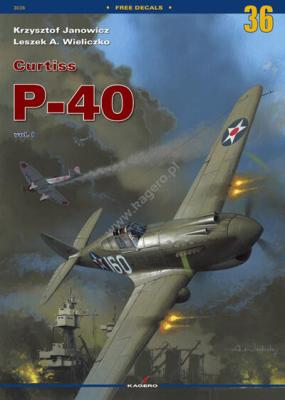
Bottom line up front: The title states this is a reference for the Curtiss P-40B/C, but actually, it is a reference for the P-40E with a few photos and color plates for the P-40B/C. The accompanying decals are for a P-40B/C.
The soft-cover booklet is 1-1/2” x 11-3/4” with 24 pages. There are ten black & white aircraft photos, twelve detail photos, six color profiles, a four-view color profile for the aircraft covered in the decals, and twenty-two line drawings of P-40Es and Kittyhawk IAs. The price on the Kagero website is Euro 12.95.
The decals cover a single P-40B/C in both 1/72 and 1/48th scale. They are in good register, the colors are solid and crisp, and the carrier film is thin.
From the publisher’s website:
Nearly forty years have passed since the explosion at the Chernobyl nuclear power plant - the most severe nuclear accident in history and one of the gravest man-made disasters ever recorded. Countless books, documentaries, and films have examined the catastrophe and its aftermath. Yet, despite this abundance of material, a crucial aspect of the story has remained largely overlooked in English-language accounts: the immense contribution of Soviet aviation to the response effort.
In the shadow of the “liquidators” who manually cleared radioactive debris, thousands of aviators - especially helicopter crews - risked their lives flying repeated missions into the deadly plume above Reactor No. 4. Their work was vital in containing the fallout, delivering personnel and equipment, and monitoring radiation in conditions no aircraft had ever been designed to endure. Their story has never received the recognition it deserves.
Background
From Review Insert
The formation of the U.S. Army's 10th Mountain Division was inspired by Finland's success during the Soviet Union's invasion in 1939, where Finnish ski troops effectively used winter terrain to overcome Soviet armored divisions. Recognizing the strategic value of such a unit, Charles Minot "Minnie" Dole, founder of the National Ski Patrol, lobbied for a similar division in the U.S. Army. His efforts eventually led to the formation of specialized mountain warfare troops. In 1941, the War Department authorized the formation of experimental ski patrols, and by 1942, the 8Zth Mountain Infantry was created. Recruited primarily from skilled skiers, this unit was stationed at Camp Hale in Colorado. The 10th Light Division (Alpine) was formed in 1943. Later renamed the 10th Mountain Division in 1944, it became a critical component of U.S. mountain and winter warfare capability.
The non-profit UK based group known as the Great War Aviation Society publishes their journal, Cross & Cockade International, four times a year. Issues are available in English as printed [Softbound, A4 (8.27” x 11.69”), 80 pages plus centerfold] as well as digital copies (or both). A new magazine, Contact!, is now available in both print and digital download. The Society also provides a free newsletter (sign up on their website) and occasionally publish WWI themed books like the Sopwith Dolphin monograph I reviewed earlier for IPMS USA. This Journal is the sister of the US Journal, Over The Front. The Great War Aviation Society also hosts a lecture series available through Zoom. If interested, you will need to register early as the call is limited in attendance. The Great War Aviation Society also is on Facebook and on X [Twitter].