I am no expert on the Ford Model T cars, but by using the internet I have found out several things. The Model T was the first affordable car that opened car ownership to the American middle class, which was due to the assembly line production method that reduced car prices. The Model T's made in 1913 were priced at $525 for a runabout, which is another name for this model car. 170,211 Model T's of all types were made in 1913 and this was the last year in which you could get a color choice. The colors being black, gray, green, blue and red. The first Model T was made in 1908 and production lasted for 17 years. Even today the Ford Model T is a name that is recognizable to a majority of American car owners as there are still several thousand of these cars that are still running. If you go to most car shows you will still usually find one or two Model T's on display.
ICM has produced a little gem – an extremely authentic, well-engineered, gem of a model.
First of all to introduce myself a bit. I have been palling around with my wife and her parents around for the past twenty-eight years, and her family has owned a Ford Model T since my wife was a young child. Between our two families, we own three Model Ts, one of which a 1914 Touring, not unlike this 1913 Roadster. My father-in-law, Jim, restored a T in the early 1970s, and Jim and I restored my wife’s 1926 T in the 1990s. I bring all of this up to illustrate that we’ve spent enough time under these old rigs to know where not to step after one has been parked for a while.
Background
The Model T was the first mass-produced automobile. In 1913 over 170,000 Model Ts were produced; an average of one Model T rolled off the assembly line every 185 seconds. For production to maintain levels that high, everything had to be done at breakneck speed, including painting.
I’ve heard and read about the quality of Tamiya models and now I’ve built one with only a couple of disappointments.
Engine
The six cylinder engine is has twin turbo chargers. There’s a pair chrome plated and a pair just plain white plastic. The plain one doesn’t even show up on the instruction sheet. All the parts fit extremely well and are well engraved.
Chassis
The chassis features nice detail and crisp engraving. Exhaust is a separate piece – again, one chrome plated and the other plain white plastic. Front and rear suspensions are multiple piece units that get glued in separately. The gas tank is even a separate unit.
Interior
The interior was a major disappointment. While the dash and seats are wonderfully engraved, there is virtually nothing engraved on the side panels. No door handles. No window cranks. No power window buttons. Nothing!
This is a Level 2 kit and contains 87 pieces. The kit is molded in white, chrome, clear, and clear red plastic. The instruction manual is typical Revell with drawings and pointers.
This kit looks a lot like the Monogram kit I built on my grandmothers back porch in the 70’s. Some web snooping has led to this being linked to the 1976 Monogram release but I couldn’t tell you for sure. What I can tell you is that this kit goes together really well with no real vices. The window fit could be better but I got around that issue with a bit of pressure and strategic gluing. Unfortunately the glue gave up its hold during final assembly. Next time I would cut off the door windows. The engine is only a few pieces but detailed enough to look good. A more accurate and detailed painting guide for the engine would have been nice though. The interior is well done with multiple pieces and decals for the individual instruments. The chassis is basic with few parts just like the real thing.
This is a Level 2 kit and contains 105 pieces of which you will use 91. There are two different front spoilers and two rear bumpers, three different rear spoilers, and four different sets of wheels included. All of these pieces are molded in white, chrome and clear plastic.
I built this kit in sub assemblies to ease painting. The engine is well done and consists of approximately 10 parts. The main chasis is one piece except for the firewall. The molded in engine bay detail is very well done. The interior consists of about 13 parts plus a decal for the instrument cluster. I don’t know that the Type R had a different interior than a base model, but this one appears to be a standard setup. No racing seats, gauge clusters, etc. There are few suspension pieces and a three piece exhaust on the bottom.
History
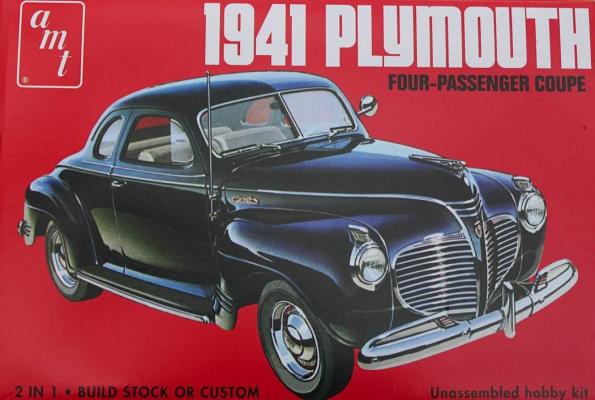
Billed as the low priced car that's most like the high priced cars…the 1941 Plymouth offered Big 3 buyers an attractive, soundly engineered and thoroughly modern automobile. The Special Deluxe Four Passenger Coupe is a prime example of Chrysler Corporations emphasis on low priced luxury. Priced at $925 it featured a longer wheelbase that its competitors for a big car ride; front stabilizer bar; safety rim wheels; oil bath air cleaners, aircraft type shock absorbers; and a smooth running 201.3 cubic inch L head six cylinder engine with Chryslers famous Floating Power mountings. Introduced in 1928, Plymouth built a solid reputation for comfort and value, playing down performance until the horsepower race of the 1050s. With growing collector interest in prewar Chrysler products, the 1941 Plymouth has become a highly desirable milestone Mayflower.
This proved to be a fabulous kit with both the tilt front end 1940 Willys Coupe as the subject matter, and the nostalgia provided with arguably the most beloved and popular individual of The Three Stooges, Curly Howard, as the backdrop. I was so impreesed with the car itself. It went together so seamless, without any fitting problems whatsoever. This particular Willys Coupe can only be built the way it is depicted on the box top artwork.
On the back of the seventh Fast & Furious movie release, Revell has re-released a kit born in the 2 Fast 2 Furious era, or more commonly, 2003. Responding to the tuner craze of the time, Revell released several 2’ n 1 style kits of popular imports such as the Acura Integra Type R, Mitsubishi Eclipse, and the subject of this review, the ‘99-00 Honda Civic Si coupe. Each of the the tuner-inspired kits included several aftermarket wheels, body kits, and spoilers, along with the parts to build a stock car.
The Kit
This review covers the 1957 Ford Del Rio Ranch Wagon 1:25 Scale Model Kit #85-4193. A 2015 release, this model is a collection of past offerings with refreshed trees and some brand new tooling. It is a skill level 3 kit for the 12-year and older builder, molded in 156 pieces of white, clear, transparent red and chrome pieces with waterslide decals and instructions. As you can tell from the piece count it comes with quite a few options. Two complete versions can be built; either the police wagon or a stock version. Both use a highly detailed rendition of the 312 c.i.d. Thunderbird V-8. This kit includes a separate frame for enhanced detailing along with custom wheels and disc brakes. The completed dimensions are Length: 8”, Width: 3”, Height: 2-3/8”
Construction and Detailing
I elected to build the police version of this wagon for its “cool” factor and because the kit pieces were so nicely done in a period accurate manner.
I was excited for the opportunity to build a truly wonderful American classic. In 1963 the Corvette had a base price of just under $4400. dollars and came in right under $5,000. for the fully loaded sport coupe . This model is one of the best offerings that will be coming out this year in my humble opinion . The car comes with all the accessories to build three different 327 c.i. power plants ! It comes with two engine blocks and parts to assemble three different versions of the famed motor. One , of course is the factory stock version , one is the custom one with a blower assembly and the other option is a fuel injected motor. The kit also gives you three hoods complete with the cutouts already completed on two of them . So trying to cut one out on my own is eliminated. That is very good news for some of us , namely me . And the third hood is for the factory edition . I chose to build the stock version of the car .