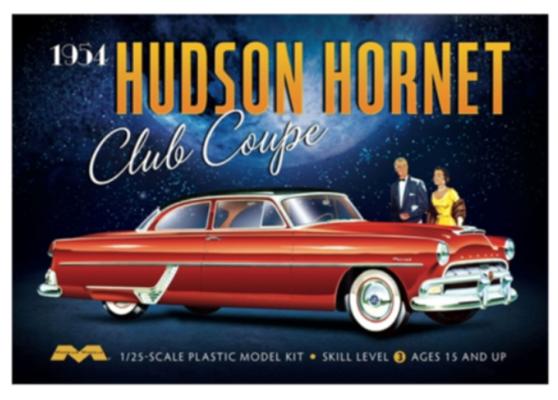
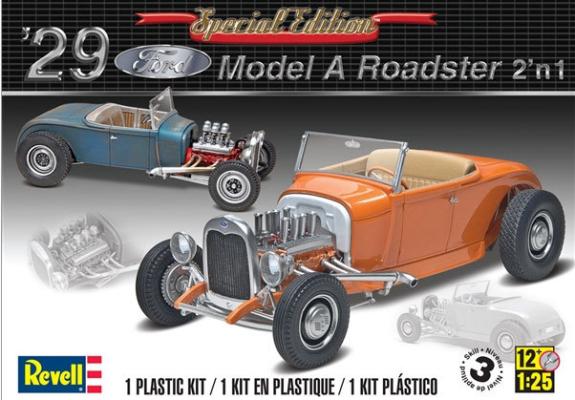
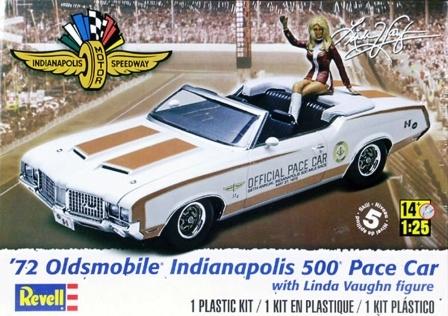
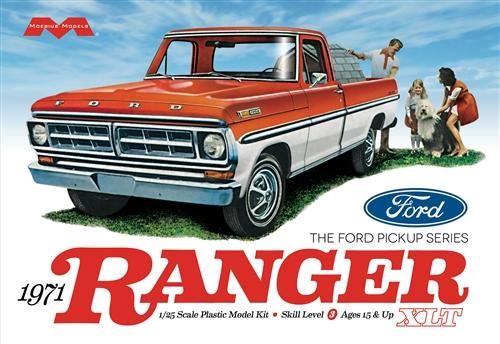
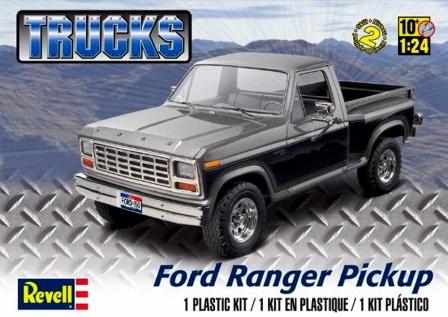
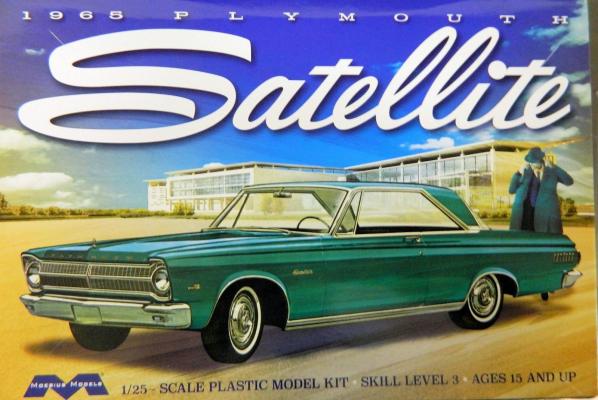
This kit is just another in the long line of wonderfully produced Moebius kits. Upon opening the box you see the fine detail and craftsmanship shine through. The instruction sheet is 10 pages and printed on glossy finished paper . The instruction sheet provides great detail to build your model accurately but it also includes an accurate Ford paint color chart for both the interior and exterior to complete the kit in factory trim.
The Ford Ranger has been the number one selling vehicle in America for over three decades. It’s hard to argue with that kind of success.
The Kit
This review covers the Ford Ranger Pickup Truck 1:24 Scale Revell Model Kit #85-4360. This is a nice clean kit with some pretty good detailing and it is one that can readily be improved with some additional work. Just adding some foil to the trim and a wired engine makes it a standout on the display shelf. This is a re-release as it has seen other boxings in the past.
This kit has 78 parts molded in white, clear and chrome with vinyl tires. The decals are newly designed for a two-tone color scheme. The instructions are well presented, although there are some errors in it. It has a nicely detailed engine and interior. Finished dimensions are: Length: 7-13/16", Width: 3-15/16", Height: 3".
The 1965 Plymouth Satellite kit does not show up on the Moebius website. I’m not able to tell you why it doesn’t. (ed. note - it is listed under the Club Moebius section of their site listed above)
Engine
The Commando 426 engine with TorqueFlite automatic transmission is extremely well done with excellent engraving and separate pieces for the oil filter and Carter carb.
Interior
Moebius did an interior platform with separate side panels and seats that feature wonderful engraving. The well engraved dashboard has decals for gauges and the radio face. The separate console fits very well.
Not only did they give the seventh version of the Corvette stunning looks, it has a matching performance clocking in at 0 to 60 mph in only 3.8 seconds. The new Stingray has everyone turning heads, and it’s still a great bargain for a personal luxury roadster.
I have been a fan of Tom Daniel and his hilarious model concepts since I can first remember building model kits. The very first model I built was the Red Baron and the second the Paddy Wagon. Over the last 45 years, I’m pretty sure I have built well over 75 of Tom Daniels models.
Enter the 2015 reissue of the Monogram “Jinx Express” which was originally minted in 1971 and then again in blue plastic as the “Fast Buck” in 1973. Conceptually it appears to be just a hot rodded armored car but as you look closer you will find a combination lock on the rear panel where access doors should be and on the roof there is what appears to be a coin slot. YES, this “thing” is actually a piggy bank in disguise. Monogram refers to it as the “screamin’ Fort Knox.”
The Dan Fink Metalworks Speedwagon is a wonderful car and Revell has made a terrific kit.
Engine
The small block Ford engine goes together very well but has no alternate parts. I guess because the kit represents an actual car. Parts fit and looks good when completed.
Interior
Interior has separate side panels that can be easily detailed due to the excellent engraving.
Body
The body panels fit like they’re supposed to fit without issues. The fenders, tub and hood are separate pieces. Fenders, hood and grille are probably from the Revell ’32 Ford 5 window coupe kit. I chose to use HOK majik blue pearl while the wood panels were hand painted in a 4 step process.
Chassis
I think the chassis/frame parts were used from another kit – possibly the ’32 Ford 5 window coupe. Nothing wrong with that because it builds just wonderfully.
After dabbling in automotive design at GM, Pete Brock started his own design firm in 1965 known as Brock Racing Enterprises, (BRE). His designs were successfully used in GT, CP and Trans Am class racers in the sixties and early seventies. This kit replicates the C Production class winning 1969 Datsun 240Z driven by John Morton.
The Kit
This review covers the BRE Datsun 240Z 1:25 Scale Revell Model Kit #85-1422. This is a Limited Production SSP Series model and a re-released kit from 1972. Produced as a one-time offering kit and rated a skill level 3 build. I think that‘s about right due to some difficult decals, tutone paint, and some altered build sequences. There are at 105 parts molded in white, clear and chrome parts, along with vinyl tires and engine tubing. This kit features a detailed 6-cylinder racing engine, vinyl oil lines, front and rear spoilers and soft black tires. Finished dimensions are: Length: 6-5/8 ", Width: 2-5/8", Height: 1-15/16".
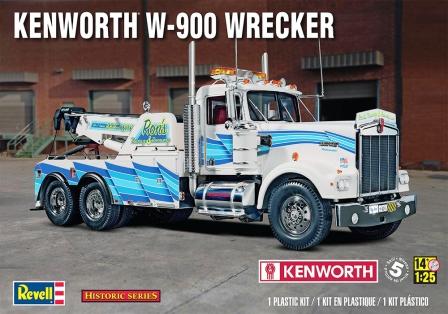
After being developed in the early sixties the W-900 Series truck has proven to be such a value that it is still being produced. Its dependability and value have made it a perennial favorite with owner-operators.
Geoff Stunkard provides an insight into his decades of experience as a photographer, writer and editor. If you have ever lifted a copy of Mopar Muscle magazine, you know who he is. Currently he is the owner of Quarter Milestones Publishing based in Johnson County, Tennessee. Geoff Stunkard has delivered what is perhaps the definitive history of the development and racing of the Chrysler 426 Hemi engine.
Geoff Stunkard traces the history of the Hemi engine’s development at Chrysler, from the first Hemi installed in the Republic XP-47H in 1945 to the last in 1969, the A279 project. Of course, Chrysler’s merger with Germany’s Daimler-Benz AG in 1998 has since resurrected the Hemi for street and competition, but Geoff Stunkard focus for this book is the first and second generation Hemi engines.
Plusmodel has recently released some interesting 1/35th scale diorama accessories. The Fordson N-big Tractor is another one of them. It is an entire kit and has to be one of the best if not the best resin kit I have built. The parts were flawlessly cast with little to no flash. The fit was exceptional.
From the instruction sheet: Fordson tractors were produced in Cork, Ireland. The first of them, Fordson N-Big left the plant in 1927. In 1933 the production was transferred to Dagenham in England and this factory produced 136,000 units so the type became the most common tractor in the U.K. during WWII. It was powered by a 4-cylinder diesel or petrol engine, both of 4.4 L (267 ci) with app. 25 HP power.