Reviews of products for scale aircraft models.

Review Author
Paul R. Brown
Published on
Company
Scale Aircraft Conversions
Scale
1/72
MSRP
$13.95

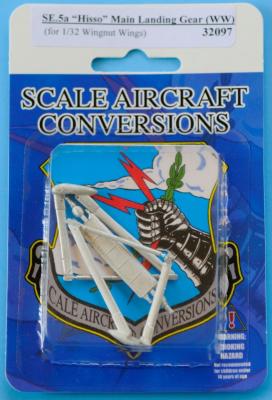
As with most of SAC’s landing gear sets, this set provides drop in replacement parts for the three main gear struts for Hasegawa’s new Su-35S kit. The set consists of a nose gear strut and two main landing gear struts. The three castings are very sharp and crisp. I used a brass wire wheel in my battery operated Dremel tool and slow speed to polish up the struts and remove the casting seams. I then primed the struts with Tamiya grey primer and painted them with a Tamiya light grey, with the oleo sections picked out with chrome silver. I had hoped to show them off installed on the Hasegawa kit, but the kit I ordered is apparently either on the slowest boat or is taking the long way around the world to get to me, as it is still in transit from somewhere.

The set paints up really well and will add a nice touch of detail (and weight) to your Su-35.

Recommended. Thank you to Scale Aircraft Conversions and IPMS/USA for the review sample.

Review Author
Keith Pruitt
Published on
Company
Aires Hobby Models
Scale
1/72
MSRP
$8.49

Quickboost is well-known for producing high quality, “drop in” resin replacement parts for many model kits from a variety of manufacturers. Many of the current Airfix kits are produced from new molds, and are exceptionally well molded and nicely detailed on their own. However, with the limitations inherent in the injection molding process, some parts can be improved with resin parts, which can be molded with a greater level of detail and accuracy.

Review Author
Rod Lees
Published on
Company
Kitty Hawk
Scale
1/32
MSRP
$100.00

We sincerely appreciate the manufacturer Kittyhawk for providing this kit to IPMS/USA for review! (and the usual thanks also to IPMS USA Reviewer corps leadership for sending the kit my way).

Kittyhawk, as a relative newcomer to the plastic model aircraft arena, is breaking new ground with each new release. First, they are delivering kits we old timers never thought we’d see. A look at their website shows a commitment to stepping up to the plate. Right now the 1/32 kits are causing extreme excitement, and rightfully so. Read on.

We customers are provided with a box espousing six marking options (one United States Air Force Gray, Two United States Marine, one Thai, and one Philippine Air Force. All are colorful options, and cover the bases for markings. By the way, the wing mounted zuni pods are NOT included in this kit; they are from a 1/32 crusader, more later.

Review Author
Dave Morrissette
Published on
Company
AOA Decals
Scale
1/32
MSRP
$5.75

One thing that has been overlooked by some manufacturers is markings for the weapons they include in their kits. They are sometimes afterthoughts or incomplete and a few are actually not bad, but seeing a beautifully built plane with average weapons kills the mood. AOA Decals has started a trend to fix that with their release 32009 for Mk. 20 Rockeye cluster combs.

Inside the package is a two-sided color sheet detailing the markings with notes for the Mk. 20 and a small decal sheet containing enough markings for four bombs total. One really thoughtful note is that the yellow-stenciled markings are presented with variations compared to each other so that each set is slightly unique, which will give you a nice variation and a more realistic weapon. There are also alternate double stripes denoting a thermally coated casing. The inspection windows are also provided as decals.

Review Author
Ron Verburg
Published on
Company
Eduard
Scale
1/72
MSRP
$19.95

The Messerschmitt Bf 110, often (erroneously) called Me 110,[2] was a twin-engine heavy fighter (Zerstörer—German for "Destroyer") and fighter-bomber (Jagdbomber or Jabo) developed in Nazi Germany in the 1930s and used by the Luftwaffe and others during World War II. Hermann Göring was a proponent of the Bf 110. It was armed with two MG FF 20 mm cannons, four 7.92 mm (.312 in) MG 17 machine guns, and one 7.92 mm (.312 in) MG 15 machine gun or twin-barrel MG 81Z for defense. Development work on an improved type to replace the Bf 110, the Messerschmitt Me 210 began before the war started, but its teething troubles from its aerodynamics resulted in the Bf 110 soldiering on until the end of the war in various roles, alongside its replacements, the Me 210 and the significantly improved Me 410 Hornisse.

Review Author
David Horn
Published on
Company
Quickboost
Scale
1/48
MSRP
$5.00

Quickboost is well known for their fine resin details and plenty to choose from. The Hawk pitot tubes are typical of them with fine details that are difficult if not impossible to produce with injection molding. There are three Pitot tubes provided so if you do not break them, one set will allow you build three kits. The tubes come in a plastic bag with while the pour block (sprue) contains supports to protect the fine parts.

Compared to the Hobby Boss (HB) kit parts, the QB parts have a more defined shape including the various tapers and tip of the probe.. The kit part has a very “blunt” tip where the QB tip is tapered and well defined.

Quickboost is known for exquisite detail on all of their update sets and this review sample is no exception. I would like to thank Aires for this review sample.

Review Author
Keith Pruitt
Published on
Company
Quickboost
Scale
1/72
MSRP
$8.49

Quickboost is known for producing high quality, molded resin replacement parts for many model kits from most manufacturers. The current Airfix kits are produced from new molds, and are exceptionally well molded and nicely detailed on their own. However, with the limitations inherent in the injection molding process, some parts can be improved with resin parts, which can be molded with a greater level of detail and accuracy. Quickboost now offers a set of resin replacement engines for the Airfix C-47 Skytrain kit. The kit engines are three separate plastic parts, including the front and rear cylinder banks and the gear case (the propeller shaft is also a separate part, which fits inside the gear case). The Quickboost resin replacements are molded as one piece, with cylinder banks and gear case all together. While the cylinders are smooth on the kit part, the Quickboost replacement engines are more accurate with finely molded fins on the cylinders.

Review Author
Charles Landrum
Published on
Company
Trumpeter
Scale
1/48
MSRP
$58.99

The Su-9 was a Soviet interceptor from the later 1950s until the late 1970s. It superseded by the Su-15 Flagon and Mig-25 Foxbat. Often mistaken for a Mig-21 because of the delta wing, it was in fact a much larger aircraft with greater range. It was the second Sukhoi fighter with the Su-9 numerical designation, the first being a prototype early twin engine early jet fighter similar to the Me-262 which never saw service. The Su-9 shared an airframe and engine with the Su-7 Fitter, the aircraft being developed somewhat in parallel. It only saw service with the Soviet Air Force (VVS) and was never exported.

Review Author
Allan Murrell
Published on
Company
Dragon Models
Scale
1/32
MSRP
$60.00

This is the first aircraft kit I have built made by Dragon and I must say I was most impressed once I cracked open the box. In the box is:

  • 8 sprues molded in light grey
  • 1 clear sprue
  • 2 small sheets of Photo etch parts
  • Two rubber wheel bay housings
  • 1 decal sheet
  • 1 instruction booklet

The sprues are well molded with no visible flash, well positioned ejector pin marks. The detail is very fine and crisp. The panels are all great and even vary in depth at the right places on the parts.

Review Author
Pablo Bauleo
Published on
Company
Eduard
Scale
1/48
MSRP
$7.95

Eduard continues to expand its line of WWII 1/48 Superfabric seatbelts. This time with a set of USN Beige WWII-era seatbelts.

The Superfabric seatbelts are made of some sort of “rubber-like” material. They have volume - i.e, they are not flat like decals - and they have a little bit of texture like if it they were made of ‘fabric’ (pun intended).

From what I read in the Eduard website you can either apply the seatbelts “dry” directly on the painted seatbelt or “wet” if the seatbelt has been coated in Future.

I choose to apply the seatbealts over a “flat surface” (i.e, just over enamel paint).