all 2013

Book Author(s)
Daniele Guglielmi
Review Author
Pablo Bauleo
Published on
Company
Casemate Publishers
MSRP
$34.95

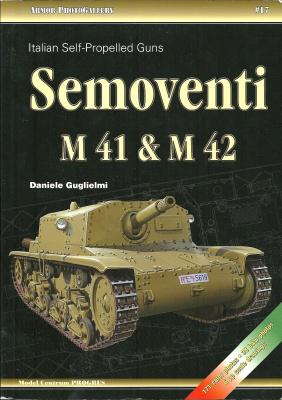
Italian armored equipment has never received the level of coverage than armored equipment from other countries has gotten. This book is part of recent efforts to correct that historical trend.

The book has 3 main sections: the walk-around of three preserved self-propelled units (two M 41 and one M 42), a section with line drawings, and a brief historical summary, with period photos.

The walk-around is clearly the most important part of the book. It covers three surviving Semoventi, the M 41 da 75/18 at Rome, the M 41 da 75/18 at La Spezia (this one is a full running Semoventi), and the M42 da 75/18 located in Rimini. The last one is in German markings and built to German specs, after the Italian surrender.

The pictures are in full color (for a total of 171 pictures among the three Semoventi), including interior pictures. They show every detail from the running gear to the weaponry, armor plates, external brackets, etc.
Review Author
J.R. Sharp
Published on
Company
Meng Model
Scale
1/35
MSRP
$89.99

Background

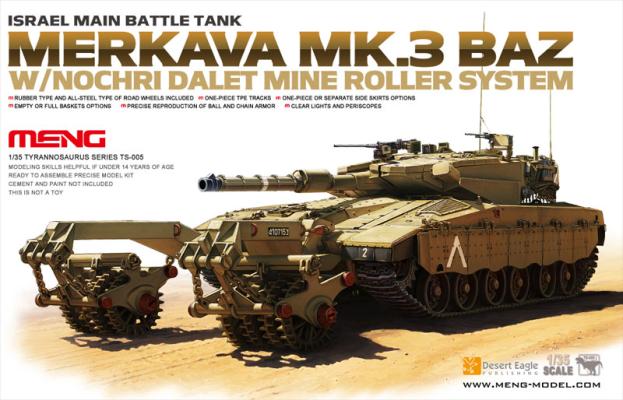
The Merkava Mark III was originally introduced into the IDF in December, 1989. Sporting upgrades to all major systems, the Merkava was the most modern main battle tank in the world for its time. The Mark III was given a 1,200 horsepower engine, a 120mm Israeli-designed main gun, and new laser designation and fire control systems. The development of the BAZ system in 1995 further increased this vehicle’s survivability and lethality. Some features of the BAZ system are air conditioning, NBC systems, and removable modular armor on the chassis and turret.

Review Author
Keith Gervasi
Published on
Company
Hasegawa
Scale
1/48
MSRP
$33.95

History

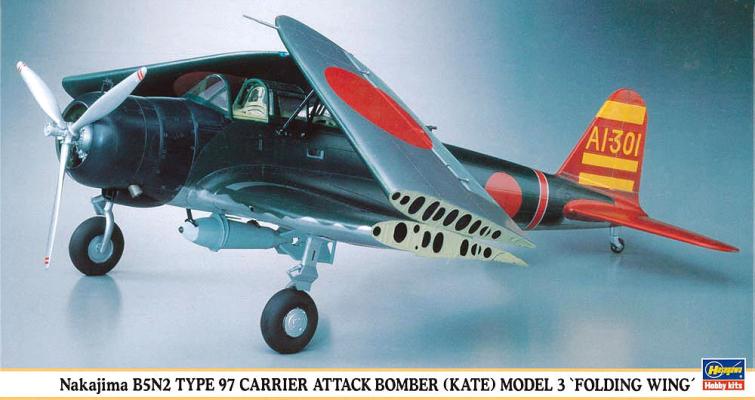
The B5N2 Kate entered service in 1939, replacing the B5N1. The B5N2 was given a more powerful engine and streamlined a bit to try and make it capable of outrunning enemy fighters. The B5N2 was replaced by the B6N Tenzan starting in 1943, but continued to serve right through to the end of the war.

The Kit

After opening the box, I was impressed by what I found – 8 sprues of medium grey and 1 sprue of clear injected plastic, 1 small (but very nice!) fret of photo etch, and, in the bag of PE, 4 white metal parts (for the folded wings). Also, for some reason, the cowling is on a sprue by itself and attached in a most peculiar manner. The plastic is flash free, the clear pieces are very nice, and the detail is above average on this kit. There are a few pin marks but nothing that is un-fixable.

Review Author
Keith Gervasi
Published on
Company
Hasegawa
Scale
1/72
MSRP
$64.98

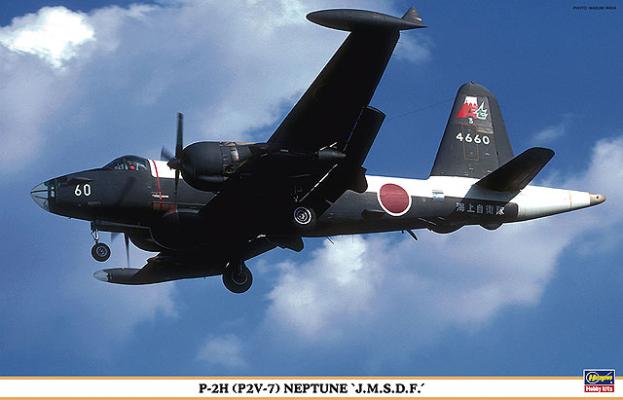
History

First flown in May of 1945, the P2V-7 was the final variant of the P2V produced by Lockheed. It was powered by R-3350-32W and J-34 engines and fitted with lower drag wingtip tanks, AN/APS-20 search radar in a revised radome, and a bulged cockpit canopy. 287 of this type were built, with 48 of them being assembled in Japan. First delivery of P2V-7s to the Japanese was in 1959, the last in 1965, and the model was retired in the early ‘80s. Kawasaki built 80 more Neptunes (P-2J), but with a few refinements that included using GE T-64 turboprops, Ishikawajima J-3 turbojets, a lengthened fuselage, increased rudder area, and a 10,000lb weight reduction. These were flown well into the 90s before being retired.

Review Author
Dave Koukol
Camden Koukol
Published on
Company
Polar Lights
MSRP
$20.99

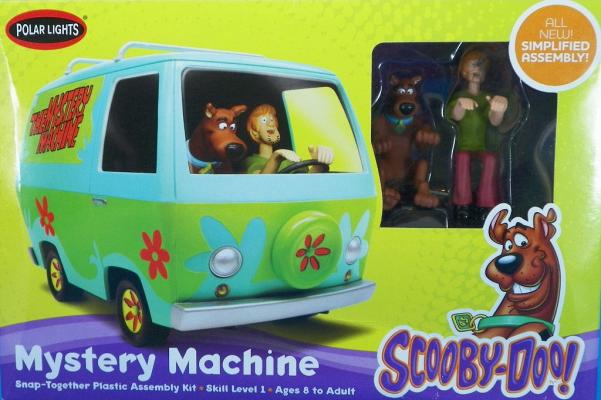
Once again, Round 2 Models’ Polar Lights brand brings modelers (young and old alike) another great classic TV subject – the Scooby-Doo Mystery Machine, complete with everyone’s favorite mystery-solving K-9 and his best friend.

Re-released and touting “All New! Simplified Assembly,” the Mystery Machine comes molded in black, turquoise, and clear plastic, and is accompanied by steel axles, a full-color sticker sheet, and pre-painted Scooby and Shaggy figures.

Assembled in under 30 minutes by 7-1/2 year-old Camden, the kit’s design is simple and fit is pretty good, although he did need an assist from large hands to snap in the clear windshield piece and a couple of drops of super glue to hold the wheels onto the axles.

Review Author
Chris Smith
Published on
Company
Cyber-Hobby
Scale
1/72
MSRP
$39.95

Introduction

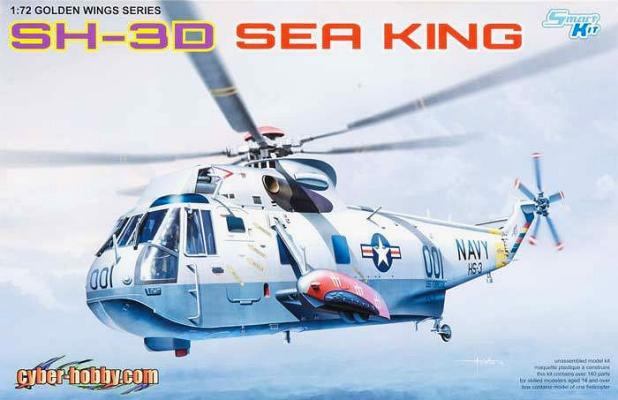
The Sikorsky Sea King first flew in 1959 and entered service in 1961. It served in many roles, including SAR, troop transport, and perhaps most memorably as the helos that recovered the Apollo missions after splashdown. These were not the missions the S-61 (company designation) was originally designed for. As the cold war developed after WWII, the US Navy was concerned about the expansion of the Soviet submarine fleet. They needed helicopters capable of pinpointing subs with a mobile sonar unit. This kit represents that version of this highly useful aircraft. Twin turbine engines gave the Sea King the ability to carry impressive payloads (including a sonar unit) over practical distances. Cyber-Hobby has graced us with no less than four versions of this great machine. Two are Westland-built versions used by the UK’s Royal Navy and Air Force. The other two, including this kit, are US Navy birds.

Review Author
Jim Pearsall
Published on
Company
Minicraft Model Kits
Scale
1/144
MSRP
$18.99

I’ve built several B-29s, one of them a Minicraft kit for an earlier review. That being said, I’m still waiting for the moment of inspiration to strike when I get out another B-29 kit and build the Tu-4 “Bull” which is almost identical to the B-29. Or a Washington, also a B-29 with RAF decals.

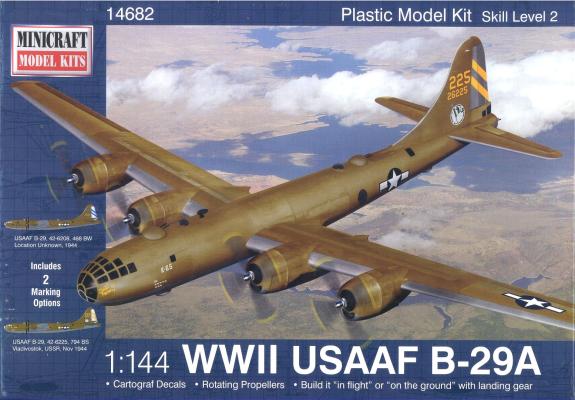
Minicraft has reissued this kit with very different markings. Little attention has been paid to the early B-29s, which were painted OD. I built this particular kit with the kit markings because it is different, and the markings are certainly visually and historically interesting. In fact, the location of the B-29 I built, Vladivostok, USSR, in November 1944, probably points to it being one of the prototypes for the Tu-4.

Review Author
Dick Montgomery
Published on
Company
Aviaeology
Scale
1/72
MSRP
$10.89

Introduction

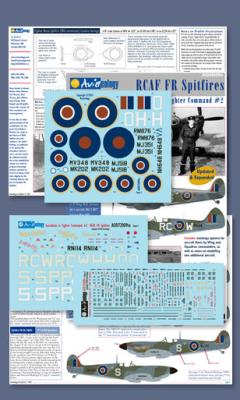
SkyGrid Studio / Aviaeology Publishing is located in Canada. The website is easy to navigate and intuitive, and products can be purchased through the website. Prices shown on the website are in Canadian dollars. SkyGrid Studio / Aviaeology accepts Pay Pal and a handful of credit cards. Aviaeology produces excellent decals, but SkyGrid Studio / Aviaeology Publishing does not limit its line of products to decals. Visit the website and you will note that there are some rather attractive book titles shown, as well as some prints.

The samples being reviewed arrived in a very sturdy cardboard container which protected the product nicely. There is more to the product that the customer receives than meets the eye. We will get to the bonus item in a minute, but first, let’s look at what is in the ziplock baggie that one receives.

The Decals

Please reference the image, labeled “aod72009mdisplaycontent” below to view these items.

Review Author
Marc K. Blackburn
Published on
Company
Meng Model
Scale
1/35
MSRP
$47.99

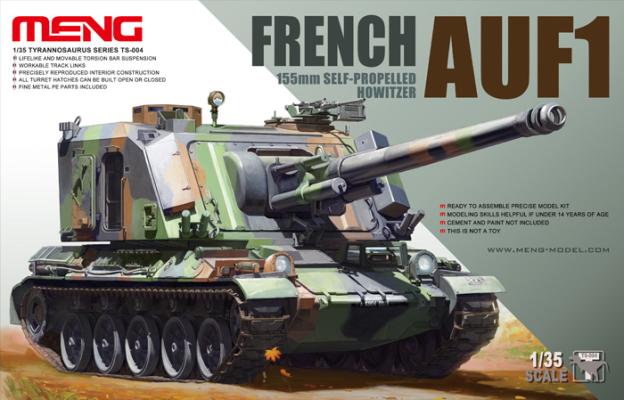
The recent release of the Meng AMX-30 B was quickly followed up by the AUF 1. It uses virtually the same hull as the AMX, so it’s an obvious follow-on to the AMX. In the 1970s, the French Army explored a new self-propelled howitzer to replace the MK F3 155 mm. Development of the AUF 1 was completed in 1972 and production began in 1977 with a run of 440 vehicles. Vehicles were also exported to Saudi Arabia and Iraq. It’s armed with a 155 mm gun with an auto loader and a crew of four.

The kit is composed of eleven sprues molded in green and five sprues of track links and pads molded in brown, a small sprue of clear parts, a small fret of photo etch, and a lower hull and turret. There are decals for two vehicles, though the color profiles only feature one.

Assembly

I wrote the review for the AMX 30, so the assembly of the chassis and tracks is nearly identical to the AMX 30.

Book Author(s)
Dana Bell
Review Author
Hub Plott
Published on
Company
Classic Warships Publishing
MSRP
$17.95

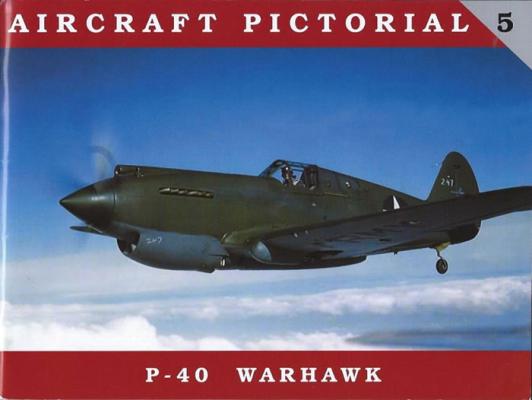
This book is number 5 in the Aircraft Pictorial series. The author is well known for his attention to detail and research methodology that brings rare photographs and little known details to light. This book does not disappoint.

This particular volume deals with the early P-40s used by the US, often referred to a “long nosed” due to the look of the nose with the elongated gear box on the Allison engine. The British Tomahawks are not covered but do make a cameo appearance, in a way. How, is due to the fact that the original P-40-CUs had a frequent ground loop problem; 50 sets of Tomahawk wings were diverted from British orders to repair damaged USAAC P-40-CUs, thus creating the P-40G, a hybrid with a P-40-CU fuselage and four-gun British Tomahawk wings.

Review Author
Anthony Tvaryanas
Published on
Company
Quickboost
Scale
1/72
MSRP
$3.30

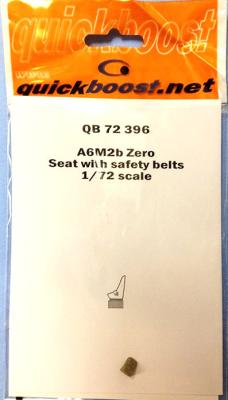
Quickboost now provides a seat with safety belts for the A6M2b Zero among their line of resin aircraft accessories. This is a tiny seat, but the details are excellent. The seat is molded in gray resin that is without flaws – no problems with seams or bubbles. The mold block attaches to the bottom of the seat, thereby making clean up easy, particularly as the attachment point will not be visible once the seat is installed in the cockpit. I removed the mold block with a jewelry saw and smoothed the surface with a few swipes of a sanding stick. Several of the lightening holes in the seat back had some flash, but that was easily cleaned with a sharp knife blade.

Review Author
Rob Benson
Published on
Company
Moebius Models
Scale
1/8
MSRP
$29.99

Thank you to the crew at Moebius Models – Frank Winspur, Dave Metzner and Bob Plant – for providing this review kit! The opportunity also wouldn’t be possible without the IPMS Review Corps staff, who graciously allowed me to give this one a try.

Review Author
Dave Steingass
Published on
Company
MiniArt
Scale
1/35
MSRP
$39.00

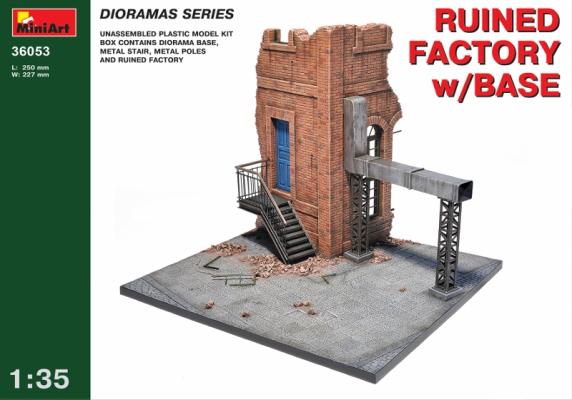
Once again, I’ve chosen MiniArt’s 1/35 diorama series for my conversion project. Like the other kits in this line, the walls and base are thin vacuformed styrene. The air ductwork is also vacuformed in halves, like the walls. This requires a lot of putty-work to clean up the gaps as usual, so I do not recommend this kit to beginner modelers. However, despite the extra modeling work required for these kits, the results can be very rewarding. I used half a tube of Squadron Green Putty on this kit, and the putty and sanding took longer on the ductwork than the walls.

Book Author(s)
Robert Forczyk
Review Author
Pablo Bauleo
Published on
Company
Osprey Publishing
MSRP
$18.95

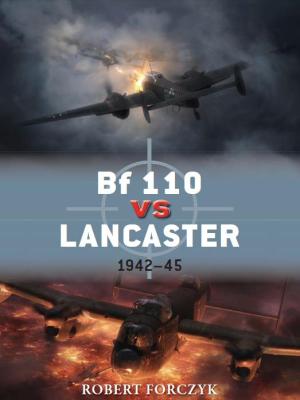
The Duel series from Osprey Publishing has been expanded to include a volume devoted to the aerial night fighting campaign between the Bf-110 and the Lancaster during WWII.

Most of the previous titles have been devoted to similar classes of airplanes, armor, or ships. However, this title is different in the sense that it’s a fighter versus a bomber (disparate classes of aircraft), and the weapons that changed the tide in their fight were usually technical developments in the field of electronic measures and countermeasures, not a higher rate of fire, better tactics, or improved performance.

Like all the other books in the series, this one has a section devoted to the evolution of airframes, the strategic situation, training, combat, etc. It is illustrated with plenty of period pictures, plus multiple color illustrations which would be welcomed by modelers looking for detailing their builds.

Book Author(s)
Marek Ryś
Review Author
Paul Markezich
Published on
Company
Mushroom Model Publications - MMP Books
MSRP
$45.95

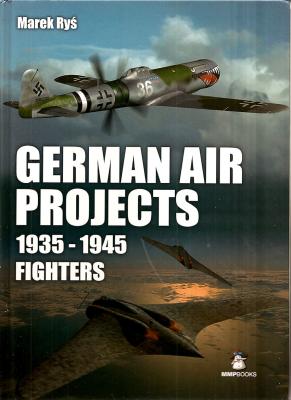
For years, I’ve been fascinated by what has come to be known as the 1946 Luftwaffe, or Luft ’46 – the seemingly inexhaustible blizzard of drafting-table designs the German aircraft industry produced before and during the Second World War for aircraft that were never built. The what-iffyness of these proposals that could have been flying against the Allies had the war continued for one more year has always deeply intrigued the science fiction fan in me. I first became aware of the phenomenon in 1967 when I bought Aireview’s German Military Aircraft in the Second World War, which included a series of line drawings of aircraft I’d never heard of before. As the decades passed, more and more information about these fanciful designs has come to light from declassified government files.

Review Author
Mark Aldrich
Published on
Company
Plusmodel
Scale
1/35
MSRP
$15.80

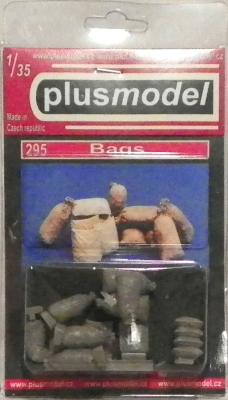
You simply can’t get any easier than this. You get 14 resin bags in different combinations almost ready to be used as you need. Seven of them appear to be large potato-filled bags, while the other seven might be sand bags. One piece is three of the potato filled sacks already stacked on each other. Three of the four single potato bags have the same pose and the other is different. Three of the sand bags are single and then there are four stacked on top of each other. All you have to do is cut off the pour lug and paint. Even the simplest of us modelers can do this! But Plusmodel may need to sharpen its quality control measures; in my sample set, one of the sacks had a ¼” wide by ¼”-deep air bubble that will require filling. Luckily, I have become pretty good at using baking soda and super glue as a filler.

Review Author
Mike Kellner
Published on
Company
Hasegawa
Scale
1/72
MSRP
$57.00

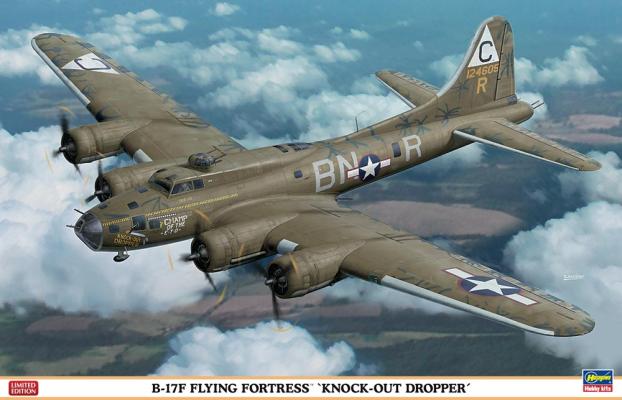
Designed in 1935, the B-17 became a force to reckon with by 1942 when the F model was introduced. It had a total production run of 3,405 – 2,300 by Boeing, 500 by Vega, and 605 by Douglas.

This release by Hasegawa features a new set of decals, but the same basic moldings which this kit had 35 years ago: overall good fit, lightly raised panel lines, light grey plastic, and some sink marks expected in an older kit. It has 98 parts and comes in a nice box with a sturdy cardstock bottom and a nice glossy top.

Review Author
Jim Pearsall
Published on
Company
Eduard
Scale
1/144
MSRP
$19.95

The Aircraft

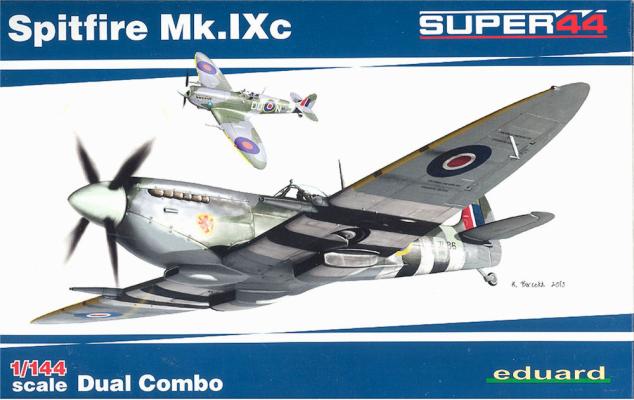
The Mark IX Spitfire was supposed to be an interim between the Mk V and the Mk VII and VIII. With the Fw-190 outclassing the Mk V to the point where the RAF couldn’t operate over France, something had to be done. The fix was to put the newer Merlin 60, 62 or later 66 or 70 engine in a Mk V airframe and call it a MK IX. This fix was so successful that the Mk IX and XVI (a IX with a Packard Merlin engine) were the most numerous of the Spitfire marks. I was also confused by the LF and HF (Low and High Altitude) for the Mk IX. It had to do with the engine installed, not whether it had a long or short wing.

Review Author
Mike Van Schoonhoven
Published on
Company
Model Art
MSRP
$11.00

The August issue starts off with "Model Art New Item Special Information". They cover a multitude of new kits that have just hit the market or are getting ready to. Some of the kits mentioned are the Tamiya 1/32 F4U-1, Wingnut Wings 1/32 AEG G.IV, Wolfpack 1/48 T-38A, Meng 1/35 T-90A, and Takoma 1/16 Renault FT.

The feature article focuses on IJA aircraft and different techniques that can be used to replicate realism in your models. This article consists of forty pages. A few of the techniques shown are replicating fabric covering, chipped paint, and oil leaks. Of note is one reference picture of wing tip lenses. There is some debate on whether the lenses are green or blue. This is a color photograph and the lens is blue.

Review Author
William Carrell
Published on
Company
Hasegawa
Scale
1/72
MSRP
$57.99

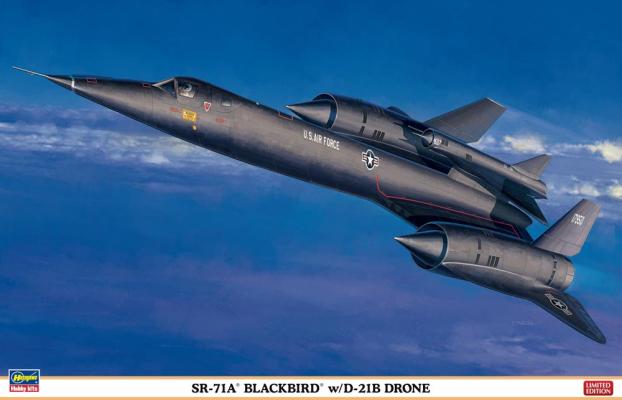
The SR-71 was the third and final version of what is still quite possibly one of the most famous and recognizable aircraft in the world. Its predecessors, the CIA’s intelligence-gathering A-12 and the Air Force’s interceptor YF-12, were responsible not only for the SR-71’s ultimate success but were also the launch beds for so many other aircraft designs and weapons systems. This success allowed the United States to be the leader in military systems for so long. There are a number of good publications available and a great amount of web-based data available via simple search requests.

I had always wanted to build a model of this epic aircraft and can now say I have. Having the luck to get a Hasegawa kit with the drone was just icing on the cake. When I opened the box, I removed the plastic wrap only to find this kit is much older than I would have expected, and is virtually all raised panel lines. All of that aside, it is still a subject I wanted to build.

Review Author
David P. Lennox
Published on
Company
Aires Hobby Models
Scale
1/48
MSRP
$37.99

The Model Kit

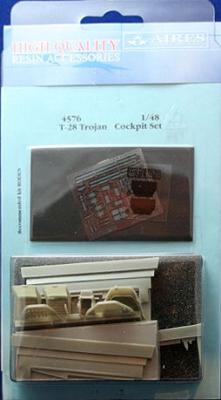
Roden’s T-28 has a very respectable cockpit included in their kit. Their biggest weakness is in the seats and instrument panels. The Roden cockpit is composed of 17 parts, where the Aires tops out at 45, which include the individual components for each seat belt. Aires has developed a complete replacement that not only addresses these weaknesses, but also improves the side consoles without a lot of scratchbuilding.

Review Author
Dick Montgomery
Published on
Company
Scale Aircraft Modelling
MSRP
$7.00

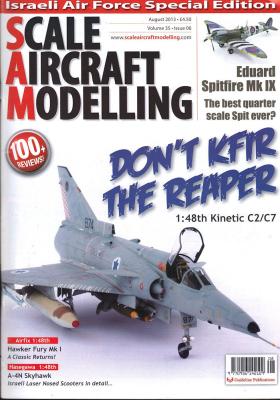
The August issue contains two Fature articles that will certainly attract the attention of “Jet” fans. In Feature 1, World Class modeler Yoav Efrati builds and reviews the Kinetic Kfir C2/C7 in 1/48th scale. The images attest to Yoav’s high level of skill as a painter and modeler, but the article itself is a goldmine for some weathering techniques. Yoav used Van Gogh Oils to weather the Kfir, and the effect is stunning.

The article is followed by a two-page spread of color images of the real deal – Kfirs in flight, on the ground, and with the usual detail shots of landing gear, pods, intakes, and some weathering provided by Mother Nature. Topping it off are two pages of profile drawings showing camo patterns, and with the colors involved being identified with FS numbers.

Review Author
David P. Lennox
Published on
Company
Roden
Scale
1/48
MSRP
$55.99

The Aircraft

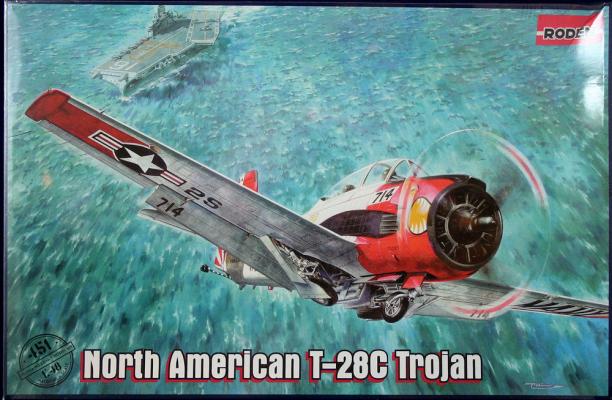
The T-28 Trojan was built by North American Aviation as a training replacement for the venerable and very dated T-6 Texan. The Navy wanted a tandem, tricycled training aircraft to train recruits to the new aircraft entering service. The contract was signed for VSN2S in 1946. The Army, also wanting to replace their T-6’s, contracted for their version of the VSN2S, the T-28 Trojan. In 1949, the newly formed United States Air Force and the Navy took delivery of the first T-28 Trainers.

Review Author
Greg Wise
Published on
Company
Hasegawa
Scale
1/48
MSRP
$45.00

History Brief

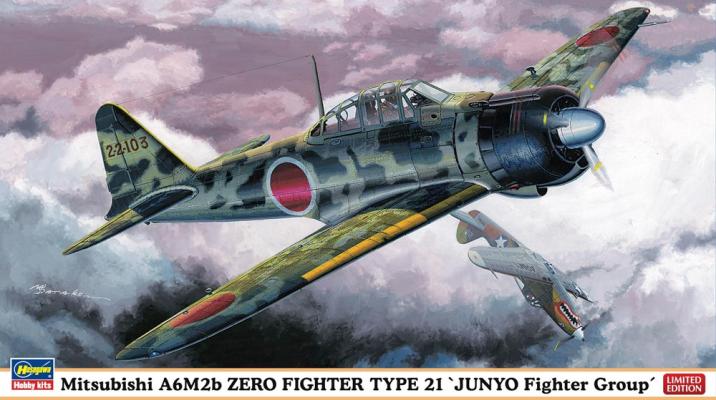
The IJN aircraft carrier Junyo was a mighty warship at the outset of WWII. Her fighter groups were made up of Zeros, and they outclassed all other opposing fighter types at that time. The Junyo, however, would suffer heavy damage in the Battle of Guadalcanal and would never again regain her prior reputation. The carrier would repeatedly suffer damage at the hands of the US Navy, thus keeping her out of service for long periods of repairs. Her air crews carried on the fight despite being depleted on more than one occasion. By war’s end, the Junyo was nothing more than a floating derelict with irreparable damage and her aircrews wiped out.

Review Author
Pablo Bauleo
Published on
Company
Hasegawa
Scale
1/48
MSRP
$64.99

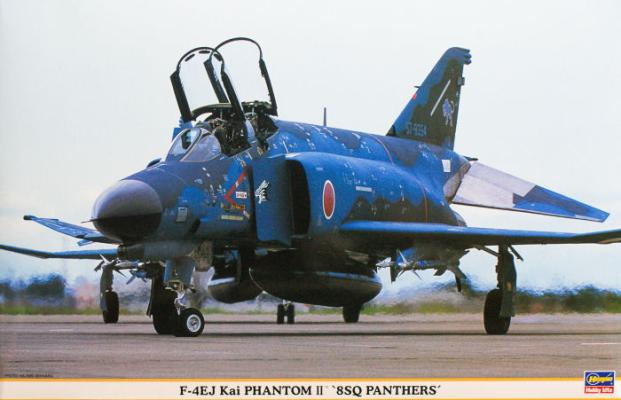
Hasegawa has re-released their “J” mark (Japanese) F-4EJ Phantom II. And that is a great thing, as this model is a pleasure to assemble. The box has 8 grey sprues, one clear sprue (for a total of 132 pieces), and a very large decal sheet with markings for five 8SQ aircrafts, including stencils for one airframe.

Regarding the stencils – they are the proper color. These airplanes were “hand-me downs” from other squadrons and they arrived in a two-gray interceptor camouflage. When transferred to a maritime strike squadron, their stencils were masked off and the aircraft were painted over, leaving a grey surrounding to the stencils –which are black. Only after the airplanes were sent for overhaul at the maintenance shop did they get re-painted and new stencils (in white) were applied. If you look carefully to the box image, you can see the grey surrounding area in the stencils.