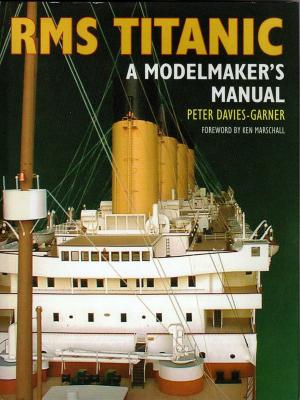
Philip Reed is an accomplished British master modeler of large-scale, museum-quality (or better) ship models. Although web searches and some book selling sites spell his first name with two Ls, his name is Philip with one L. Trained as an artist, and having a teaching career gives Philip the right background for this book. Philip started scratch-building WWI and WWII warships and switched to a long and successful career building sailing ship models. Philip Reed has at least three other books explaining how he builds wooden sailing ships. This book details his return to building WW2 steel warships from scratch – no kit used. Everything was made by hand from raw materials, with a sprinkling of generic photoetch brass. His latest book, Waterline Warships- An Illustrated Masterclass, is from Seaforth Publishing, a venerable British publishing house obviously devoted to nautical books.
Bottom Line: As good as it gets for some, but not all, boat davit types for World War 2 IJN destroyers. Wish I had these for all those IJN DDs I have already built.
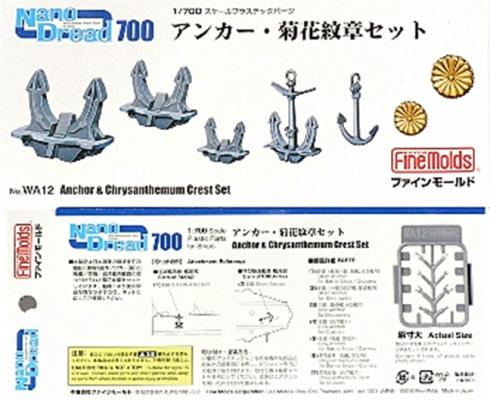
Fine Molds has been producing a line of very finely detailed and realistically close-to-scale aftermarket equipment sets for World War 2 Imperial Japanese navy warships with injection-molded plastic. These sets use advanced molding techniques to product very small parts with exceptional detail. Combined with historical accuracy and attention to detail makes Fine Molds Nano Dread sets ideal for upgrading WW2 ships. They have an advantage over photoetch metal sets by being three-dimensional, easier to handle, no folding or assembly required, rigid, stronger and just plain better-looking. Set WA11 is specifically for half of the boat davit types for WW2 IJN destroyer (DD) classes – the radial type.
Introduction
Hello IPMS members. Today I have the all-new tooling IJN heavy cruiser Tone as she appeared during the Battle of Leyte Gulf 1944. Fujimi has been burning the midnight oil and has released several newly tooled and retooled 1/700 scale WW2 Japanese ships for 2011
History Brief
After doing a little online research I discovered that there were two Japanese cruisers bearing the name Tone. The first (1907) a “protected cruiser” participated in the World War 1 Siege of Tsingtao, a German controlled port in China. The vessel was stricken in 1931and sunk as an aircraft target in1933.
Thanks once again to Stevens International for providing IPMS with yet another review kit. Without your support (and our purchasing the items) companies like Tamiya could not continue to provide us with new, interesting kits to build!
This volume of the Osprey New Vanguard series highlights perhaps the most enduring class of fighting ships of the 20th century. Considering that transformation in warships during the last 70 years, the longevity of the Iowa class battleships is noteworthy and a testament to their design and construction.
The book is basically divided in to two sections. The first deals with design and construction of the four units of the class (U.S.S Iowa, U.S.S. New Jersey, U.S.S Wisconsin and U.S.S. Missouri) with particular emphasis on how design parameters of previous battleships (of both U.S and foreign navies) as defined by the Washington Naval Treaty influenced the development of the Iowas. These considerations had a direct bearing on such things as armament, protection and speed. The author also goes into some detail describing the brains of these heavyweights – the fire control systems. The use of radar as well as aircraft for gunfire spotting is also detailed here.
In this new offering from Osprey Publishing, author Brad Elward (and Illustrator Paul Wright) introduce the reader to the fascinating world of the Nimitz-class aircraft carriers of the United States Navy. Having served aboard the USS Dwight D. Eisenhower (CVN-69) and USS Abraham Lincoln (CVN-72), I quickly volunteered for this review when the book came out in a review list. As I possess a fair amount of knowledge on this subject myself, I am always looking to learn more about these magnificent ships, their history, and where the Navy plans to go in the future.
Editors note: The reviewer has included Cyber-Hobby Models Photo-etched Railing Upgrade Set for “Scharnhorst” Kit Number CHC-3880 ($19.95) with this review.
The Dragon 1/350 scale model of the German Battleship Scharnhorst is one impressive kit, not only in the size of the model itself but the enormous number of parts. The large box was stuffed full with 28 individually bag sprues, 5 photo-etched frets, an upper hull, a lower hull, a plastic base, a decal sheet, and an instruction sheet. If that was not enough, there wis also a supplemental photo-etched set of railings and other miscellaneous items provided by Dragon that was used as part of this build.
Introduction
In 1941, the IJN battleship Nagato(already 21 years old and 5 years after her last major re-fit) was the flagship of the Combined Japanese Fleet, flying the flag of Admiral Yamamoto. On 2 December 1941, Nagato transmitted "Niitakayama nobore 1208" to the fleet, which translated into "Climb Mount Niitaka on 12/08" (12/07 Hawaii time).
In mid-2010, Fujimi released a 1/500 scale rendition of Nagato, as she appeared in 1941, at the 'Outbreak of War'.
First, many thanks to Fujimi for providing this kit for review. This kit is well thought-out, engineered and designed and features excellent detail and fit for a 1/500 scale kit.
In the Box
Inside the box are 21 sprues of gray, black and clear individually bagged parts, a 9 1/4" x 14 3/8" instruction booklet, decals, a metallic nameplate label, a length of anchor chain and a 1:1 size, 5-view color chart for reference.
Please read the in box review (published earlier) for the history and a parts break down of this interesting kit.
The kit goes together without any problems. I followed the construction sequence as recommended with the following exceptions. I left the clear glazing (windows) off until final assembly. This made painting the bridge and deck house area a lot easier and I also left the life rings off until final detail due to them being an orange color and hard to paint with them installed.
I decided to do the MAS 563 version because of the colorful paint scheme. I followed the recommended painting instructions and guide. Model Masters paint was used almost exclusively. Light Ghost was used for the majority of the hull and fittings and Gunship grey for the deck. I painted the aerial recognition stripes on the bow before adding any deck detail.
Thank you to Amberley Publishing and the hardworking duo of John Noack and Dave Morrisette for providing this book to enjoy and review!
Martin Bowman has earned an excellent reputation as an aviation historian. Combat Carriers continues this legacy with a wonderful series of chapters detailing important events related to carrier aviation since the start of World War II.
The table of contents is paraphrased below: