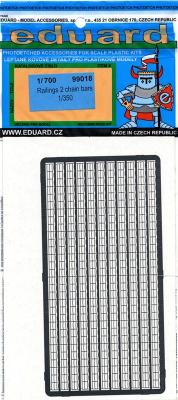
Adding to its expanding line of ship detail sets, Eduard has released photoetch ship railings in the popular ship modeling scales. This unpainted stainless steel set represents drooping chain railings founds on the main decks on most all types of vessels (metal bar railings tend to be found more often on the upper superstructure deck levels). This is generic railing, not geared to any specific navy or class of ship.
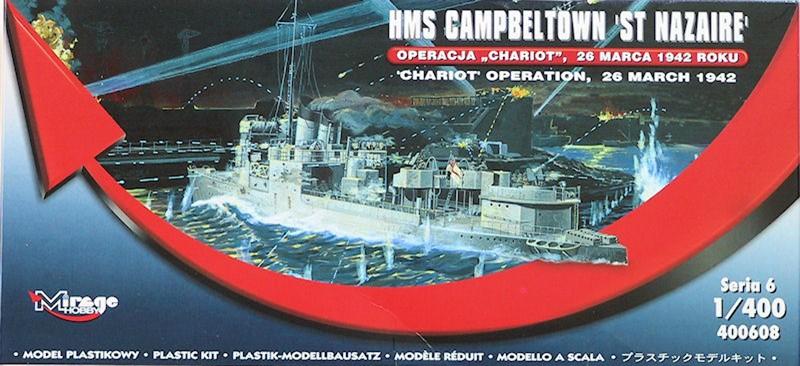
HMS Campbeltown was originally the Wickes-class destroyer USS Buchanan, DD-131. She was commissioned in 1919 and transferred to the UK as part of the “Destroyers for Bases” deal between the US and Britain in 1940. In exchange for 50 aging “four-piper” destroyers like the Buchanan/Campbeltown (obsolete for fleet duties, but still useful as convoy escorts) for the Royal and Royal Canadian navies, the US got basing rights in the Caribbean and Newfoundland.
HMS Campbeltown is one of the most well-known of the traded ships, as she was famously expended as a floating bomb in the “Operation Chariot” raid by British commandos on the St. Nazaire docks in March of 1942. The purpose of the raid – and it succeeded – was to deny the use of the St. Nazaire dry dock to heavy German units such as the battleship Tirpitz.
My thanks to Roger Wallsgrove, Editor-in-Chief of Mushroom Model Publications, who provided this review sample. I have had the pleasure of meeting him and his team at Nationals.
ModelArt Spring 2011 No. 39 is entirely devoted to US Light and Escort Carriers in WW2. Armor, aircraft and car buffs will only have a few small ads to peruse, with one exception. Aircraft modelers will love the section on aircraft markings for individual carriers. No. 39 turns out to be an excellent reference work on US Navy WW2 smaller carriers, but as usual the text is entirely in Japanese. However, the historical data section is still useful, and the usual scrutiny of recently available kit builds are very helpful for modelers. This format is larger than regular monthly ModelArt magazines, and the printing quality is of high standards. The book measures 210 X 296 mm (that’s 8-1/4 by 11-3/4 inches). The majority of the article photos are in color. My chief complaint with their layout is that many larger photographs of ship models cross pages, resulting in a dead zone where the spine is – it really breaks up otherwise spectacular photos.
Bottom Line: New molding for 1/700 scale IJN Nagato as she appeared at the beginning of WW2 (1941). Excellent detail, excellent fit, accurate appearance.
IJN Nagato
For any modeler, but especially ship modelers, it is hard to achieve a realistic effect when gun barrels are out of round, warped or fail to have the right taper and shape; which is often the case with styrene injected or resin barrels. With smaller caliber guns and in smaller scales the barrels are often too fragile to handle. For these reasons turned metal barrels are an attractive alternative. Master Models continues to release well-priced brass barrels for the discriminating ship modeler.
Without a doubt, Dragon’s Smartkit of the Scharnhorst is a real gem with a superb level of detail thanks to its CAD designer. The gun mounts are very detailed and the molded barrels, with the slide mold technology, are quite nice in this scale, including bored muzzles. Dragon has packed the kit with a significant amount of aftermarket detail including injection molded blast bags; a nice touch given how difficult they are to make from scratch.
For any modeler, but especially ship modelers, it is hard to achieve a realistic effect when gun barrels are out of round, warped or fail to have the right taper and shape; which is often the case with styrene injected or resin barrels. With smaller caliber guns and in smaller scales the barrels are often too fragile to handle. For these reasons turned metal barrels are an attractive alternative. Master Models continues to release well-priced brass barrels for the discriminating ship modeler.
After producing several 1/400th U-boats, Mirage is now offering U-boats in the increasingly popular 1/350th scale. The U-511 was a Kriegsmarine long-range IX-C type submarine. The Turm-I variant included trial installation of a six tube Wurfkörper 42 artillery rocket launcher rack and improved 37mm and 20mm anti-aircraft armament. The kit features a 2-piece full hull, detailed exterior surfaces, conning tower with 2 periscopes and wintergarten, 10.5cm deck gun, display base, photo-etch parts (railings for all deck levels, anchor, cable cutter, WGr42 launcher base, ladders, screw blades and nameplate), and decals (U-511 bow placards and ensign). The completed model is approximately 8.6" long.
While the aircraft carriers of Imperial Japan may have captured the glory of the navy’s early victories in the Pacific, by and large it was her cruisers that did the slugging, round after round, with the U.S. and Allied navies during the initial stages of the war. This latest New Vanguard edition by Osprey Publishing chronicles the development and use of Japan’s heavy cruiser force. All 18 of the heavy cruisers (designated “Class A cruisers” in the IJN) that fought in the Pacific War were completed before the outbreak of the war. No Japanese heavy cruisers were built during the war.