Reviews of products for scale ship models, including submarines.

Review Author
Bill O'Malley
Published on
Company
Veteran Models
Scale
1/200
MSRP
$34.94

Background

(from The Battleship Bismarck, By Stefan Draminski

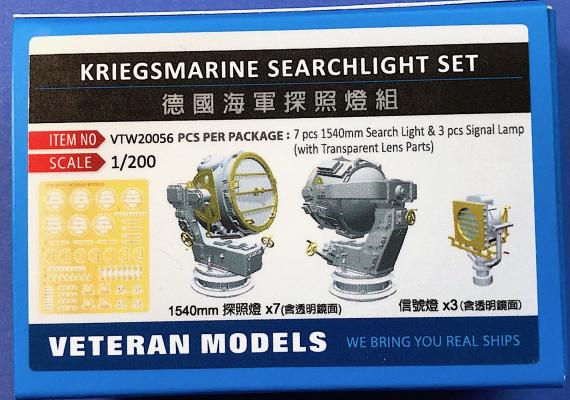
German battleships and heavy cruisers were equipped with seven searchlights for illumination at night or in poor visibility conditions. They were produced by Siemens-Schuckertwerke and had a diameter of 1500 mm. Three signal lamps were also provided: one on either side of the admiral’s bridge, and one on a platform at the base of the mainmast.

Veteran Models Searchlight Set provides seven 1540 mm searchlights and three signal lamps, both with transparent plastic lenses. The kit includes extremely finely cast resin parts with amazing detail, and a small photoetch fret, also with amazing detail. The resin pieces are exquisitely cast with virtually no imperfections. There is some minor flash on the parts, but no bubbles or voids. Some of the resin and photoetch pieces are extremely small and delicate.

Review Author
Charles Landrum
Published on
Company
Master Model
Scale
1/350
MSRP
$18.99

I would like to thank Master Model for this review sample.

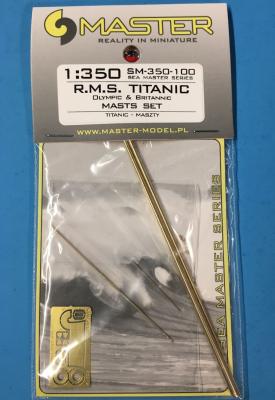
Master Model continues to “turn” out metal details for the ship modeler and this one is indispensable. For anyone who has tried to work with tall thin masts made of plastic in small scale, the mast either end up being too thick so they don’t bend or too flexible if they are to scale. The solution is either wood or metal for thin masts that don’t bend, but the trick is achieving the required taper with this material. If you are not a machinist, skilled at turning wood or brass, Master Model comes to the rescue.

I was surprised to find when I opened the package that the rather long masts were put into a bag too small to hold them. This was noticeable when I removed the display card. The result was that the taller main mast was bent 90 degrees and the bag itself was not sealed. I was able to gently bend the mast straight using smooth jawed pliers. I hope this was a packaging anomaly.

Book Author(s)
Ryan K. Noppen
Review Author
Bill Kluge
Published on
Company
Osprey Publishing
MSRP
$19.00

Despite having produced the world’s first ocean-going ironclad warship in 1859, the Glorie, the French Navy (Marine Nationale Francaise) entered the twentieth century unsure of its direction and at the mercy of confusing political demands. It was left with a hodgepodge of capital ships at the end of the nineteenth century few in number and facing obsolescence. It took the emergence of Germany’s Imperial Navy, the Mediterranean threat from Italy and Austria-Hungary, as well as its traditional rivalry with Britain’s Royal Navy to shake the French Navy and the Marine Ministry from their stupor and confusion, and institute a program leading to the development of modern battleships.

Divided primarily into four sections, this edition of Osprey’s New Vanguard naval series describes:

Review Author
Bill O'Malley
Published on
Company
Veteran Models
Scale
1/200
MSRP
$34.95

Background

German battleships and heavy cruisers were equipped with three armored fire-control posts (in the conning tower, on the foretop, and on top of the aft superstructure. Target selectors around the foretop selected air targets. Each of the selectors, called ZAGs, worked in conjunction with one of the Directors for targeting. Veteran Models Fire Control Set provides 4 - ZAG Light Flak Directors, 4 - Zielsäule C/38 S Night Directors, plus 8 - 1540mm Search Light Directors.

The resin pieces are exquisitely cast with extremely fine detail, and virtually no imperfections. There is some very minor flash on the parts, but no bubbles or voids. The eyepieces even have recessed ends! The small photoetch fret provides hand wheels for the Light Controllers and Night Directors, and there are several spares for the extremely small pieces.

Review Author
Bill O'Malley
Published on
Company
Veteran Models
Scale
1/200
MSRP
$34.98

Background

For directing the 38cm and 15cm guns, Bismarck was equipped with three armored fire control posts (in the conning tower, on the foretop, and on top of the aft superstructure. The main and aft control posts were equipped with 10.5m rangefinders, while the front control post received a 7m rangefinder. Each station was also equipped with optical target givers (Zielgeber C/38 S), two pieces in the aft post and three each in the fore and main posts. Binocular columns were also probably placed in the fire control posts. Veteran Models provides a diagram of the Bismarck showing possible locations for the equipment. The Battleship Bismarck By Stefan Draminski

Review Author
Dave Morrissette
Published on
Company
Italeri
Scale
1/720
MSRP
$26.99

I wanted to build one of the new USN Super Carriers and since I wanted a water line model, I added Coastal Kits 1/700 water base that was reviewed previously.

I broke the build into separate parts- hull, air wing, flight deck Italeri has released several versions of the US nuclear carriers in 1/720 scale and this latest rebox release represents CVN-70, the USS Carl Vinson which is notably as the carrier to dispose of Bin Laden’s body along with supporting the current war on terror. I am big fan of the carrier too as most know as my son was stationed on her for five years.

Book Author(s)
Mark Stille
Review Author
Tim Wilding
Published on
Company
Osprey Publishing
MSRP
$20.00

This book is number 90 in Osprey’s Duel series where they take two opposing forces and compare/contrast them. The two subjects are the Imperial Japanese Navy’s submarines verses the US Navy’s destroyers. The book explains the develop of both these forces before the attack on Pearl Harbor, then goes into greater detail of the next 13 months of fighting until the end of 1942.

The book starts with a four-page introduction detailing Japanese developing submarine tactics of using their force to attack US Navy capital ships in a war of attrition leading up to a decisive grand battle between the fleets. They developed large, fleet submarines that were over 300 feet long and had airplane hangers on them. Whereas, the US Navy’s destroyer force was not training is anti-submarine warfare, but rather using their destroyers surface warfare fighters. These two beginning war strategies did not serve either side well the first year of combat.

Book Author(s)
Witold Koszela
Review Author
Luke R. Bucci, PhD
Published on
Company
Kagero Publishing
MSRP
$24.95

Thanks to Casemate Publishing and IPMSUSA for the review copy!

The Moskvawas specifically designed to be a US Polaris submarine hunter/killer in the Arctic Ocean, along with her* sister ship Leningradin 1962, and operational in 1967. Their primary weapon was helicopter-launched torpedoes and depth charges assisted with sonobuoys, although the ships themselves carried missiles and torpedoes. Their reason for being evaporated when the US switched to longer range Poseidon ICBMs, meaning the boomers did not need to be in the Arctic Sea anymore. Since survival of the Moskvain open waters was problematic, as was finding boomers in time before launches, these two ships were transferred to the Black Sea fleet. Moskvaspent her remaining time shuttling to and from the Atlantic, Mediterranean and Black Seas until being withdrawn from service in 1996 and sent to India for scrapping in 1998.

Book Author(s)
Mark Lardas
Review Author
Luke R. Bucci, PhD
Published on
Company
Osprey Publishing
MSRP
$24.00

Thanks to Osprey Publishing for the review copy and IPMSUSA staff for delivering the book and publishing the review.

Mark Lardas is a real “rocket scientist” who has worked on Space Shuttle analytics and navigation. He is also an accomplished author with at least twelve books on naval topics, and a model maker as well. See his website for more details (www.marklardas.com). He has the gift of dissecting complex subjects (military campaigns) and finding the key fulcrums of change that led to the historical outcomes. He takes a fresh approach to re-analyze with additional information, with an objective, less-jaundiced eye for what really happened. The result is refreshing, especially for something like Tsushima 1905, something naval buffs think they know a lot about.

Review Author
Luke R. Bucci, PhD
Published on
Company
Master Model
Scale
1/700
MSRP
$6.00

Bottom Line: Brass barrels in 1/700 scale for all WW2 Imperial Japanese Navy (IJN) warships mounting 14cm (5.5in)/50cal guns, for mountings without (-058) or with (-059) blast bags.

What You Get

A 2 ¾ by 5 1/8 inch 2-piece cardboard card wrapped in clear plastic containing a small Ziploc bag with Instructions and another card with a small plastic bag holding 20 barrels taped to the card (Figure 1). For no blast bag mounts (-058), each barrel is 7mm long with a 1mm tab at the end. For mounts with blast bags, each barrel is 4.5mm long with a 1mm tab at the end (Figure 2). The tip has a fine hole that is difficult to see, but it’s there.