The Panzerspahwagen Sd. Kfz. 232 was one of many various types of vehicles with eight-wheel drive and eight-wheel steering used by armored reconnaissance units of the Wehrmacht and Waffen-SS. These armored vehicles were used in many campaigns in Africa and Europe during World War 2. The Sd. Kfz. 232 was noted for its medium range wireless set and frame antenna. This type of antenna was used until 1942 when it was replaced by a single pole antenna. Sd. Kfz. 232s were usually armed with a 2cm KwK 30 L/55 auto cannon capable of firing at a rate of 280 rounds a minute and a 7.92mm machine gun, both mounted in a single turret. A crew of four was typical. The commander and gunner sat in the turret, the driver sat at the front, and a secondary driver was emplaced in the rear of the hull. Powered by a 155 hp 8-cyl gasoline engine with a range of 186 miles and a top speed of 53 mph, it is easy to see why it was one of Rommel’s best long-range recon vehicles.
Short History
Soviet Airborne Forces used the ASU-85 in airborne operations during the Cold War Era. Its primary role was light infantry support or assault, with limited anti-tank capability. The ASU-85 replaced the open-topped ASU-57 in service. It weighs approximately 13,780kg or 13.78 tons and has a very low silhouette of just 2,1 meters. It is powered by one V-6 six-in-line water-cooled diesel engine with 240hp. It was designed on the PT-76 tank chassis, but lost its amphibious capabilities. Armament consists of an SD-44 85mm gun carrying 40 rounds (4 rounds per minute) and one 7.62mm PKT co-axial machinegun. Effective range is around 260km (162 miles), and armor protection is up to 40mm. The vehicle was NBC-sealed and equipped with IR-sights for night fighting.
The Flakpanzer IV “Wirbelwind” (German for whirlwind) was a self-propelled quad 2.0 cm anti-aircraft gun based on the Pz IV. It was developed in 1944 as a replacement for the Mobelwagen. The Wirbelwind was replaced by the Ostwind with a single 3.7cm FlaK 43. The number of units produced ranged from upper 80’s to approximately 105.
This is a multimedia kit comprised of 500+ styrene parts, magic tracks, one braided metal wire (which is very stiff even after annealing), one photo etched fret, decals and the set of instructions that need to be reviewed very carefully before gluing any parts together.
Most Dragon models today are a collection of old sprues and new sprues added to create a new kit variant. In this case, Dragon has done so and you will have some sprues with the same letter. Even though Dragon has not advertised this is a 2-in-1 kit, you have many options that need to be reviewed and decided on before you start this kit.
The Panzerkampfwagen II, or Pzkfw. II for short, was a light tank produced as a stop gap measure by the German armaments industry for the German Armed Forces prior to and during the early stages of WW2. What the German High Command really wanted was the more powerfully armed Panzer III and Panzer IV tanks, but German industry found producing the more complex heavier tanks in any meaningful numbers beyond their capacity, at least initially. That said the Pzkfw. II series of light tanks went on to serve with distinction during the initial phases of the War, especially in the Polish and French Campaigns of 1939 and 1940, with nearly 1,900 vehicles of all marks eventually seeing production.
The LVT-(A) 1 was part of a series of US Marine Corps. and Navy amphibious assault vehicles developed during WW2. The idea for the military vehicles came from an original, civilian design by Donald Roebling, who designed his Alligator as a rescue vehicle for use in areas inaccessible to standard cars or trucks, such as swampland. LVT stood for Landing Vehicle, Tracked, and the main contractor during WW2 was FMC: Farm Machinery Corp. As well as the standard open topped tracked landing craft designed to bring troops and cargo ashore, there were also vehicles such as the LVT-(A) 1 which came completely enclosed, and armed with turrets. The LVT-(A) 1 (“A” for Armor) had the turret and gun of the M3 Stuart light tank, and the vehicle was also powered by an M3 Stuart engine. Just over 500 (A) 1’s were produced during the War, with a total of just over 18,000 LVT’s of all varieties eventually rolling off the assembly lines.
Since 2003, when MiniArt released their first kit, they have become quite a diverse company with kits ranging from figures to tanks, with most of their emphasis on designing kits, to enhance or stand alone, for dioramas.
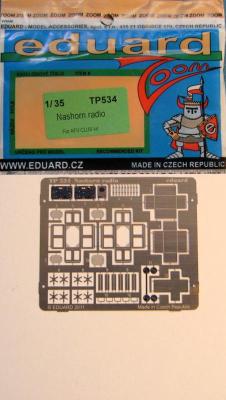
Eduard has put together a bunch of German Radios in 1/35 scale which are very detailed, right down to the tiniest handles and each radio can be made to sit alone as is or have straps supplied to each unit so that it can be attached to a figure to make the figure appear to be actually carrying the radio. Small headphones which attach to each radio by a wire (which you will have to supply) add even more realism. Eduard has painted them in such a way as to depict them as being “well handled”. The detail is so precise and clear which meets their usual standards. There are nine radios all together (some are doubles) and each one is better than the next. Everything is included to make different variations on each one, so the variations are limitless.
Short History
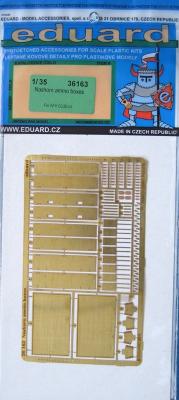
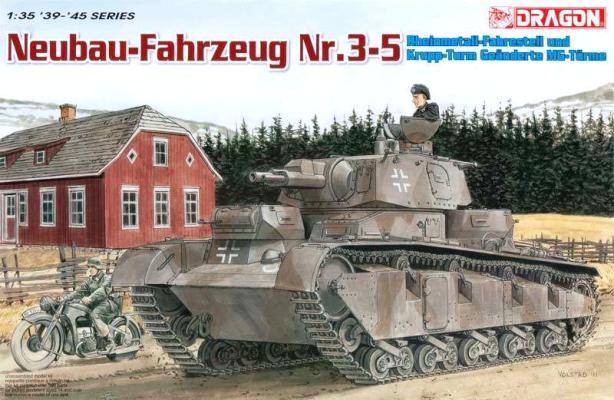
In the interwar years the Germans experimented with large, multi-turreted Medium tanks. The Neubau-Fahrzeug is the result of those experiments. Beginning in 1934, Rheinmetall-Borsig produced five vehicles, two prototypes and three ‘production’ vehicles. The prototypes were used for training and the production models eventually took part in the Norwegian campaign where one was destroyed.
What’s in the box
My oh My!!! By definition that men are visual creatures……I am men!!! I LOVE getting reference books that are FULL of pictures of vehicles. Save the reading and writing for another form of model builder. Give me a picture, obscure or basic, and I am a very happy camper. Squadron’s new series of walk arounds have not been a disappointment. They contain numerous pictures of preserved and restored vehicles. Some contain a few line drawings and color plates while come have a minimum of in actions shots as well. How can you go wrong with that? You can’t.
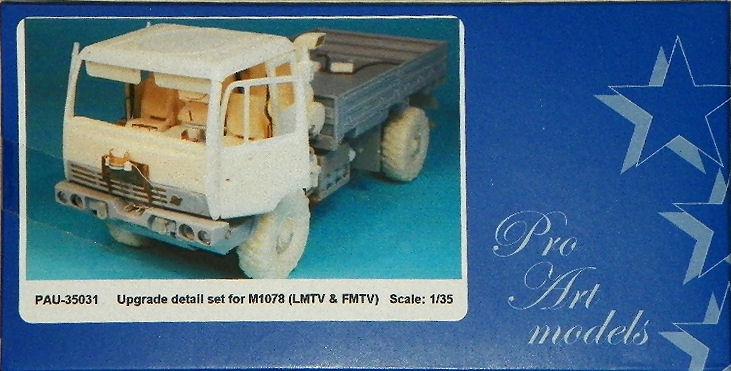
With Trumpeter’s release of their M-1078 Light Medium Tactical vehicle (LMTV), it was only a matter of time before the after-market companies stepped up. There are at least one full PE set, two different resin interiors/exterior sets and four different tire sets. This is understandable as many modelers (for one reason or another) do not appreciate or like the rubber/vinyl tire option. The Trumpeter tires look fine to me. However, if you have to have resin, this is a way to go! The only difference between these two sets is the number of tires included. One set (35030) contains five tires, two front, two rear and a spare and the other set (35037) contains two front, four rear and a spare. Set 35037 is being sold for the Trumpeter M-1083 that was announced but has not yet been released. For the difference in cost, I would suggest getting the seven wheel set. That way, regardless of which one you build, you will have all the tires you need or some extras.