The Bf-110 went though not only technical changes throughout its career, but also through a development of its operational use. It entered the war as a heavy escort and attack fighter. By the time of the Battle of Britain, it became apparent that the aircraft, in the role of escort fighter, had been pushing the envelope of its capabilities. On the contrary, as a defensive weapon against British bombers, the Bf-110 made an extremely good showing of itself and remained a deadly foe through the end of the war. The placement of RAF bombing operations within nighttime hours from 1941 brought the Bf-110 into the realm of night fighting on the Western Front. On the Eastern Front, they excelled as fast fighter bombers.
After 28 years of publishing, Ray Rimell’s Windsock Worldwide should be a familiar periodical reference to any serious WWI model aircraft builder. It’s fair to say that any such builder who is not familiar with the publication has been missing a lot and has been pursuing the subject at a great disadvantage when compared to those who look forward to the mailing of each new issue. Windsock Worldwide is, without a doubt, THE reference on the subject.
The September/October 2012 issue continues to deliver what can be best described as the bread and butter of WWI model aircraft news and information. This issue follows the now-familiar format…regular columns presented in order, with the center of the issue devoted to one or more featured subjects. This issue will be of great interest to any model builder who has purchased recent Wingnut Wings’ Fokker Eindecker or DH2 kits, because they comprise the featured subjects.
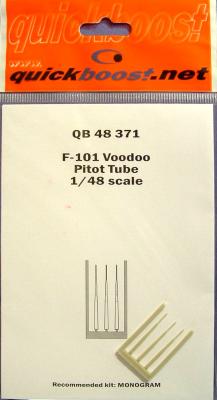
Prominent on the nose of the F-101 Voodoo is a large pitot tube, which in 1/48 scale extends 1 1/16 inches (27mm). From a modeling perspective, such a large pitot presents several challenges. First, you hope that the part is not bent, broken, or molded out of round. Surviving that, you then need to remove the mold lines and ensure that the cross-section is round. Lastly, such a large pitot tube becomes a transportation liability during model shows and displays. This Quickboost product provides a safety net to the modeler who has had difficulty with any of these issues with the Monogram/Revell Voodoo kit.
The Mi-24V Hind E is the prime Russian attack helicopter. This variant entered production in 1976 and has become known worldwide for its effectiveness. Variants remain in operation in many countries around the world and, I believe, some variants are still in production. The Russian scale plastic model company, Zvezda, offers an excellent kit of the Mi-24V, as well as the earlier Mi-24A and the later Mi-35. One notable feature of the aircraft and the kits is a variety of exterior antennas. This offering from Quickboost provides a number of these antennas, finely molded in resin and much more petite than is possible with injection molded plastic.
Everyone knows the F-14D Tomcat and its swing wing design – Top Gun locked that down to the general public. Before the F-14 was built, Grumman produced the XF10F Jaguar, which was the world’s first swing wing fighter. Never heard of it? Me, either, until Planet Models produced a resin kit of it. One reason it never became famous is that only one was ever produced (although a second was started) and, like many early jets, it suffered from being…well, underpowered. Add that to the weird cantilever tail and the other problems, and the plane ended up being a test bed for swing wings, and I can say that lots of good information was learned and ended up in the F-111 and F-14. If you want to see one today, you can’t. Both of them were destroyed, so we have a model left to bring us that part of history.
Roden continues its 1/48th scale family of T-28 Trojans with a “D” model. The kit comes with three sets of markings for an Air Force Training Squadron from Eglin, a CIA plane based in the Congo (both of which are light gray in color), and a Special Operation marking in SEA camouflage based in Thailand in 1960. The kit parts are found on light gray sprues with good panel lines, and there are a clear sprue, decals, and an instruction sheet.
The word Vulcan conjures different images for different people. If you are into Roman mythology, you think of the God of Fire. If you like the show Star Trek, Vulcan is that red planet Spock calls home. But if you are in the US military or build models of those vehicles, Vulcan is the 20mm Gatling gun that is so deadly on the battlefield.
First used in 1959, the M61 has adorned most of the US aircraft from the F-104 to today’s F-22. Its 6,000 rounds per minute can chew up enemy targets, and it has also been used by the Navy in the Phalanx CIWS system and the Army as the M163 Anti Aircraft weapon.
Aircraft History
Airfix has presented us with a newly-tooled 1/72 P-51D Mustang. Nearly everyone will be familiar with the venerable P-51 Mustang, the long-range WWII fighter that finally allowed US bombers to be escorted deep into the heart of Germany. Over 8000 of the “D” model variant were produced. Armed with 2 additional .50 caliber machine guns (for 6 total) and a bubbletop canopy for enhanced visibility, it represents the ultimate wartime expression of the Mustang.
Kit Contents
Inside the box you’ll find 53 parts across three sprues, two in Airfix’s familiar blue-gray and one in clear, along with decals and instructions. The instructions are generally very clearly illustrated. However, the painting callouts are made using Humbrol-specific numbers only, and there is no key provided for matching color names to the numbers. I found this need of looking up a cross-reference for the paint colors to be perhaps the most frustrating part of the build.
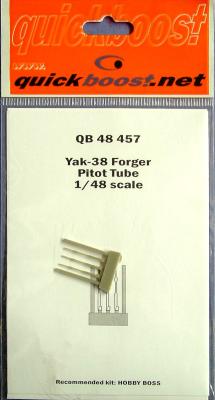
As with most Soviet-designed aircraft, the Yak-38 Forger has a nose pitot tube. While not as prominent as the pitot tubes on the MiG and Sukhoi bureau aircraft, the pitot is still visibly right in front and on top of the nose. As with previous detail sets in this line, Quickboost provides multiples of the same pitot, no doubt because the pitot is one of the most vulnerable parts to damage during transport and handling. This pitot tube is noticeably longer than the one provided by Hobby Boss in their kit. After a comparison with photos of the plane, it appears that, in fact, the Hobby Boss pitot tube is too short. The Quickboost replacements are accurate in length and shape and are drilled at the tip! The part is also keyed to fit right where the kit part mounts. I have found the resin used by Quickboost to be more durable than the styrene and therefore more resistant to breakage. Highly recommended.
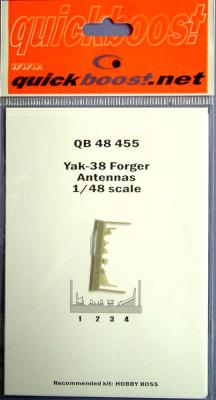
***Note: the packaging of this set indicates that it is antennas. In fact, the details are pitot tubes and angle of attack indicators.