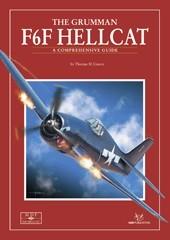
Scotland native Alex Crawford is back for his sixth book with Mushroom Model Publications and his third on the Gloster Gladiator. This book is an operational review of the squadron’s two disastrous visits to Norway. The first trip ended with the destruction of all of 263 Squadron’s Gladiators after two days of heavy fighting. The squadron was evacuated and re-equipped with more Gladiators and made a return trip to Norway. Improved organization allowed 263 Squadron to perform better for three weeks of fighting before they were once again evacuated. The remaining ten Gladiators were flown on board HMS Glorious for the return to the UK. Disaster struck the next day when during HMS Glorious was attacked and sunk by the German battle crusiers, Gneisenau and Scharnhorst, with the loss of all of 263 Squadrons’ pilots.
Aires has come out with a nice upgrade for the Hasegawa A6M series of kits with their horizontal control surfaces set. The Aires parts allow you to alter the position of the elevators and provide improved stabilizer to elevator detail. There are no supplied instructions; you simply swap out the kit provided plastic parts with the new Aires replacements.
Aires has molded the stabilizer and elevator perfectly in light grey resin with no apparent bubbles. The Aires stabilizer and elevator are supplied on a single resin sprue with thin resin attachments to the parts that should minimize any cleanup.
Although most paints will adhere to resin alone, I would recommend that you wash the parts to remove any remaining mold release and prime them first. They will need to be installed with your favorite CA (super glue) or epoxy, as the normal plastic glues or solvents will not react with the resin.
Highly recommended!
History
In response to the USAF’s 1970’s initiatives to launch new fighters, the F-15 and F-16, the Soviet Union fielded their own modern equivalents, the Su-27 Flanker and Mig-29 Fulcrum. All these aircraft are still in service with their respective, and other, countries. During the last twenty years, the Mig-29 has even seen service in several nations that are now part of NATO. They mostly operate as interceptors. In the plastic modeling world, the F-15, F-16, and Su-27 have been well represented in kits, but the Mig-29, not so much. Trumpeter has filled the void with a quality model of an early production version, Product 9-12, of the Fulcrum.
The Bell P-39 Airacobra is one of the most distinctive looking and interesting aircraft designs to be built in large numbers in the early years of World War II. It was designed by Bell Aircraft Corporation in the late 1930’s as a fighter interceptor with some very innovative features. The large V1710 Alison engine was located behind the cockpit, a 37mm cannon was mounted through the spinner shaft and rather than having a top opening canopy it was designed with car style doors.
This highly anticipated new kit from Kitty Hawk is the first kit of this awesome fighter in 1/32 scale that is not a short run kit. This boxing includes parts to build either the Q or N variants which saw extensive service with the Soviet Union and the Pacific Theater.
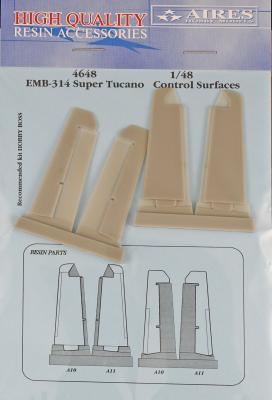
Want an easy upgrade the new tool Airfix kits of the Gloster Gladiator? Step right up to the new Aires Gloster Gladiator horizontal control surface that provides a beautiful replacement to the kit parts. The Aires parts not only allow you to alter the position of the elevators, but the stabilizer hinges and the elevator torque tube really stand out. There are no supplied instructions; you simply swap out the kit provided plastic parts with the new Aires replacements.
Aires has molded the stabilizer and elevator perfectly in light grey resin with no apparent bubbles. The Aires stabilizer and elevator are supplied on a single resin sprue with thin resin attachments to the parts that should minimize any cleanup.
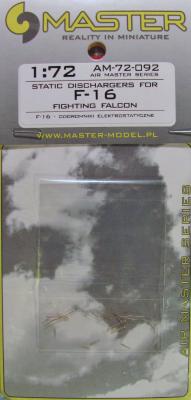
Thanks to Piotr at Master models for providing these incredible “Nano-size” static dischargers to improve our models, and thanks to IPMS Reviewer Corps leaders for sending this my way!
What is in the packet: an instruction sheet, and 14 microscopic jewelery-quality Static dischargers used on modern Sukhoi jets (Su-27, Su-30, Su-33, Su-34 and others). These are the newer, shorter versions; longer versions for early Sukhoi aircraft are available from Master under set 48-088.
Aircraft and History
The HH-65C used by the US Coast Guard (USCG) is derived from the civilian Eurocopter AS365 Dauphin. The USCG selected this helicopter in 1979 and entered service in 1985.as a short range recovery Air-sear rescue helicopter. A total of 102 aircraft were manufactured and are still in service today. One distinctive feature of this aircraft is a “Fenestron” ducted fan anti-torque tail. This design improves safety for crews and the airframe itself from tail rotor strikes. The HH-65C carries a crew of 4 which consist of a pilot, copilot, flight mechanic and rescue swimmer. In addition to search and rescue, the aircraft tis also used for homeland security patrols, cargo/drug interdiction, ice breaking and pollution control.
Background
The Polikarpov I-16 was a Soviet fighter aircraft of revolutionary design; it was the world's first low-wing cantilever monoplane fighter with retractable landing gear to have attained operational status, and as such "introduced a new vogue in fighter design." The I-16 was introduced in the mid-1930s and formed the backbone of the Soviet Air Force at the beginning of World War II. The diminutive fighter, nicknamed "Ishak" or "Ishachok" ("Donkey" or "Burro") by Soviet pilots, prominently featured in the Second Sino-Japanese War, the Battle of Khalkhin Gol, and the Spanish Civil War. The Type 24 replaced the skid with a tailwheel, and featured the much more powerful 670 kW (900 hp) Shvetsov M-63 engine. The Type 24 also featured four ShKAS guns, proper landing flaps replaced the drooping ailerons, and a second cockpit door was added on the starboard side.
Airfix has created a smashing new Heinkel 111 P2 kit, and this one is well worth getting if you like the HE111. The detail and high quality of this product is fantastic.
In the box:
- 5 x light grey sprues
- 1 clear sprue
- 1 decal sheet
- 1 instruction booklet
All the sprues are well molded with no flash at all.
The detail is very fine and crisp. The panel lines on the He111 P-2 are all very well defined.
Construction
First based on the order in the instruction booklet, we start on the interior of the fuselage, which like the cockpit on this kit is extremely well-detailed for a 1/72 kit. In fact the amount of detail is better that a lot of 1/48 kits I have built.
The fuselage halves are joined, and then we start in the bomb racks and wing center section.
There is a little filling to do when you bring the center wing section and the fuselage together, but not much.
This is another of SAC’s marvelous landing gear replacements for 1/144 scale aircraft. One of the worst things to fix on a finished aircraft is the broken landing gear which occurs from either a move or less than careful handling, usually by a friend of spouse. I was at a display when a spectator started to pick up one of Brian Baker’s planes. I tried to stop him, but he said “I know what I’m doing!!” and then proceeded to remove the antenna, landing gear and rigging in one grab.
The Kit
You get two sets of nicely cast metal gear legs. This is cool, because Eduard has two Spitfires in their 1/144 kits. Well, there IS a single kit, but I haven’t seen that one yet.
I show in the photos below that the SAC parts match the Eduard parts pretty closely. In 1/144, it’d be hard to say exactly. Even with a magnifier, I’m not that good.