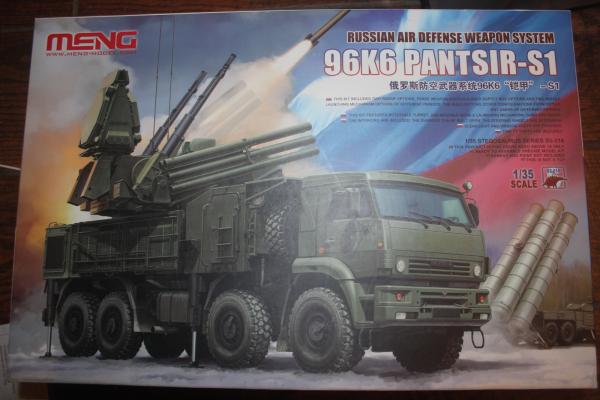
The Pantsir missile system is a family of self-propelled, medium range surface to air missile systems. The 96K6 Pantsir-S1 is a combination of the 2K22 Tunguska missile system with a KAMAZ-6050 8x8 cross country truck. The turret is equipped with two 2A38m 30mm AA guns and 12 57E6 series surface to air missiles. This vehicle has been exported to number of countries including Syria, Serbia and Iraq and it has participated in combat operations in Syria and Ukraine. This new kit from Meng is one of three modern kits to represent this interesting vehicle.
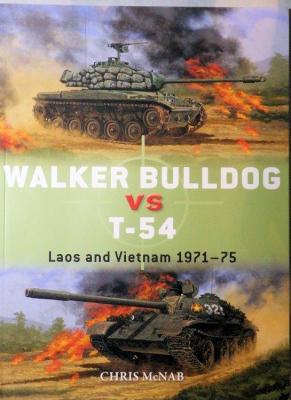
Osprey’s Duel series is a well-established line of books providing an overview of machine-on-machine combat action from design and development through combat. The books include a thorough analysis of the elements which affected the overall outcome of specific battles.
This volume focuses on some lessor known armor actions of the Vietnam war. When we think of the battles in Vietnam, we generally don’t think about armored warfare, we tend to focus on guerilla warfare, aerial bombardment, and helicopter assaults. However, near the end of the war there were few battles featuring rather extensive use of armor by the North (PAVN) and South (ARVN) Vietnamese armies. The ARVN’s main armor component was the M-41 Bulldog light tank, which by the early 70s had been long since retired by the U.S. Army. The PAVN had supplies of Soviet T-54s, and Chinese produced versions of the T-54.
Sherman Tank, Vol. 2, is the second book in David Doyle’s Legends of Warfare series on the Sherman Tank. The first volume of the series covered the Sherman M4A1 Tank in several variations. This Volume 2 covers the Sherman M4 medium tank, which is a welded hull, radial engine-equipped tank. The M4 was the predominant US tank in WWII until late summer 1944 when it was replaced by the M4A3.
The M4 was used by both the US and British forces in Africa, Europe, and the Pacific. The M4 went through three major hull designs, multiple turret designs, and was armed with 75mm or 105mm guns.
Description
The HMEE-1 is an armored backhoe loader designed for high speeds in order to self-deploy with military convoys, and capable of towing heavy loads with good off-road mobility. It is based on technology from the JCB Fastrac tractors. The maximum speed of the HMEE is 60 mph on improved roads and 25 mph on secondary roads. Wikipedia
History
From the Airfix kit: The British named the M3 "General Stuart" upon receipt of the tank under the Lend-Lease program in June of 1941. The tank's ability to "shoot and scoot" as well as keeping the crew safe from small fire arms fire, earned an affectionate nickname of "Honey" by its operators. The British cavalry men liked this tank as it could travel 10 to 20 mph faster than their own or enemy tanks, and for its ease of maintenance. The M3s were designed to replace the outdated M2s. The M3 incorporated a thicker armor, lengthened hull, and a trailer idler wheel to act as another road wheel to decrease ground pressure and improve weight distribution.
Bottom Line Up Front: Tamiya knocks it out of the park once more with a well detailed, brilliantly engineered ‘new tool’ kit of an interesting subject. The construction portion of this kit took me about three and a half hours to complete and I did not feel rushed.
History
The Panzerkampfwagen 38(t) was a pre-WW2 Czech design which compared favorably to early German armor. The German Panzerwaffe adopted the tank shortly before the outbreak of hostilities in 1939. The (t) stands for tschechisch, the German word for Czech. Pz. 38(t)s saw limited service in the invasion of Poland and France. The vast majority of the roughly 1,400 Pz. 38(t)s produced served on the Eastern Front.
For a long time, Airfix has continued the tradition of reboxing their older kits from their 1/76 scale line. Since this is a reissue, despite the newer box with red highlights, this Sherman M4A2 comes from a mold that is pushing 60 years old (and it shows). The kit includes rubber band tracks and a couple of sprues. Given the age of the mold, the parts are in okay conditions, though there is flash. Certainly, the parts are not as crisp as in a new kit, but they are adequate. When you compare this Sherman with newer kits, the details are soft. I can only assume that the vehicles depicted through the decals are new to this reissue.
History
At the end of WW2 Industries within the US were encouraged to design more sophisticated military equipment based on experiences gained during the war.
The US Navy Bureau of Ships invited multiple civilian engineering firms to submit proposals for a new tracked landing vehicle (LVT). The Borg Warner Company submitted a design for a new LVT. The prototype was completed in August of 1951. It’s large box like structure could transport 34 fully equipped infantry and possessed excellent seaworthiness. The vehicle was designated the LVTP5. Developed concurrently with the LVTP5 was the LVTH6, the support version armed with a turreted 105mm 24L Howitzer. The LVTH6 entered service in 1957 with 210 units produced.
Kit
The kit is produced by AFV Club, a well-known model company. The box art work in outstanding! The scene depicts marines landing on a pacific island beach.
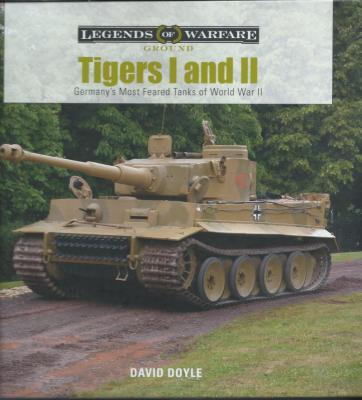
Whether I am reviewing his armor books as now, or his aircraft books, like my previous review on the SBD, I am always finding David Doyle’s books to be tremendous additions to the reference bookshelf. I find myself referring to them numerous times, whether for my own projects or to check on something for friends asking advice. The best advice, of course, is to buy themselves their own copy of the book…and this Legends of Warfare volume on the Tigers is no exception.
The book is not the end all or be all purchase that you’ll never need anything else to buy for the library. It is, however, a good place to start for someone transitioning to armor modeling for the first time, or just looking to build one of the various offerings of Tiger kits available. WWII buffs in general will thoroughly enjoy looking through the texts and various photos. Enough babbling…what’s inside Mike?
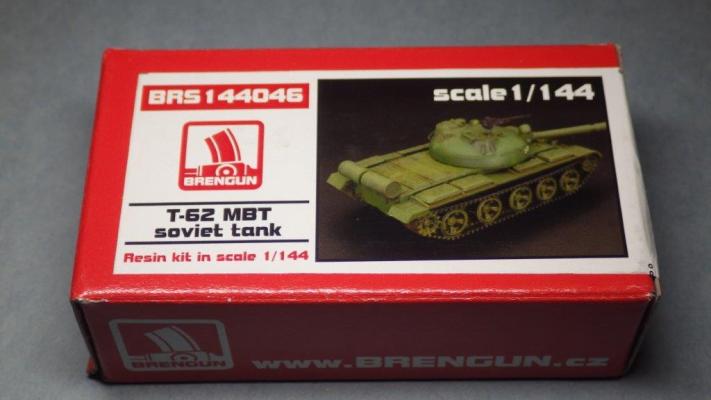
Brengun, based in the Czech Republic, is known for producing a range of photo-etched and resin accessories for airplane models. They also produce a small number of 1/72nd and 1/144th model sets in both plastic and resin. One of their resin kits is the T-62 Main Battle Tank in 1/144 scale.
The T-62 entered service with Soviet Union in 1961, and remained in service with the former Soviet Union until the early 2000s. Originally, designed as an upgrade to the T-55 series of tanks, the T-62 was the first tank armed with a smoothbore gun and replaced the T-55 as the standard tank of the Soviet army. While the T-62 is no longer in service with the Russian army, it is still commonly seen on today’s modern battlefields in Syria and Yemen.