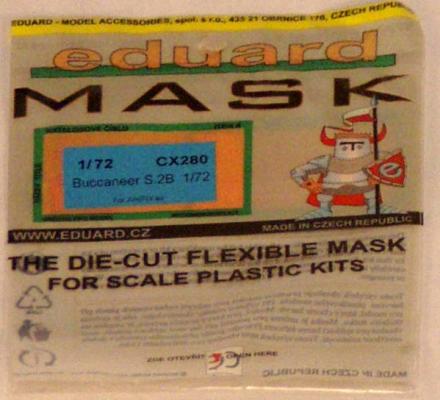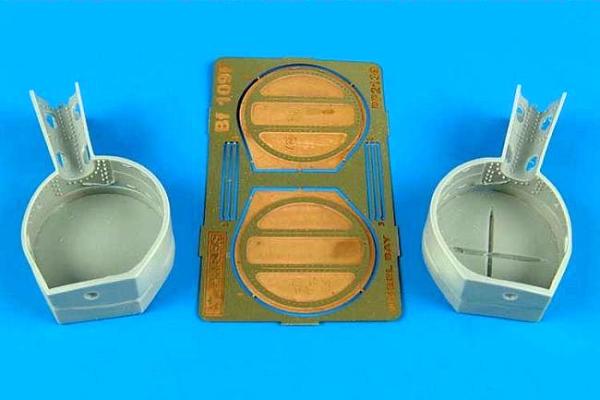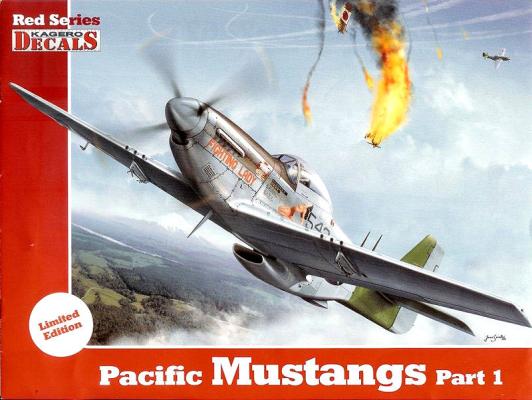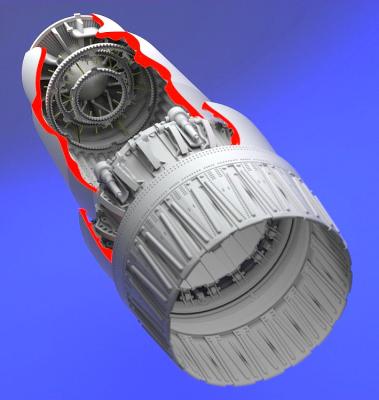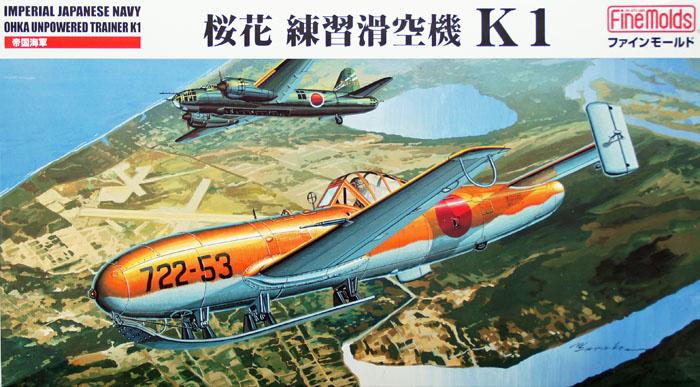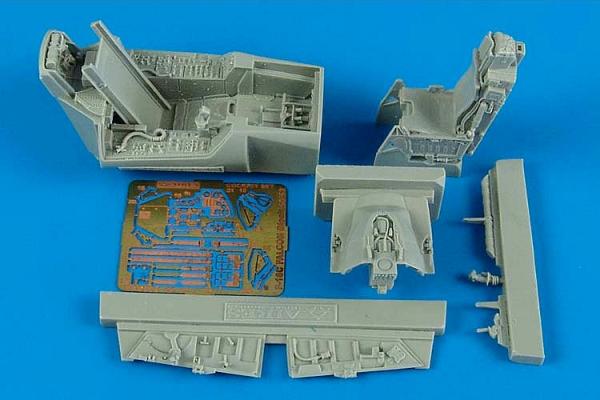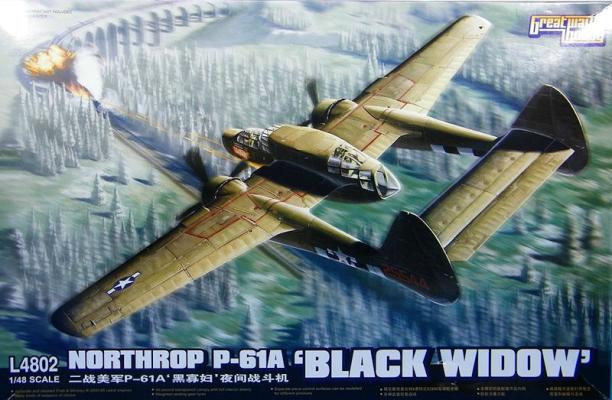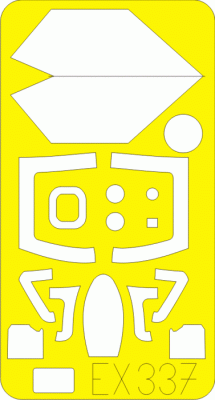
Eduard continues to lead the pack in taking older kits and upgrading them with PE and resin upgrades. In this case, we have the Academy MiG-29A, which in its own right is an excellent kit, with several items added to bring the basic kit to the next level. In this case, Eduard’s own PE instrument panel and detail set, combined with their in-house “Brassin” resin upgrades. Oh yeah, there is also one outstanding decal sheet included with no less than five variants to finish your model; Two Soviet, one Polish, one Czech Republic, and one Iranian. All are in register, and make for quite a variety of color schemes. The decals also include a comprehensive stencil suite, including missile and launch rail details. Outstanding!
Master Models has created a superb replacement for the venerable M61 Vulcan cannon found in so many planes. The set consists of 6 perfectly turned brass barrels with hollowed out ends, a machined brass ring a machined center barrel and a set of photetched pieces to bring it all together.
Background
I'll not spend much time here. Google for "Jane Russell", when you're done reading that, click any link to "Howard Hughes", and when done with that click the link to the "Hughes H-4 Hercules" to find out all you need to know about this aircraft.
I will add that SWMBO and I had a trip planned that would allow her to go to a big quilt show in Sisters, OR, and allow me to stop off in McMinnville and see the 'Spruce Goose' -- it didn't happen but is still in the back of our minds. Unfortunately, we'll never hear the sound of 8 R-4360's cranking over and running -- that's 224 cylinders generating 28,000 h.p. …. and 448 spark plugs to change ….
I would like to thank Osprey Publishing for submitting this book and thank IPMS/USA for allowing me to review it.
When we hear the name P-40 we almost invariably think of the shark mouth P-40s of The Flying Tigers doing battle with Japanese Nates and Zeroes over Southeast Asia. Nevertheless, the P-40s also spent considerable time in the air over North Africa and the Mediterranean area engaging the Luftwaffe’s Bf 109. It is the latter struggle that author Carl Molesworth captures in his book P-40 Warhawk vs Bf 109, MTO 1942-44.
Eduard is planning to release a pre-painted injected plastic PSP base. The base has a copyright of 1999 in the back, so I think it is the “old” PSP base which now gets a pre-painted treatment.
What about the pre-painting? It is great. Deep browns and grey shades, with a touch of lighter spots and rusty shades. This is not just pre-painted, it is weathered, too!! Now, be aware that the sides of the base are left in bare plastic (white). You might want to consider painting the sides to match the colors of the top and maybe to apply a wash to the overall base to bring out detail.
What is the quality and detail of the plastic? It is outstanding as we became used from Eduard. No flash or molding flaws. Clean and crisp details. The dimensions are 164 mm x 234 mm. It will fit a P-51 just fine, but it might be a bit tight for a P-47, as it is shown in the pictures.
Master Models continues its excellent string of releases in all scales with turned aluminum refueling probes in 1/32 and 1/48 scale. The parts are perfectly made and, like many Master Model parts, simple to use. You build the refueling probe, paint as required, and the cut the tip off. Drill a hole for the part and glue it on and it leaves you with a perfect part with a realistic metal finish because it is metal.
Items are:
- 1/32 32030 $4.95
- 1/48 48033 4.95
Highly recommended to add a perfect finishing touch to any kit using a NATO refueling probe. My thanks to Master Models and IPMS/USA for the chance to review these excellent parts.
Beechcraft has built many multi-engined airplanes over its long and successful history, but when anybody in aviation mentions a "Twin Beech", they don't mean a Baron, a Duke, or even a Super King Air – they mean a Model 18. Designed at the end of the 1930s as a competitor to Lockheed's Electra 10, it soon eclipsed that type in production with demand for light transports and aircrew trainers during WW2 (with Lockheed busy with building P-38 Lightning fighters, Hudson bombers, and bigger transport planes, Beech was in the perfect position for the business!). Thousands built, they served second-line military roles all over the world with all the Allied nations, and Beech kept the type in production afterwards for the growth of postwar air travel. Many are still in flying condition today and they are often seen at warbird airshows.
Introduction
The Grumman F6F Hellcat series was one of the most important U.S. Navy carrier fighters of World War II, with the first F6F-3 production models appearing in late 1942. Powered by a P.W. R-2800-10 radial engine of 2000 hp., the fighter was powerful, heavily armed with six .50 cal. machine guns, well protected with armor and self-sealing fuel tanks, and fast, 335 mph. at sea level and 376 mph. at 17,300 ft. Although it could be out-turned by the Zero, its main adversary, it held virtually every other advantage, especially since by the time the Hellcat came into service in 1943, many of the highly experienced Japanese pilots had been lost in combat, and their replacements were poorly trained compared to the American pilots, who entered combat with roughly four times the flying time of their Japanese counterparts.
While meandering through the vendors rooms at the Omaha Nationals, I bumped into Ernie Gee while visiting with Gordon Kwan of Sprue Brothers. For those of you who don’t know, I consider Ernie to be the living GrandMaster of lost brass castings such as landing gear, boat propellers, and a multitude of other stuff. He handed these to me and asked if I might review them. Well…here is the review. EXQUISITE! There really isn’t much more to say about the absolutely beautiful work this guy does. (The last Fisher kit I reviewed, the RB-51 Red Baron Racer, had Ernie’s landing gear included, as does the F7U Cutlass I’m currently knee deep into). There can’t be enough good said about the quality of these products. If you haven’t tried any G Factor products, it’s past time. These can be ordered in the U.S. at https://spruebrothers.com and in the United Kingdom at https://www.hannants.co.uk.
First, let me thank Squadron Products for these review samples an IPMS/USA for allowing me to review them.
The recommended model for these two sets of decals is the Revell 1/48 A-6E Intruder. Revell first released their A-6E 23 years ago in 1988 (kit # 4578). They have re-released it in 2011 (kit # 85-5626). The new kit includes decals for VA-85, the Black Falcons on the U.S.S. Forrestal and VA-35, the Panthers on the U.S.S. Nimitz. The old kit contained decals for VA-196, CAG, on the USS Coral Sea and VA-85 on the USS Saratoga.
Squadron Products has issued two new decal sheets for this old, but popular war bird. Decal set MS481254 contains markings and tail art for Marine squadrons VMA-121 and VMA-224. Decal set MS481253 contains markings and tail art for VA-196 and VMAT-202. You may have noticed a repeat, VA-196, with the old Revell kit. The decals for VA-196 were added after the release of the movie, Flight of the Intruder in 1991.