Every once in a while something nice happens to you. This little photo-etch set is just the sort of thing I’m referring to. I’ve had the major parts of a Hasegawa Ki 48 Lily kit clipped off the sprues for some time in the hope that eventually I would locate enough reference material to guide me in adding cockpit detail when I continue with the build. The opportunity to review this new Platz photo-etch detail set for the Ki 48 was just what I needed to move me from a state of static inertia to critical mass. The kit box was located among the ‘in-progress’ stack, reopened, contents examined, the workbench was cleared and my Optivisor was back in place.
The Story
This book represents a novel approach to aviation history, and instead of the usual treatment of aircraft types, famous pilots, or even significant designers, the author identifies what he considers to be the significant aircraft producers of the World War I era, and goes through the development of the companies and the actions of their founders and CEO’s, explaining how their aircraft were developed and used. After producing a list of 92 significant producers, the authors selected 27 to discuss in detail, and he does an excellent job of presenting the startup of the firms, the personnel involved, and the airplanes, both successful and unsuccessful. He alludes to the postwar period a number of times, as many of these aircraft, such as the DH-4, Curtiss JN-4, and other types were used long after the end of hostilities, in both military and civilian roles.
This large book (8 ¼ inches x 12 inches) was originally titled Aviation Modeling Techniques: The Greatest Guide when first published by Euromodelismo.. The book is profusely illustrated with almost 1000 color photos. The book is entirely in French. Each chapter covers the complete building process of one aircraft model. These chapters cover aircraft from WWI up to modern day.
Each chapter features a step by step guide to the building process. From detailing, assembly, painting and decaling each step is thoroughly discussed. Typing some of the captions into Google translation yielded some interesting and helpful information. Some of my favorite chapters include one showing the build of a Ki-43 and another on the F4D.
Beginning on page 160 is a Gallery of other completed models. Some favorites here are a complete but unpainted IL-2 showing the metal and wooden areas to advantage, a super-detailed 1/72 FA-18 and an F7U under construction.
Short History
The Douglas A-4 Skyhawk is a ground attack aircraft designed for the United States Navy and Marine Corps. The delta winged, single-engine A-4 was designed and produced by Douglas Aircraft Company’s chief designer Ed Heinemann. The aircraft was later produced by McDonnell Douglas. The A-4 was originally designated the A4D under the Navy’s pre-1962 designation system. The A-4 was in response to a call by the US Navy for a jet-powered attack aircraft to replace the older Douglas Skyraider. Ed Heinemann opted for a design that would minimize size, weight and systems complexity. The little Skyhawk quickly began to be called by other nicknames such as “Scooter”, “Kiddiecar”, “Bantam Bomber”, “Tinker Toy Bomber”, and one of its more famous of nicknames, “Heinemann’s Hot Rod”.
This series of decal sheets is long overdue, and covers an area that modelers have needed for a long time. I have had experience with Aviaeology’s products in the past, and have found them to be excellent quality decals. One advantage that this company offers is that they always do their homework in historical research, getting things right.
The AN/APG-66 radar system was developed by Westinghouse (now Northrop Grumman) in the 1970’s for use in the General Dynamics (now Lockheed Martin) F-16 Fighting Falcon, and entered service in 1979. The radar was utilized in both the A and B versions of the F-16, and was later replaced by the AN/APG-68 system. The AN/APG-66 weighed in at 362 pounds and was a multi-role, x-band unit with a range of 160 nautical miles. In addition to the F-16 A and B, variants of the radar was also installed on the F-4EJ (Japanese export version of the Phantom II), British Hawk 200, US Navy T-39N, and New Zealand A-4 aircraft. The modes of operation were range-while-scan, track-while-scan, velocity search, and gun director.
Editor's note: Eduard M.A. has requested that the following information be included in this review: The product reviewed "..that it's actually prototype product, and that there might be differences/enhancements when compared to the final, publicly released deck.." The item as given was not intended for review. Oct. 10, 2011
The Product
This was presented to IPMS President Dick Montgomery by Eduard at the 2011 IPMS convention held in August in Omaha as a not yet released item to be submitted for review. I told Dick, “I will do my best to give a complete and honest review.”
The base appears to be made of some type of hard plastic with very nice engravings and has what looks to be a date ‘2001’ embossed on the hollowed backside. Measuring 11 5/8” x 15 5/8”, this thing is big. It depicts an elevator centered in the wooden deck. The coloring is eye-catching, to say the least, and looks great from a couple feet away.
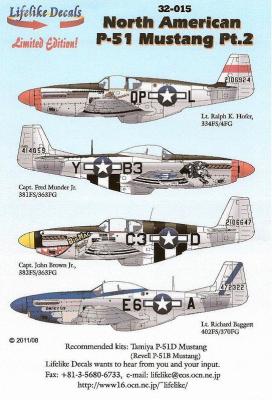
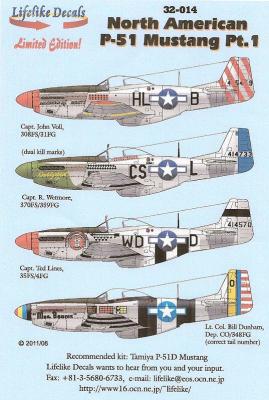
Well, here it is September already, and our busy beaver fellow IPMSer Ross McMillan follows through with 6 new releases, including one for the all-new Tamiya 1/32nd P-51D Mustang.
As always, crisply cast with only minimal flash and very little cleanup required. Many thanks for the review samples! Keep up the great work.
The Contents
You get a heavy duty envelope with 4 plastic sleeves inside. You get:
- 73355 PE, one self-adhesive mostly cockpit, and two really big PE frets for interior and exterior detail
- CX257 Canopy and Wheel mask
- 73008 Remove Before Flight Tags
You also get 2 full pages of instructions, folded so that you have 8 separate half pages of instructions, plus a half page instruction for the masks.
The Aircraft
The F/A-18 Hornet has been around for a while, and it looks to be almost as big a winner as its predecessor, the F-4 Phantom. One of the stories going around St. Louis in the 90s was that the plant wanted to build 5058 Hornets, one more than the production run for the Phantom. Well, the production line is still open, and they’re past 1100 now.
The EF-2000A Typhoon, otherwise known as the Eurofighter Typhoon, the one of the latest generations of advanced technology fighters. Since its debut, several kits have been released, including the Revell and Trumpeter 1/32 scale kits. While I have not yet seen the Revell kit, the Trumpeter version is a great kit, but sadly is lacking in the pilot’s office. Once again, Aires to the rescue! Aires has released a great cockpit set for the Typhoon. While the set is designed for the Revell kit, I found it also fits great in the Trumpeter kit. The set is cast resin with a high level of detail, and few, if any, casting defects. The set also includes a set of flexible cast oxygen hoses, a clear cast HUD glass, and a fret of photo-etched metal parts.