Less than two years after treating the modeling world to a state-of-the-art 1/48 scale Ventura PV-1, Revell has released a second version of the Ventura…the type ordered by the RAF in early 1940. According to Revell’s website there are 142 parts, but I counted 143. A number of them are common with the PV-1 kit, but a number of additional ones necessary to replicate the unique details of the RAF Mk.I and Mk.II are included. Twenty-one parts are molded in clear plastic. They are crystal clear and thin enough that interior details are easily viewed. All of the others are molded in a medium gray. As with the PV-1 kit, all parts are well molded with no flash or severe ejection pin marks to deal with. Recessed details are delicately engraved and a few raised details are nicely represented. Fortunately rivet detail is limited to a few conspicuous ones on the top of the fuselage and around fuel tank caps on the wing tops.
I had a love-hate relationship with this set of decals. This is my first experience using decals from Yellow-Wings, and also from the new Microscale printing process. The colors are excellent and in perfect register, the film around the edges is minimal, they are exceptionally thin and they cover aircraft from my favorite era. However, the thinness lead to issues with the long and thin decals. Additionally, the smallest decals required a perfectly smooth service to be moved about easily, an important issue on a small model like a 1/72 F3F-2. I ended up purchasing a second set of decals to fix several issues; severely torn decals and a set of wing chevrons that were not sufficiently opaque.
The Decals
This 1/72 multi-aircraft decal set is the second from Yellow-Wings Decals. You get four complete sets of decals on one sheet of decal paper for the following aircraft:
Background
Platz, out of Japan, has been involved in the 1/144th modeling community for a while. They have produced many of their own kits and have teamed up with another Japanese company called F-Toys. F-Toys produce various subjects, among them being 1/144th scale aircraft kits. These kits from F-Toys are typically pre-painted, mostly assembled, and somewhat snap together. Many 1/144th scale modelers will take these pre-painted F-Toys kits strip them down, add details, repaint, and decal them. However, now we are seeing Platz take those same F-Toys kits and produce them as traditional model kits. This T-34A is a prime example of that venture; first it was released under the F-Toys name as a pre-painted kit, and now it’s released as a traditional model kit.
The Kit
Recently, Airfix has upped its game with the release of several 1/72 scale aircraft kits with new tooling and featuring excellent detail. One such kit is their Hawker Typhoon Mk Ib. Despite Airfix’s excellent out-of-box detail, aftermarket detail manufacturers have tossed their hats into the ring to make an excellent kit even better.
Among them is Quickboost -- bringing their improved engine exhausts. Comparing fairly closely to the kit parts, the Quickboost versions offer the feature of hollowed out exhaust ports – saving the modeler time and stray cuts in the kit parts and fingers from errant drill bits or hobby knives.
Quickboost’s mold quality and fidelity of detail is exceptional, and the hollowed out stacks make a subtle contribution to improving this legendary 1/72 RAF tank killer. Highly recommended for the braille scale modeler wanting to really trick out his Typhoon Ib.
Background
The Avro Biplane was the first biplane design built by A. V. Roe. It was a further development of his previous designs, which featured tri-plane layouts. I remember an Avro tri-plane in this series but its not been reissued. The design shared some common features with the other aircraft of the day. A triangular shaped fuselage was large enough for a pilot and passenger. The increased surface area of two wing surfaces handled the extra weight. Wing warping was used to turn the aircraft. What set this design apart was the 35 HP water-cooled engine built by the Green company. A cooling system helped provide reliable power over long durations, something that plagued other aircraft engines.
Quickboost’s offers a set of detailed propellers to their aftermarket parts line that are to be used to replace the ones found in the new Airfix 1:72 scale C-47 Skytrain kit. The Quickboost propeller set provides separate blades and hubs that feature far better hub detail and more accurate blade shape than those found in the kit. The size and general shape of the Quickboost parts match the kit parts so they are designed to be quick drop-in replacements with no surgery. An alignment tool is included that makes properly aligning and attaching the blades to the hubs almost foolproof. See the photo below comparing them to the kit parts.
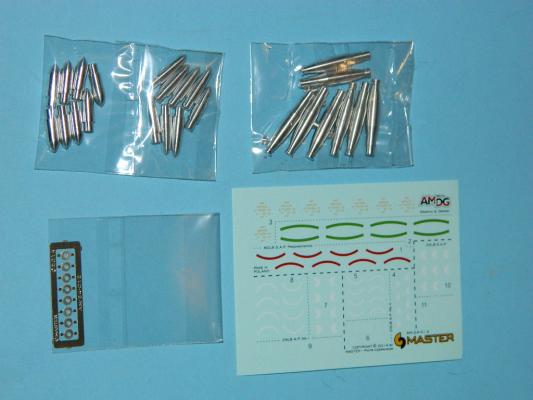
In this BRASSIN detail set, Eduard provides modelers with a quick and easy way to add a quartet of highly realistic SC-250 (Sprengbombe Cylindrisch 250) bombs to a 1:48 scale German aircraft model. The set includes resin and photo-etched brass parts and a small decal sheet for the stenciled identification. Four resin parts and four photo-etched parts make up each bomb and the decals add all markings needed for finishing the assembled and painted models. This multi-media combination makes into realistic looking miniatures of the real thing.
First, welcome to FLY models and thanks very much for sending us this great kit to review… and to the IPMS USA review corps leadership for sending this kit and the landing gear accessory to the crazy builder in Oklahoma…
I purposely did not open any other review commentary on the new Fly Arado 234B-2/B-2N kit… my impression was to be that of someone who just invested in a new company and wondered how it was going to come out.
To the people at FLY… You need not worry; this is one magnificent effort and I’m VERY impressed!
History
The Lavochkin La-7 was a logical development of the highly successful radial engine fighter, the La-5, which was itself an improved LaGG-3 all wood fighter which, while having reasonable performance, was not satisfactory as a first line fighter at the beginning of the “Great Patriotic War”, as the Russians designated World War II. While the LA-5 went through numerous changes during its production life, it became obvious that the 1820 hp. Ash-82FN radial engine had reached its development peak, and that there was no suitable replacement for this engine, as the Ash-71F radial of 2200 hp. was unreliable and unsuitable for service use. Therefore, the Lavochkin Design Bureau decided to upgrade the basic La-5 design, making aerodynamic refinements on a prototype designated La-5 (206) which included a new cowling, oil cooler location, supercharger intake, exhaust cover outlet, and radio mast shape.
Many thanks to Mr. Ross MacMillan of Scale Aircraft Conversions and the IPMS Reviewer Corps for allowing me to try this neat conversion and replacement set for the Hong Kong Models Gloster Meteor. I am delighted to report on another sweet add-on and upgrade.
The 9 white-metal parts arrived in a blister pack, backed by the distinctive SAC company logo. The heft of the parts is very noticeable. All parts are free of sprues with the exception of the main mount retractors. The parts require very little buffing, cleanup and polishing. The SAC gear struts directly replace the Meteor kit parts. The main mount parts and nose strut parts attached to the kit fuselage with no difficulty, even as a refit or upgrade to an existing kit. Kit parts that are replaced by SAC parts are C1, C2, C8, C11, C12, C13, C14, C17 and C18. No replacement is provided for C9 AND C10, but no replacement appears to be needed.