This set is part of Eduard’s growing line of Steel seat belts sets. The set consists of 3 sets of seat seatbelts and shoulder harnesses for Yakovlev World War II fighters and 3 sets for Lavochkin World War II fighters. The set will particularly useful for dressing up the cockpit of an older kit. I had an old Italeri La-5 kit that has been in my stash for quite some time, so I pulled it out to see how the belts worked.
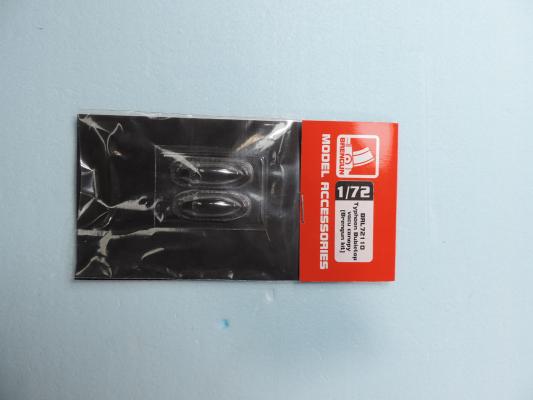
Eduard Models continue to expand its Brassin line, this time with a drop-in replacement part for their excellent Spitfire Mk IX line: the top cowling.
The part itself is molded in resin and very small casting pours, making removal of the part trivial. The part itself shows no bubbles and exquisite fine detail, down to the rivets.
The plastic parts are not bad at all, however, they have a seam line that needs to be puttied and sanded to make it disappear. The resin part does not have any seam line and it is ready to be installed.
Note that the resin part fits excellently the width of the fuselage nose. However, when removed from the pouring stab it is slightly longer than the rest of the fuselage, perhaps by 1/32 of an inch.
It was very simple to sand it to fit of the surrounding plastic parts. Moreover, the sanding marks will be hidden by the propeller spinner.
Recommended to modelers of all skill levels.
This is a brand new tooling of the Bi-Plane flown by Scooby-Doo and Shaggy in the cartoon. It is a snap together kit aimed at the young modeler. With that in mind I had my 7 year old son build it while I looked on.
In the box is;
- 44 parts packed of the sprues
- 1 decal sheet (stickers)
- 1 instruction booklet
All the sprues are extremely well molded and no flash or sprue marks; the instruction booklet is easy to follow and well-illustrated.
Construction
Was very simple and my son had no trouble assembling the kit I about 20 minutes from start to finish. The only little issue he had was attaching the top wing assembly. In fact I did end up gluing this in place for him.
The final stages were the assembly of the three included figures which are Scooby-doo, Shaggy and Velma. These were a little tricky to push the arms on so I assisted.
The Me 262 Schwalbe (Swallow) was the first operational jet fighter. Design and testing of the first German jet engine was well underway even before World War II started. Due to problems encountered with new materials needed, fatigue and German High Command intervention and delays, the aircraft did not see operational flying until April 1944. The Me 262 was highly maneuverable and faster than any other aircraft of the time, but continued to suffer from engine problems. Many aircraft were lost to engine problems or mishandling.
Me 262B-1/U-1 was a two seat trainer converted into a night fighter, with the addition of a FuG 218 Neptune radar. This was an eight-dipole antenna array mounted on the nose of the aircraft.
Des Brennan provides a thorough coverage of the development, deployment, service, and retirement of the Panavia Tornado ADV in this publication. Illustrated by Richard J. Caruana, this book is an excellent resource for the aviation historian as well as the modeler.
The written content is well written, in clear and precise language. The content is presented in chronological sequence, as most publications of this type are, beginning with a thorough description of the role into which a new aircraft was to fit. The author describes, in detail, the requirements that the aircraft was to meet in order to accomplish its purpose in a theatre of operations with rather complex needs.
The text is supported by a large number of excellent color images and stunning 3-view drawings of the aircraft with varied markings. Richard Caruana, the illustrator, certainly captured the aircraft well in these illustrations.
Osprey Publishing, out of Oxford, UK, is back again with another Aircraft of the Aces series entitled Allied Jet Killers of World War 2, by Stephen Chapis and Andrew Thomas. Jim Laurier was commissioned to illustrate the various allied aircraft via original color artwork. Anyone familiar with aircraft modeling literature and research will recognize this authoritative series, and this latest release won’t disappoint.
Allied Jet Killers follows the format of the previous Aircraft of the Aces volumes, containing beautiful (original) color plates and numerous black and white photos with detailed captions, although much of what is contained in the captions is also reflected in the main text.
The photos are credited, and while I’ve seen some of the images before, most are new to me.
Background
The air war in Vietnam was a departure from what the United States had experienced in prior conflicts. The over-dependence on air-to-air missiles, micromanagement of operations from the White House, and countless constraints and rules of engagement put American aircrews at a distinct disadvantage against North Vietnamese adversaries. Despite those limitations, the US forces adapted to circumstances, exercised some good old American ingenuity, and managed to generate several aces and some legendary missions based on unorthodox tactics. A common thread in the making of these aces and employment of these tactics was the F-4 Phantom II.
I am honored and privileged to review a beautiful new scale model offering in the Super Wing Series from Zoukei-Mura, Inc. I also wish to extend a very deep appreciation to the IPMS/USA Reviewer Corps for choosing me to review the F-4S variant of the famous McDonnell Phantom II.
The kit was released on 26 JUL 17, following on the heels of a previous F-4J release in the same scale and series. This review is the second of two sequential reviews, including my adventures in completing the kit build. This final review dovetails with the previous IPMS reviews of the Zoukei-Mura F-4 kits. I am not a subject matter expert (SME) on the F-4x family, but I sure enjoy a well-designed kit and fun build, learning about the real thing as I go. The Zoukei-Mura F-4S does not disappoint!
The McDonnell Douglas F-4 Phantom II is a tandem two-seat, twin-engine, all-weather, long-range supersonic jet interceptor and fighter-bomber originally developed for the United States Navy by McDonnell Aircraft. It first entered service in 1960 with the U.S. Navy. Proving highly adaptable, it was also adopted by the U.S. Marine Corps and the U.S. Air Force, and by the mid-1960s had become a major part of their air wings.
The Phantom is a large fighter with a top speed of over Mach 2.2. It can carry more than 18,000 pounds (8,400 kg) of weapons on nine external hard-points, including air-to-air missiles, air-to-ground missiles, and various bombs. The F-4, like other interceptors of its time, was designed without an internal cannon. Later models incorporated an M-61 Vulcan rotary cannon. Beginning in 1959, it set 15 world records for in-flight performance, including an absolute speed record, and an absolute altitude record.
Jakub Fojtik attended the Police Academy of the Czech Republic in Prague, achieving his Bachelor degree in Management of Security Forces, Security, and Law Studies. He followed up with a Master Degree in Management of Security Forces and a Master of Laws (LLM) in International Business Law. To top it off he achieved a Doctorate (JUDr.) in Security studies at the Academy of the Slovak Police in Bratislava and a Ph.D. in Management of Security Forces from the Police Academy of the Czech Republic in Prague. Jakub Fojtik is currently a University Lecturer at the Police Academy of the Czech Republic, the Vice President of Military Sales for Aero Vodochody Aerospace a.s. (Aero L-39, L-159, etc.) and an independent aviation journalist who is regularly published in aviation related journals and aviation magazines, including Air Forces Monthly, Defence Helicopter, Fly Past, Flying Revue, Hobby Historie, Letectvi a Kosmonautika, 4 Rotors, and many others.