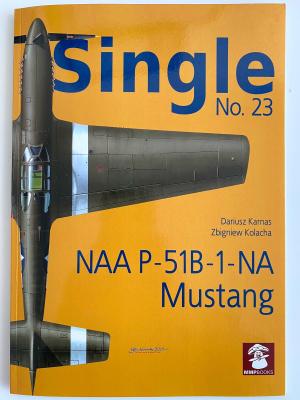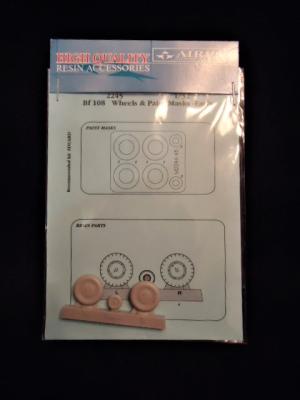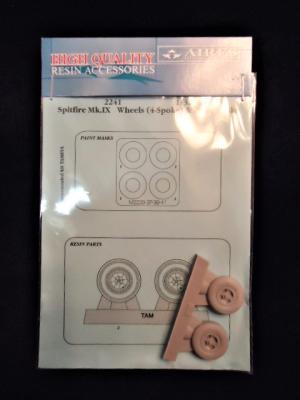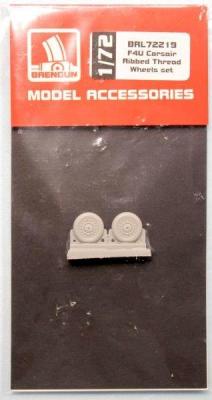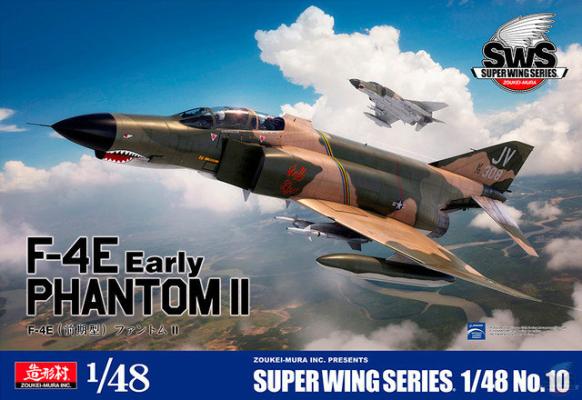
History: The North American Aviation P-51 Mustang is an American long-range, single-seat fighter and fighter-bomber used during World War II and was originally developed in remarkable time of 102 days in response to a request from British Purchasing Commission. The first P-51s with Allison engines were not able to show stunned high performance. By replacing Allison Engines with Rolls-Royce Merlin Engines, P-51 became a high-performance aircraft and evolved into long-range bomber escort in European War and was rival for Japan Army in Pacific War. D-version of P-51s were produced in larger numbers than any other Mustang variants. The P-51D featured a bubble canopy for all-around visibility and was armed with six wing-mounted 12.7mm caliber machine guns. Wing racks allowed the carriage of drop tanks to extend range or bombs for ground attack.
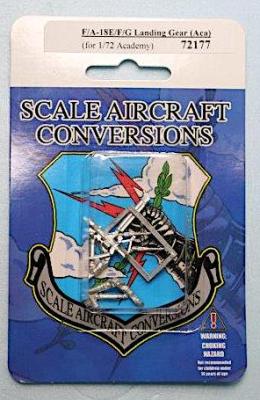
This is a cast white metal conversion set for the Eduard, or actually any, 1/72 scale Fokker D.VII kit. The package I received contained four airfoil shaped spreader assemblies for the landing gear, and two sets each of the landing gear struts and tailskids.
Not having an Eduard kit available, I used an old Revell Fokker D.VII, and the unit fitted nicely. The spreader bar unit was a little roughly cast, but it was easy to sand it down to where is looked good. Not having an Eduard kit, I’m not sure why the unit needed replacement, as there isn’t really much to the gear, just the spreader and the two supporting “V” struts. The struts fit easily into the notches on the bar, but they need a little cleaning up, as there are two molding lines on each set of struts.
Eduard Models has expanded its Look line by releasing a set to enhance their own P-400 model.
This set of the Look line includes a pre-painted resin instrument panel and prepainted photoetch seatbelts, plus prepainted photoetch levers and such.
The instrument panel is provided in two resin parts and they are meant to be drop-in replacements for the original parts. They fit perfectly. You only have to remove them from the casting blocks and you are ready to go.
The prepainted PE is part of the STEEL line. I’ve been fortunate to review items of that line before and I knew I was in for a treat. Despite the STEEL name of if the PE is very easy to bend to final shape. You only have to remove them from the fret, bend them to shape and glue them in place (use CA).
As you can see in the pictures, the parts look amazing. Talk about a simple and fast way to improve the Look of your model!
Highly recommended.
The PBJ-1H is U.S. Navy variant of the B-25 which was operated by the U.S. Marine Corps as a ground attacker. This aircraft is a powerful ground strafing machine and due to the weapons package built-in, it can be viewed as a gunship.
This accessory is not identified for use on one specific manufacture’s kit. The PBJ-1H in 1/72 scale is or has been produced by Hasegawa, Dragon Models & Matchbox.
Assembly is straightforward as there are only two components. The resin cast is feather-light and has very crisp detail and is flash free. To begin, I washed the cast using a mild solution of water and dish detergent. Next, I sawed the cast in half to gain easier access to each of the two components. After each piece was removed, I gently sanded smoothed the sawed surfaces and then adjoined both pieces using CA. The completed assembly was primed and painted with Tamiya Sky Gray.
Eduard Models has re-released their P-400 (actually P-39/P-400 family if you consider all the parts in the sprues) this time in the Profipack boxing, which includes several finishing options, photo-etch upgrades and pre-cut masks.
I’ve believe this model dates to the year 2000. Despite being 20-yr old at time of writing this review, the molds hold really well. There is no flash anywhere and the panel lines are sharp and well defined. Eduard knows how to keep its technology in such way that their products are consistent over time.
I had the opportunity to review this kit with the P-400 Look set (reviewed independently) so the interior that you will see is from that set.
This model (like most) starts with the interior. Given the “car door” design of the P-400, plus the “bubble canopy” it is a good idea to spend some time making sure you get things to look as nice as you can. Either using the Profipack PE or the Look set you will get a top notch interior.
Aircraft and History
The Grumman E-2C Hawkeye is an airborne early warning (AEW) aircraft whose mission is similar to the USAF E-3 AWACS but it is much smaller in size and focuses on naval fleet defense. Compact in size, the Hawkeye is a twin engine (powered by the same engines used on the C-130), high wing aircraft that can operate from an aircraft carrier. Operated with a crew of five; pilot, copilot, radar officer, combat info officer, and aircraft control officer, the crew becomes the “eye” of the fleet.
Aviation Collectables Company is a multi-faceted company that produces aviation related books, prints and novelties. The C-130J Super Hercules book, many of their publications, covers nearly every detail from overall photos, open panels, interior photos and notes for scale modelers. The publication is in full color high resolution photographs as well as artist renderings. This subject covers the C-130J Super Hercules that is operated by the Italian Air Force. The book is split into two languages with typically half the page in Italian and the other half English.
This edition of MMP’s “Single” covers the Messerschmitt Bf 109G-2, and anyone familiar with this series will know the format. For those who are not, these are very “to the point” booklets, homing in on a particular variant of an aircraft.
History
This book provides a complete history of the Grumman F6F Hellcat, the U.S. Navy’s most successful fighter plane of World War II. The prototypes were developed during 1941 and 1942, and after extensive testing,finally entered service with Navy carrier-based units during 1943. Hellcat pilots were credited with more enemy aircraft destroyed than any other Navy aircraft, and at the end of the war, the type was phased out of front-line service because of the appearance of its successor, the F8F Bearcat, the F4U Corsair, and later by jet fighters. Hellcats were used by reserve units until the early fifties, and were also used as drones and drone control aircraft, resulting is some of the most colorful aircraft in the Navy. The F6F, unlike many other World War II aircraft, did not have a civilian career, except for a few flying today as warbirds.
Yet another beautiful kit from Leonid Shilin and Konstantin Nikolaychuk aka, Croco models. This is the third kit I’ve reviewed from these gentlemen and they continue to produce subjects the big companies never will. This time around we get a fantastic replica of the Miles M-65 Gemini, a light twin with some novel design features I’ll get into later. The Miles aircraft company started in the early 1930s and consisted of Fredrick George Miles, his wife Maxine and his brother George. Known for some interesting designs of both light civilian and several specialized military aircraft that were used for training and target tugs for gunnery practice. Examples of the later include the familar Martinet, Magister and Messenger. The Gemini included some of the elements Miles had used in other designs including trailing beam landing gear, fixed slats inboard of the engine nacelles and separate flaps that simplified the wing structure while increasing the wing area.