The Bell Boeing V-22 Osprey had a checkered development history and near cancellation of the project. However, persistence paid off and this unique and versatile hybrid aircraft has seen great success in the US Marine Corp (MV-22B) and US Airforce (CV-22). It is also being integrated into the US Navy (CMV-22B) to replace the aging Grumman C-2 Greyhound’s, as well as a Presidential (Marine MV-22B – VIP) transport. The only export customer so far is the Japanese Ground Self-Defense Force (MV-22B). There are several other countries who have or are considering the Osprey.
Aircraft and History
The Stearman PT-13 (Boeing model 75) “Kaydet” was a primary trainer used by the US Army Air force and the US Navy before and during WWII. The Stearman’s is a fabric covered, open cockpit biplane, powered by a radial engine and extremely rugged design which is ideal for a training aircraft. Introduced in 1934, the Stearman served as a trainer through the end of WWII. After the war, many surplus Stearman’s were sold on the civilian market and served in many roles like crop dusting and air shows. The PT-13 and PT-17 airframes are basically the same except for the engine where the PT-13 has a Lycoming R-680 radial (9 cylinder) and the PT-17 has a Continental R-670 radial (7 cylinder) engine. There are still a few Stearman aircraft flying today which you will see at local fly ins and air shows. Many of the aircraft owners will offer rides in their aircraft so if you get a chance, do not turn it down.
The Battle of Britain (BOB) brings to mind Spitfires and Hurricanes in swirling dogfights with the Luftwaffe's Messerschmitt's, Dornier's and Heinkel's in the summer skies over England in 1940. One of the lesser-known participants in the battle was the Regia Aeronautica (RA) or the Italian Air Force. In fact, the RA had participated in the invasion of France providing escort to bombing forces until France surrendered. From September to November 1940 the RA stationed two squadrons, the 85th and 95th of the 18th fighter group at Ursel Belgium. Here the CR 42 would prove unsuited to the task. Lacking the performance of modern fighters, the Falco's took a beating at the hands of the RAF. More critical was lack of firepower and the open cockpit that froze pilots operating in the cold air over the English Channel. One of the 95th squadron aircraft, serial 95-13 was shot down and landed virtually unharmed on English soil.
Helion produces books on many aspects of Military History from the Late Medieval period through to the present day. Helion was established in 1996, and since then they have published almost 1,200 books, with 100 or more new titles coming out every year. The 'Africa@War' series covers African military history since 1945.
This book covers the many captured foreign aircraft that were put into service and tested by the Luftwaffe. The book has twelve chapters.
Chapter one has many pictures of aircraft taken from Czechoslovakia and absorbed from Austria. Many Fiat, Avia, Letov are featured in the accompanying photos.
. Chapter two has great photo coverage of planes from Poland, Norway, the Netherlands. Many of these were put into Luftwaffe service especially in the training role.
Chapter three covers the aircraft taken with the fall of France. These included all types of home manufactured aircraft such as Bloch, Dewoitine, LeO and Morane as well as American made aircraft used by the French such as Hawk 75 (P-36) and North American models 57 and 64 trainers. Also included are the many British aircraft, both those serving with the French as well those left behind by the British when forced to retreat.
ICM has lately really gotten into making combo kits, and this one, which combines their excellent CR. 42 Night Raider with their equally excellent German pilots set, is one of the latest. I will review each item separately, so let’s start with the airplane.
As most of you already know, the Italian CR. 42 biplane was perhaps one of the most elegant aircraft of its day. Late in the war, however, its obsolescence as a front-line fighter was painfully obvious, and both the Italians and Germans saw its potential as a night intruder for harassing the enemy under conditions where it was unlikely to encounter much, if any, aerial resistance. This involved some modifications, such as adding bomb racks, extending the engine exhausts and cutting down the landing gear spats to deal with rough field conditions.
The Su-27 entered service with the Soviet Air Force in 1985 and the primary role was long range interdiction of American bombers. Originally, this airframe was developed as a single seat fighter under the the designation, SU-27K. This was later adapted for use by the Navy for carrier trials and entered active service in 1991. While the carrier trails were ongoing, a two seat trainer version was developed, starting in 1989. This new kit by Kitty Hawk is the third in a batch of recent Su-27 releases and covers the two seat version of this important fighter.
The Author
Andy Evans is a full-time author who has contributed to several magazines including Aircraft Illustrated, Air World International and Military Magazine. His previous books include BAe/McDonnell Douglas Harrier [Crowood 1998].
The Publication Contents
Glossary
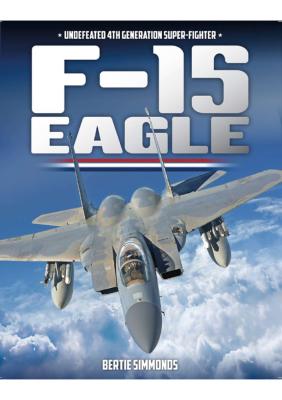
Here the author begins with a page of terms associated with the F-15. Many are familiar, while other are new to me.
Introduction
The intro pages are essentially a recap of the F-15 features, series, weapons and brief combat history.
Chapter 1 Flight of the Eagle
This chapter reviews the developmental history of the F-15 beginning with the F-X (Flighter-Experimental) Project. Several in-flight images of the First F-15A model and included. It was interesting to note the F-15 project included no prototype aircraft: The F-15 was ordered off the drawing board.
Brief History
The Douglas A-26 Invader (designated B-26 between 1948 and 1965) is an American twin-engined light bomber and ground attack aircraft. Built by Douglas Aircaft Company during World War II, the Invader also saw service during several major Cold War conflicts. A limited number of highly modified United Sates Air Force aircraft served in Southeast Aisa until 1969. It was a fast aircraft capable of carrying a large bomb load. A range of guns could be fitted to produce a formidable ground-attack aircraft.
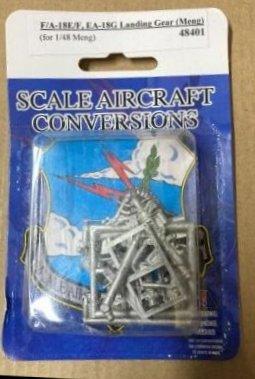
Scale Aircraft Conversions (SAC) is a Texas based company that has been marketing resin and white metal parts for scale model aircraft for over 20 years. They endeavor to be accurate in their moldings, claiming to correct inaccuracies if found. I have bought about a half dozen of their metal landing gear sets in the past, all of which have turned out to be excellent replacements for the plastic kit parts.
SAC’s two-piece landing gear set #72180 is labeled for the ‘60s vintage 1/72-scale Hasegawa F-104G/J, CF-104 kit but I find that the set matches the more recent 1990-issued F-104G/S landing gear as well. A comparison photo of the metal SAC main gear with the F-104G/S gear is shown herewith.