Welcome to IPMS/USA Reviews

Introduction: The primary organization of the IPMS/USA Review website is by IPMS/USA National Contest Class. Within each Class there are sub-menus by kits, decals, books, etc. The Miscellaneous Class is for items that are not class specific or that cross two or more classes.

IPMS/USA Members: We encourage you to submit reviews, both here and to the Journal. To volunteer for membership in the IPMS/USA "Reviewers Corps" and submit your own reviews, please read the Guidelines For Submitting Product Reviews.

Manufacturers, publishers, and other industry members: IPMS/USA is pleased to offer your company the opportunity for product reviews. All product reviews are performed by IPMS/USA members, and are posted in the publicly-accessible section of our website. With very few exceptions, we perform full build reviews of new kit releases, aftermarket products, and supplies. If you would care to provide product samples for review, please contact the IPMS/USA First Vice President.

To learn more about IPMS/USA, please see our About Us page.

Book Author(s)
Author: Gordon L. Rottman; Illustrators: Johnny Shumate Mark Stacey
Review Author
Jeff Leiby
Published on
Company
Osprey Publishing
MSRP
$18.95

Background

The 1st Marine Division landed on Guadalcanal on August 7, 1942 to stop further Japanese expansion. On August 17–18, 1942, the US Marine Corps’ 2nd Raider Battalion conducted an amphibious raid on the Japanese-occupied Makin Island in the South Pacific. This operation was intended to divert Japanese reinforcements bound for Guadalcanal, over 1,000 miles to the southwest. The Raiders were to destroy the seaplane base and radio station, take prisoners, and collect intelligence. The Raiders suffered heavy causalities and even left some Marines behind, but the raid was an invaluable test of the innovative training and tactics employed by the Raiders, and a crucial boost to national morale at this difficult stage in the war.

Book Author(s)
David R. Higgins
Review Author
Andrew Birkbeck
Published on
Company
Osprey Publishing
MSRP
$18.95

Both German and Soviet military theorists in the years leading up to WW2 incorporated tanks into their battle plans to exploit breakthroughs in the enemy’s lines. These tanks incorporated turrets capable of rotating 360 degrees, thus making them expensive and time consuming to produce and maintain. Little thought on either side was put into providing the slower moving foot soldiers with self propelled artillery or anti tank capabilities. The Germans were the first to see the utility of providing their troops with SPGs, with the introduction of the Sturmgeschutz (StuG) and Sturmartillerie, self propelled tracked vehicles with limited traverse guns protruding out the front end of the vehicle, and capable of knocking out enemy hard points and limited anti tank duties. Such vehicles were cheaper to manufacture than tanks.

Review Author
Scott Hollingshead
Published on
Company
Eduard
Scale
1/200
MSRP
$32.95

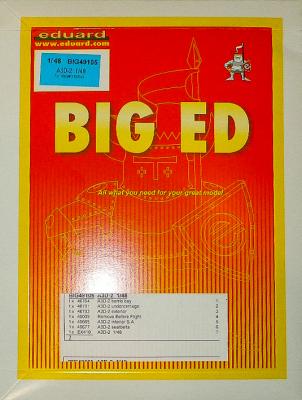
If you are looking to add some “life” to your next 1/200 scale US Navy ship, allow me to direct your attention to Eduard release 53109. This set contains 1/200 scale figures that are pre-painted, and require simple bending in order to create more of a three-dimensional effect. Although labeled as WWII, the U.S. Navy, being all about tradition, kept the denim work uniform in use past my discharge in 1991. The only challenge would be with the dress white uniform as the one depicted in the kit was discontinued sometime after the 1940’s. The figures are easy enough for anyone who is experienced with photo etched parts to use, and will make a nice addition to your next Ship, Submarine, or Boat of this scale.

Review Author
Andrew Birkbeck
Published on
Company
The Ampersand Publishing Group
MSRP
$15.95

For those readers not familiar with this series of publications, they are published by Ampersand Publishing, the firm responsible for the excellent Military Models in Review (MMiR) armor modeling magazine edited by Pat Stansell, one of my favorite magazines. As the title suggests, each issue of Allied-Axis contains a number of photo journal articles covering various aspects of the Second World War. The issue under review today contains three separate articles. For the most part, each page of any given issue is devoted to a single photograph, with an appropriate written caption. Thus the detail contained in each photograph is extremely good, due to its size. For the most part, the clarity of each photograph varies from good to superb, depending on the quality of the original print used. The Journal paper quality utilized is also very good.