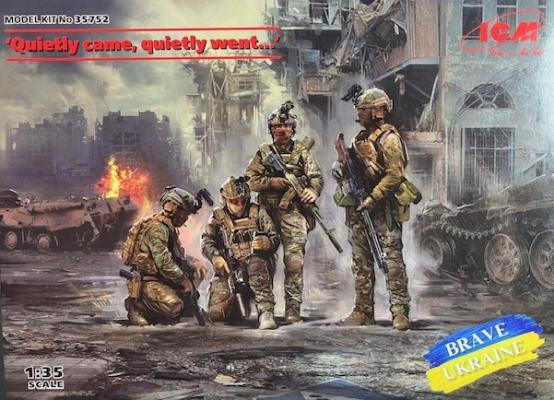
ICM has provided this 1/35 figures kit of Special Operations Forces of Ukraine. There are four figures in the kit. Two standing and two bending down. Three grey Sprues, One Instruction guide
Reviews
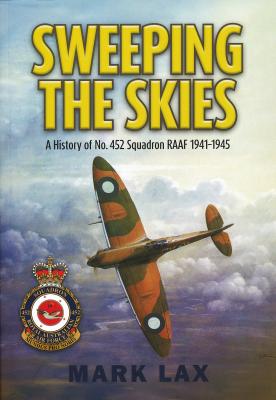
At the start of WWII, the Royal Australian Air Force was little more than a glorified flying club with few pilots and only a couple of hundred effective aircraft. With the outbreak of war, the Australian Government committed to a large and rapid expansion of RAAF airpower, including the formation of a number of units in Britain to serve alongside the RAF. One of these squadrons was 452, a fighter squadron formed in April 1941 and manned by RAAF personnel but operationally controlled by the RAF.
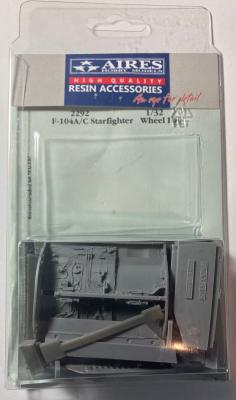
Aries has provided this very nice Resin upgrade for the Italeri Kit for the wheel bays and gear bay doors. The set includes 27 resin parts and a double-sided instruction sheet. All the parts are very detailed and will add a lot of details to the current kit details. The photos show how good these parts are. The parts are produced with very little flash or material to remove. In conclusion these parts will add so much more details to the standard kit.
Thanks go to Aries for providing this kit to review and IPMS/USA for allowing me to review it for them.
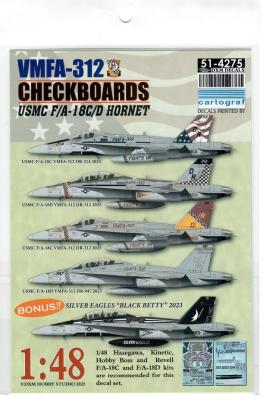
DXM (Double Excellent Model) Decals is a hobby company based in Taiwan and has been producing models since 2018. DXM produces modern jet aircraft (primarily United States, Japan, and Israel, but there are some other unique air forces – Hellenic, Islamic Republic of Iran Air Force, etc.) decals in 1/144, 1/72, 1/48, and 1/32 scales. In addition, there are weathering/rusted airbrush templates, 3D parts, and conversion sets. The decals are printed by Cartograph. You can see their amazing products on their homepage and even have a YouTube video reference for applying their decals.
DXM’s 1/48 scale USMC F/A-18C/D VMFA-312 & 115 Decals Set has five options from MCAS Iwakuni, Japan, all from VMFA-312 DR 214:
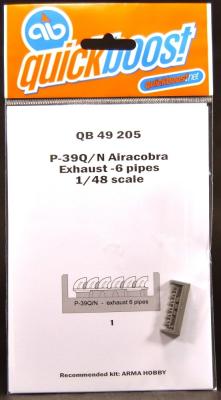
Quickboost recently provided the Reviewer Corps with drop-in resin replacement exhaust pipes for Arma Hobby’s P-39Q/N Airacobra in 1/48 scale. The sample item came in a plastic bag with cardboard backing. There are no instructions for this set. For the Arma Hobby kit and they are direct replacements for part A22.
There are two exhaust pipes (left & right) from the traditional pour moldings for these resin replacements (not 3D generated). The quality is excellent, and the exhaust pipe ends have holes molded in, so no drilling is required.
Conclusions
This is a great traditional resin set if you want to replace the engine exhaust on your P-39Q/N Airacobra in 1/48 scale. Just wash and add paint. Highly Recommended to everyone who wants to add more detail to their P-39Q/N Airacobra! I want to thank Aires and Quickboost for providing the resin set and IPMS/USA for allowing me the opportunity to perform this review.
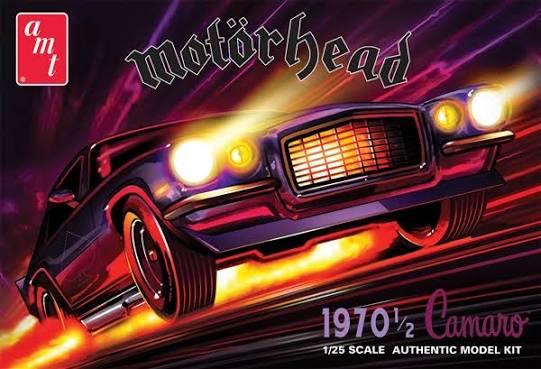
I’m gonna kick this off with a little background on the concept for this AMT kit. Motörhead was a hard rock band that started out in the 70s and was super popular in my high school years in the 1980s. They were out of the UK and had a number of top 10 singles and albums. Being a car guy, Motörhead just fit my mentality at the time, even though I wasn’t as much into hard rock in that era. Ace of Spades was one of their singles on an album of the same name. It was on their second album and reached pretty high in the charts. Doing a themed Camaro based on this band just seems to be a natural thing to do!
This was an exciting kit to see on the Reviewer Corps list! Being in High School in the 80’s this was a must-build kit, like printing money as a hard rock singer in that era! Hard charging, no holds barred, loud and proud band, no, I mean Camaro! This review is going to be an exercise in seeing how many exclamation points I can use.
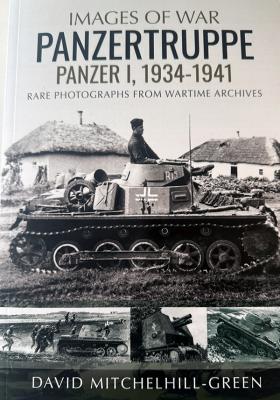
The book examines the early development of German armored forces in defiance of the Treaty of Versailles. It traces the evolution from experimental prototypes in the interwar period to the Panzer I (Panzerkampfwagen I / Sd.Kfz. 101), Hitler’s first mass-produced tank.
Although small, lightly armed, and limited in combat performance, the Panzer I played a key role in training Panzer crews and enabling the early Blitzkrieg campaigns. It saw action in the invasions of Poland, Denmark and Norway, the Low Countries, France, and the early stages of the campaign in the Soviet Union. The volume covers design innovations across models and variants, combat history, operational performance, pre-war training, and its contribution to later, more powerful German tanks.
The book is organized around the development, technical features, training role, and combat employment of the Panzer I (and related early Panzertruppe equipment) from the mid-1930s through 1941:

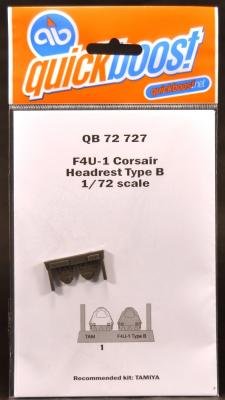
Quickboost has provided the Reviewer Corps with a resin upgrade replacement detail for Tamiya’s F4U-1A or D Corsair Headrest Type B in 1/72nd scale.
In The Package and Product Notes
The sample review came in a plastic bag with cardboard backing. There are instructions for this set and it will show the removal of the headrest pad for parts B15 & B16. This will allow the new headrest to be installed on the forward side of the bulkhead.
Note: this part cannot be used on F4U-1 “Birdcage” variant with the aft scalloped windows.
There are two headrests provided and they are the traditional pour moldings (not 3D generated). The quality is excellent with very fine detail.
Please note, since this is a resin part, Superglue (CA) or other bonding agent will be needed to secure the headrest to the kit plastic.
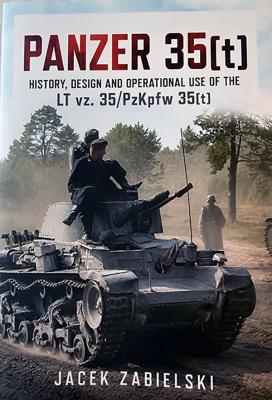
Jacek Zabielski’s new monograph arrives as a welcome addition to the literature on early-war light tanks. The LT vz. 35—better known in German service as the Panzerkampfwagen 35(t)—has long occupied an awkward middle ground: important enough to appear in most general accounts of the 1939–41 campaigns, yet rarely given sustained, dedicated treatment in English. This book sets out to correct that imbalance.
Scope and Approach
The work covers the tank’s full arc: its origins as a Škoda design for the interwar Czechoslovak Army, technical development, production, and subsequent use by Germany, Slovakia, Romania, Bulgaria, and other operators. Particular attention is paid to mobility, mechanical features, reliability, and the vehicle’s performance in the early Blitzkrieg campaigns in Poland and France, as well as its later service on the Eastern Front before obsolescence set in. The publisher notes roughly 260 black-and-white illustrations supporting the text.
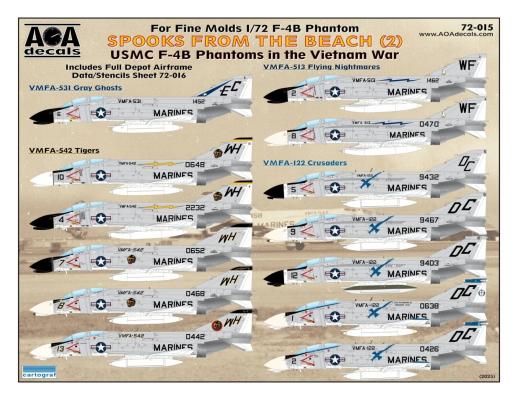
This wonderful decal set covers USMC F-4B Phantoms from the following squadrons:
- VMFA-531 Grey Ghosts
- VMFA-542 Tigers
- VMFA-513 Flying Nightmares
- VMFA-122 Crusaders
I had been eager to build the Crusader’s 3-gunned F-4B that flew from Da Nang with 3 Mark 4 gun pods for several missions, so I was eager to try out these decals. I was not disappointed. Printed by Cartograph, they are very crisp, and include various options for each squadron’s markings, a set of walkway decals, and all the stencils needed. The stencils include some specific for the J model, but they are called out on the instruction sheet so just pay attention.