
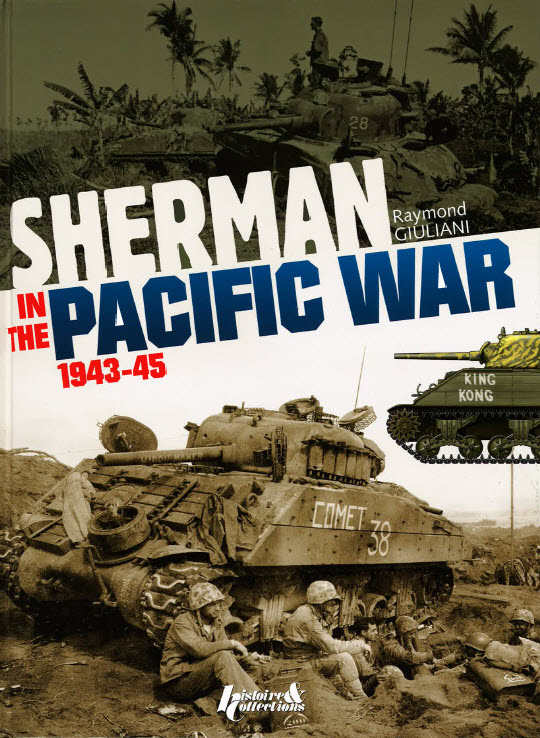
Sherman In The Pacific War 1943-1945
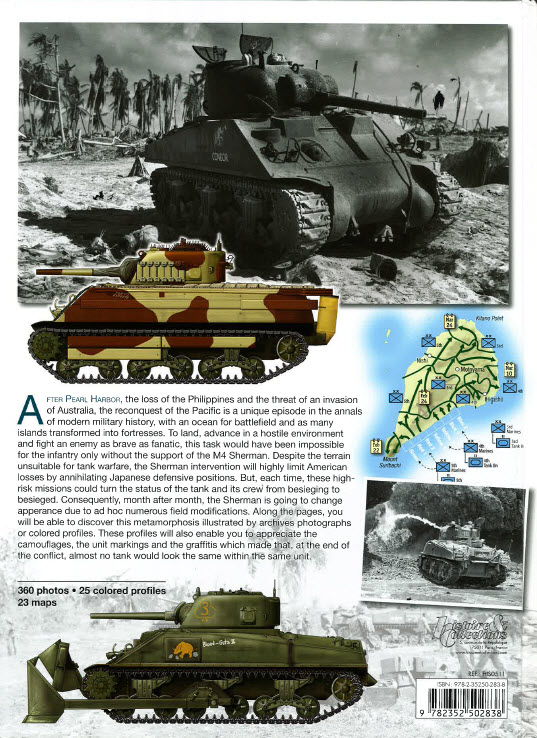
Raymond Giuliani covers a fairly rare subject, of the use of the Sherman tank in the Pacific. This book begins in 1943 as the Sherman began replacing the M3 Stuarts in the Pacific as the US island hopped towards Japan. The good news is that neither had to face any steel Tigers. Raymond Giuliani traces the trek across the Pacific island by island and also depicts the evolution of the flamethrower tank. The book includes over 350 photos, 25 color tank profiles, and 23 maps. There are spelling errors and interesting grammar choices due to the translation from French, but nothing that will hinder your understanding.
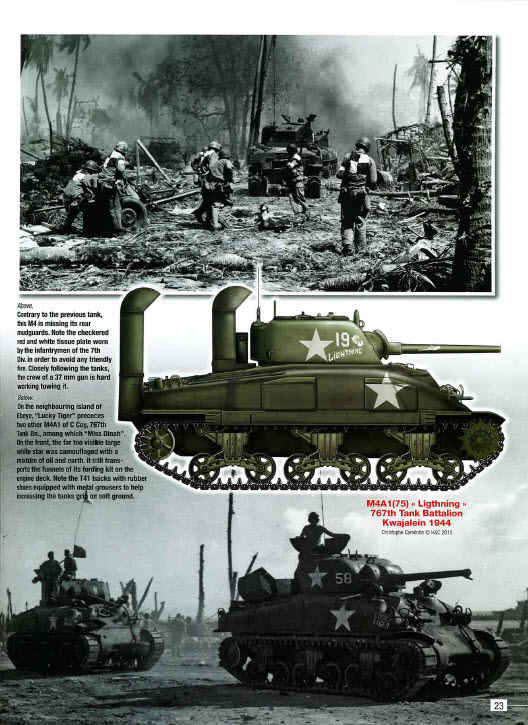
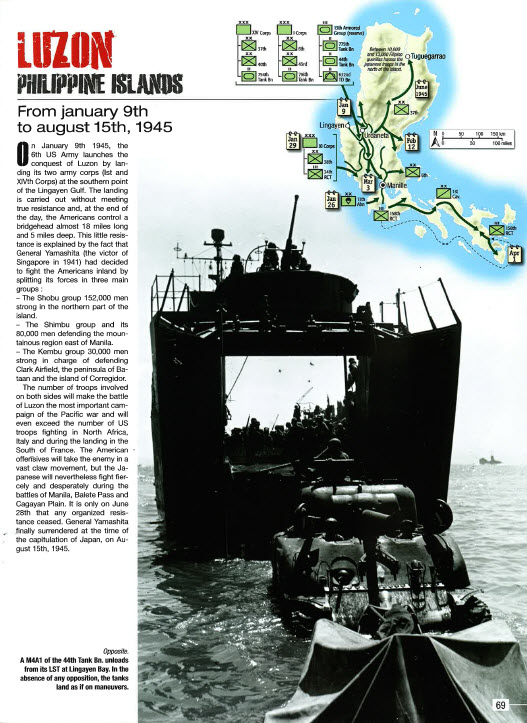
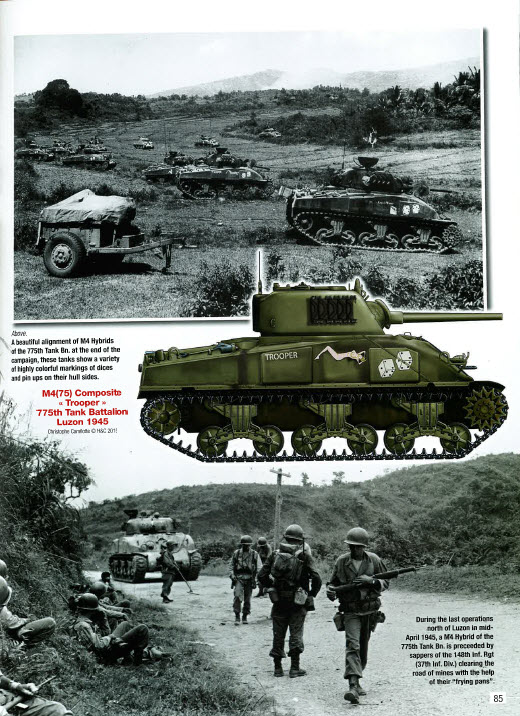
The Introduction covers the transition from Stuart to Sherman with Battalion and Company organization charts before launching into the first chapter, Taupota, New Guinea in October 1943. Each chapter basically consists of a map of the island with company deployments and progression, nice large sharp photos and descriptive text for each of the photos. Christophe Camilotte’s color illustrations highlight the black and white photos and include color ‘scraps’ to show off custom markings.
The chapter on “Calliope in Guadalcanal” shows a series of photos of Shermans outfitted with a 4.5” T34 rocket launcher and a7.2” M17 launcher that were evaluated by the Marines. Another chapter details the (later abandoned) attempts to provide tank crew with protection from gas attacks and the Japanese anti-tank magnetic mines. By the time the book progresses to Iwo Jima, the implementation of the flame thrower tanks becomes more evident with plenty of ‘in-action’ and detail shots. The author provides a nice chapter on the details and implementation of the Sherman flamethrower, including a detailed cross section of the CB-HI gun assembly. The last chapter continues as before, but tucked into this chapter are six color photos of M4A3s landing on the beaches of Okinawa. An interesting trend as the Japanese converted their 75mm guns into anti-tank guns was the additional armor that the Army and Marines began decorating their Shermans with. One sharp picture shows “The 392nd Avenger with additional heavy armor plating on the front glacis as well as hanging armored skirts over the running gear.
The Chapters include:
- Introduction
- Taupota
- Betio / Tarawa
- Bougainville
- Cape Gloucester
- Roi-Namur
- Kwajalein and Ebeye
- Eniwetok
- Biak
- Saipan
- Tinian
- Guam
- Pavuvu
- Peleliu
- Calliope in Guadacanal
- Leyte
- Luzon
- Protection Against Gas Attack and Antimagnetic Paste
- Panay and Negros
- Mindaneo
- Cebu
- Iwo Jima
- Sherman Flamethrower
- Okinawa
I was extremely impressed with the quality of this publication. The linear organization of the book that Raymond Giuliani provides, along with the superb, large photos, makes this a ‘must-have’ for any WWII or AFV fan.
My thanks to Casemate and IPMS/USA for the chance to review this great book.
Highly recommended!


Reviewer Bio
Frank Landrus

Frank retired from the Ophthalmic industry with over thirty-six years of Research and Development experience. Frank's first model kit was a 1959 Hawk 1/72 US Marines Vought AU-1 Corsair and has been building models for over sixty years. Frank's first encounter with IPMS was attending a North Central Texas ScaleFest show in 1984. Frank soon became more involved in Make-N-Take activities and became the IPMS Western Coordinator for Make-N-Takes [West of the Mississippi River]. Make-N-Takes quickly became a local model contest and airshow staple reaching a high of reaching over 1,300 children before the COVID shutdown. Frank has volunteered to assist in contest judging since 1985 and is currently the Nationals Head Figure Judge until he is dead or they find someone better.
Comments
Insignias on US m4a2
M4a2 sherman ever wear a white star on a blue circle?
Add new comment
This site is protected by reCAPTCHA and the Google Privacy Policy and Terms of Service apply.
Similar Reviews