Reviews of products for scale ship models, including submarines.

Review Author
Allan Murrell
Published on
Company
OKB Grigorov
Scale
1/700
MSRP
$17.00

OKB Grigorov has provided another very nice kit with the Israeli Gal submarine which represent a diesel-electric submarine developed and constructed in the Vickers Shipyard in the UK for the Israeli Navy. They were based on the German 206 class submarines. The “Gal” (Hebrew for Wave) class entered service in the late 1970’s and were all replaced by the Dolphin Class by the early 2000’s.

  • One resin part
  • Two very small photoetch sheets

The detail quality is great; The resin submarine is very delicate an you need to be carefully removed from the resin base.

There was no instruction sheet provided, this was not a problem as it was a simple build.

The Assembly is quick and easy.

The metal stand is a good addition to the kit.

The final part is painting.

This is my seventh one of these great kits and I really enjoy building these and they make a wonderful display all lined up.

Review Author
Mike Kellner
Published on
Company
Italeri
Scale
1/35
MSRP
$119.00

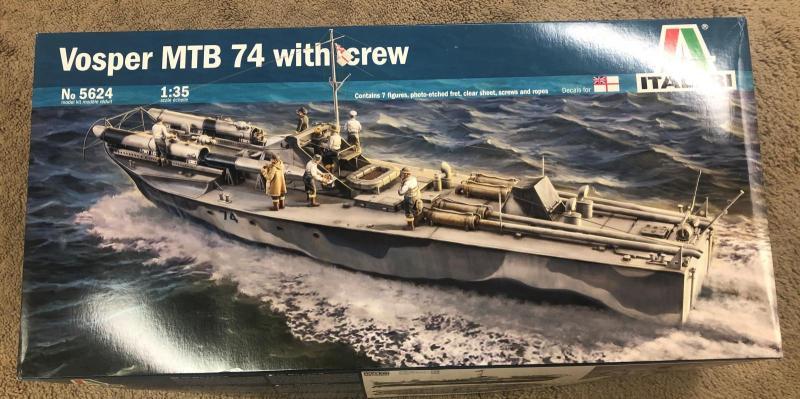
Italeri’s 1/35 scale version of the Vosper MTB 74 which was used on the 28 March 1942 Operation Chariot Saint Nazaire raid comes in a big box. It was a specially configured boat having most of its offensive armament removed and having two torpedo tubes added to the foredeck. It also had special muffler silencers added. It successfully hit the nets which protected the docks, torpedoed the lock gates and achieved its mission, but was sunk on its way back home. Chariot achieved its goal of disabling the only dry dock in German-occupied France which could handle the Tirpitz so that forced her to return to Germany for any repairs.

The kit is molded in gray plastic and includes a fret of photoetched details, a decal sheet, a clear sheet, screw, ropes, and seven crew figures. The hull is in two pieces with just the aft transom area being separate.

Review Author
Luke R. Bucci, PhD
Published on
Company
Lion Roar
Scale
1/700
MSRP
$27.00

Thanks to DragonUSA for supplying the resin/PE set for review and IPMSUSA staff for handling the request and publishing this review.

Bottom Line: LionRoar has produced a line of WW2 US Navy barges, either mixed resin + photoetch or all metal photoetch. Few parts, a tricky PE folding and assembly job for an unusual subject that would be a necessity for dockyard dioramas. Would have liked better instructions and decals for the barge YD number, but a quirky, fun build. Change of pace weekender for the more advanced modeler.

Book Author(s)
Witold Koszela
Review Author
George Cully
Published on
Company
Mushroom Model Publications - MMP Books
MSRP
$42.00

The Royal Navy’s HMS Nelson and HMS Rodney came about in an unusual way, and that helps to explain their unusual silhouette: all three of both ships’ triple barrel main gun turrets were mounted on the foredeck, and their massive bridge superstructures and secondary armament suites were sited aft. Nothing else afloat looked quite like them. These ships were named after two famous British admirals: George Rodney, victor of the Battle of Cape St. Vincent (1780) and the Battle of the Saintes (1782), and Horatio Nelson, who won the Battle of the Nile (1798) and the Battle of Trafalgar (1805).

Review Author
Frank Landrus
Published on
Company
Master Model
Scale
1/350
MSRP
$20.00

SMS Seydlitz was a battlecruiser of the German Kaiserliche Marine (Imperial Navy), built in Hamburg. She was ordered in 1910 and commissioned in May 1913, the fourth battlecruiser built for the High Seas Fleet. She was named after Friedrich Wilhelm von Seydlitz, a Prussian general during the reign of King Frederick the Great and the Seven Years' War. Seydlitz represented the culmination of the first generation of German battlecruisers, which had started with the Von der Tann in 1906 and continued with the pair of Moltke-class battlecruisers ordered in 1907 and 1908. Seydlitz featured several incremental improvements over the preceding designs, including a redesigned propulsion system and an improved armor layout. As with the rest of the German battlecruisers that survived the war, the ship was interned in Scapa Flow in 1918. The ship, along with the rest of the High Seas Fleet, was scuttled in June 1919, to prevent her seizure by the British Royal Navy.

Review Author
Frank Landrus
Published on
Company
Master Model
Scale
1/350
MSRP
$20.00

HMS Lord Nelson was a pre-dreadnought battleship launched 04-September-1906 and completed in 1908. Her sister ship in the class was HMS Agamemnon also launched 23-June-1906 and completed in 1908. The delays between launching and completion of both ships was due to the diversion of their 12” guns to the completion of HMS Dreadnought. She was the Royal Navy's last pre-dreadnought. The ship was flagship of the Channel Fleet when the First World War began in 1914. Lord Nelson was transferred to the Mediterranean Sea in early 1915 to participate in the Dardanelles Campaign. She remained there, becoming flagship of the Eastern Mediterranean Squadron, which was later re-designated the Aegean Squadron. After the Ottoman surrender in 1918 the ship moved to the Black Sea where she remained as flagship before returning to the United Kingdom in May 1919. Lord Nelson was placed into reserve upon her arrival and sold for scrap in June 1920.

Book Author(s)
Waldemar Goralski
Review Author
Luke R. Bucci, PhD
Published on
Company
Kagero Publishing
MSRP
$37.95

Thanks to Casemate Publishing & IPMS/USA for the review copy!

Waldemar Tubus Goralski is a prolific author of illustrated warship books for Kagero Publishing. He also makes exhibitions of his illustrations in Poland where visitors can virtually walk on ships. The late Piotr Forkasiewicz designed the ocean and battle settings (this virtual tour is not in this book). Waldemar is lucky to turn his passion into a career, igniting passions of many modelers around the world.

Review Author
Allan Murrell
Published on
Company
OKB Grigorov
Scale
1/700
MSRP
$17.00

OKB Grigorov has provided yet another very submarine in this case it’s the Italian Navy’s in the Enrico Toti Class Submarine. These were built in the 1960’s and were the first submarines designed and built in Italy since the second world war. They were designed as hunter killers and powered by a diesel-electric engine. They were very similar to the famous German type 205’s. They saw service from 1965 to 1993.

Inside the box are two resin parts and one Photo Etch Sheet

The detail quality is great; The parts are very delicate and need careful removal from the resin bases. There was no instruction sheet provided, this was not a problem as it was a simple build. The Assembly is quick and easy. The photoetch stand is an awesome addition to the kit.

The final part is painting. This is has joined my some navy of these great kits and I really enjoy building these and they make a wonderful display all lined up.

Review Author
Scott Hollingshead
Published on
Company
OKB Grigorov
Scale
1/700
MSRP
$9.09

The Enrico Toti (S506) was the lead boat in its namesake class of Italian submarines. The keel was laid in 1965, she was launched in 1967, commissioned in 1968, and was decommissioned in 1992. In 2005 the boat was moved by land to Milan, where she resides today in the Museum of Science and Technology “Leonardo da Vinci”. Called “pocket submarines” due to their diminutive size, the boats of this class were intended only to operate in the Mediterranean Sea, mostly to patrol the Channel of Sicily and participate in NATO exercises. The boat is 151.6 feet long, has a 15.4 feet beam, and has a draught of 18.7 feet. The two Fiat diesels provided power to the diesel-electric drive that would propel the boat at 14 knots surfaced, or 15 knots submerged. The crew consisted of 4 officers and 22 sailors, and she was armed with four 21-inch torpedo tubes.

Review Author
Dave Morrissette
Published on
Company
Brengun
Scale
1/72
MSRP
$10.00

One of the under recognized armaments for after market has been the depth charge. It is fairly simple to find missiles, bombs and other under wing things all very well done and in most scales but not so much depth charges. Brengun has issued a set (which looks like a rerelease of the Attack Hobby set) of the Mk. 54 Depth Charge in 1/72nd scale.

Looking at the set, you get two gray resin blocks which contain the depth charge body and the nose pin for the front arming propeller. There is also a photoetch fret containing 18 pieces, a set of decals and the instructions for assembly, painting and decaling the set.