Operation Colossus was an airborne commando raid into Italy early in the war to interdict a particular aqueduct vital to the towns in the ‘heel’ of Italy. The operation is not very well known and this book is a welcome addition to anyone’s WWII library as it fills a void not covered in other publications. Author Lawrence Paterson spends a great deal of time at the beginning of the book relating the story of the creation and training of the UK’s airborne forces, going into some detail as to the people and personalities involved as well as the training and equipment used. If you have any interest in airborne forces, you will find this part very interesting and even if you don’t, it is written in a very readable manner, so it will hold your interest.
In January 1945, the collapse of the German front along the Siegfried Line led to a large-scale dissolution of German combat forces and capability. Pressed hard by Allied forces advancing eastward, German units often found themselves trapped west of the Rhine River. With his eye on history, US Lt. Gen. George S. Patton, Jr. was determined to be the first leader since Napoleon to make an assault crossing of the Rhine. The most logical crossing-place was at Mainz, as it served as a major railroad logistical link from west to east. However, Patton was aware that this would be obvious to the Germans, and therefore he and his staff made rapid plans for another site at Nierstein and Oppenheim, about 12 miles south of Mainz.
The Setting
On June 25, 1950, President Harry Truman was flying back to Washington, D.C. to deal with the outbreak of war in Korea. He thought, “In my generation, this was not the first occasion when the strong attacked the weak. I recalled some earlier instances: Manchuria, Ethiopia, and Austria. I remembered how each time that the democracies failed to act, it encouraged the aggressor to keep going ahead. Communism was acting in Korea just as Hitler, Mussolini and the Japanese had acted, ten, fifteen, twenty years earlier . . . If this was allowed to go unchallenged it would mean a third world war.”
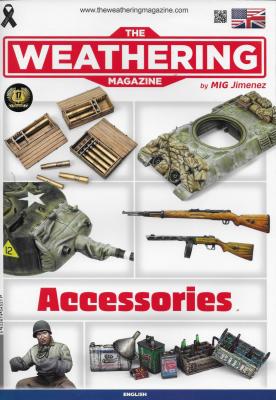
The Weathering Magazine is one of three magazine series published by the AMMO/ Mig Jimenez Company. This division of Mig Jimenez’s modeling products empire also publishes two other magazines are: Weathering Magazine: Aircraft and Special Editions. Special Editions are primarily focused on one, specific subject. The Weathering Magazine: Abandoned. Is the thirtieth edition in this series and encompasses six, specific How-To articles on a variety of subjects.
Those subjects are :
As I sit writing this review, I cannot help but think that I should just be returning from seeing some of you at the IPMS Nationals in San Marcos. Well, hopefully there are better days ahead, and I do already have my hotel reservation set for Las Vegas next year. Like many of you, I have met some great folks over the years and look forward to seeing at least some of those folks again in the future, and meeting even more fellow modelers.
So how much can you really say about masking sheets? Well, this new set from Mig contains five sheets measuring 280 by 195mm or roughly 7-11/16 by 11-1/16 inches, which seems to be a pretty good value for the price. The sheets are yellow in color for the masking material with a slightly rough texture. I measure the masking material as 0.0035 inch or 0.08 mm in thickness with an adhesive similar to that used by Tamiya on their masking tapes as far as “stickiness” is concerned.
John Miller, IPMS member and owner of Model Paint Solutions (modelpaintsol.com) has an electric pencil sander called the David 400 (D400) on his web site. The sander has a wall cord that plugs in the back of the sander, fits nicely in the hand, and is very comfortable to use.
When I first saw the tool, I thought why do I need an electric sander? I have an abundance of sanding tools already. It just so happened that I was working on the Airfix 1/72 scale Tiger Moth and had a very small area to sand under the horizontal stabilizer. With that small an area to be sanded and the delicate nature of the sanding that had to be done, I thought the D400 would have made the job a lot easier and faster.
If you are looking to learn about the battle for Crete in WWII, Crete, The Battle for Heraklion, 1941 may not be the book for you to start with. This book deals almost exclusively with the battle for the town and airfield of Heraklion, only one of three landing areas for the German paratroopers on Crete. However, if you are interested in the stories of those on the “sharp end of the stick” in a battle, this book is great as it depends heavily on first person accounts of those who were actually there. While some British, Commonwealth and Germans are included, most of the stories are of the Greeks/Cretans involved, which is good because they are usually overlooked or de-emphasized in most histories which tend to concentrate on the German paratroopers or the British and/or Commonwealth forces involved.
Thanks to Casemate Publishing & IPMSUSA for the review copy!
Philip Wilkinson has written a tome on a topic seldom seen – Anglo-Russian air force togetherness from before the First World War to a few years ago. This book contains a wealth of historical information that is very difficult to find, along with a first-hand view of military cooperation (or not) by the author. Mr. Wilkinson served in the RAF and thus this book is chiefly concerned with British airpower and its changes through war and peace. His perspective and insights are many and astute. If you are looking for technical details or operational histories, this is not the right book. If you want to know the highlights of RAF-Russian interactions from an RAF viewpoint, this is the right book.
Born in Lima, Peru, in 1977, Amaru Tincopa is a graduate in law. He developed a strong interest in history at a very young age and began researching and publishing about Peruvian and Latin American military aviation history quite early. His first book, covering the deployment history of the Aeroplani Caproni and that Italian company’s endeavor in Peru was released in 2003 for an Italian publisher. He has since published a dozen additional titles in Argentina, France, and the United Kingdom, while three others are in the pipeline. Amaru Tincopa is currently cooperating with numerous renowned military aviation history magazines around the world. This is his third book for Helion.
The Book
Inside the front cover is a listing of other titles in Helion & Company’s “Paper Soldiers” series. Interested in the Civil War? Which one, American or English Civil War? They have games for both. Roman legions? American Revolution? Trafalgar? The Spanish Armada? It’s all in there.
This book is based on H. G. Wells’ 1913 book which gives rules for movement and battle with miniature armies. The book is subtitled “A Game for Boys from twelve years of age to one hundred and fifty and for that more intelligent sort of girl who likes boys’ games and books. “