Bottom Line Up Front: This most recent addition to the Osprey Men-at-Arms Series does its best to make sense of a confusing subject, to the Japanese civil wars of the 1860s and 1870s period. It is well illustrated and provides rudimentary information that is fairly easy to understand.
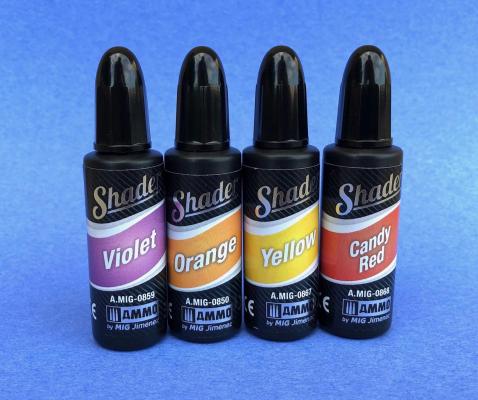
Ammo has released a new line of 20 paint effects colors in 10 ml bottles. I am reviewing four of these colors: #0863 Light Green 0864 Light Olive Drab, 0865 Military Green and 0866 Dark Green. These are the four green tones that they offer, along with blues, greys and earth tones. Here is what Ammo’s website says about this new product:
“The AMMO SHADERS are a new type of product designed to create a variety of effects on all types of models in a simple and fast way. The transparent and ultra-fine paint allows all skill level of modelers to apply stunningly realistic effects that seemed impossible before.
Being an aficionado of the history of the aircraft and persons involved in aviation during World War I, this book became a “must have” after reading some of the reviews describing the book. I must say that I was not disappointed in any way, and in fact found this “photo history of the Lafayette Escadrille” one of the most compelling “reads” I’ve experienced in many a year.
The story of The Lafayette Escadrille is laid out in photos, quotes from letters written by the pilots, and historical records of the time. The author spent a year travelling to universities and museums, as well as the actual geographic locations described in great detail in the documentation uncovered during the research phase for the book. The author captured images of some of the buildings frequented by the men of the Lafayette Escadrille and the comparison of historical images and the modern images taken by Ruffin are remarkable.
Helion produces books on many aspects of Military History from the Late Medieval period through to the present day. Helion was established in 1996, and since then they have published almost 1,200 books, with 100 or more new titles coming out every year. The 'Africa@War' series covers African military history since 1945.
Peter Baxter is an author, amateur historian and heritage travel guide. Born in Kenya and educated in Rhodesia (Zimbabwe), he has lived and traveled over much of southern and central Africa. Peter lives in Oregon, USA. His interests include British Imperial history in Africa and the East Africa campaign of the First World War in particular. He is the author of Pen and Sword's Gandhi, Smuts and Race in the British Empire. You can find out more at peterbaxterafrica.com
I have heard of Tru-Color Paints probably 18 month ago by now and since then I had the chance to review a few different colors and coats from them. They have an extensive line of railroad and car paints and they are continuously expanding their military line (aircraft, naval, armor).
This time, thanks to the kind support of Tru Paint to IPMS/USA I was able to use them for the review of an Eduard P-400 Profipack (model kit review elsewhere in this website). As I was doing a review of paints, I decided to go for a P-400 which was assembled from parts of different airplanes and sported a mix of USAAF and RAF colors.
This is not a specific set for the P-400 (Tru-Colors has a few packs of paints). It was more like I was able to “make my own” set of paints. Below is the list of paints I used in this review:
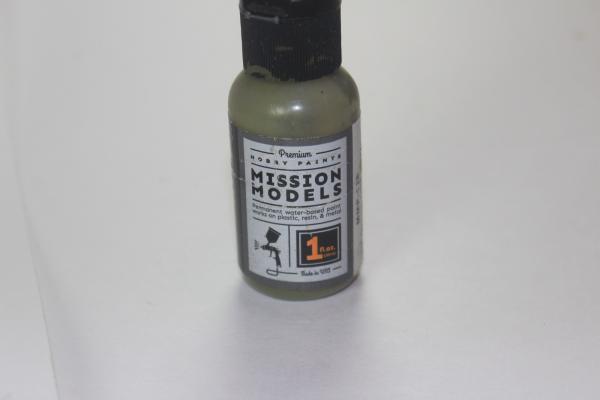
Several of my modeling friends have been using Mission Model Paints and telling really good things about them. When I had the chance to review some of them I jump on that opportunity.
Before I go into the particular details of these color change colors, I wanted to mention a few things about the Mission Models Paints:
The very first thing you notice is the volume you get in each bottle: 1 fluid oz. That would keep you painting for a while. You might worry about the fact that the paint might go bad before you are out of it, but don’t worry. Based on the chemistry of it, it is shelf stable. I don’t know if after 5 or 10 years it will still be as good as pristine, but it should last you a long, long time.
Another thing to highlight is that each bottle has a “mixing ball” inside. I’m not sure if it is truly a ball, but you can shake that bottle and the little “rattle” will help you mix the paint thoroughly.
Several of my modeling friends have been using Mission Model Paints and telling really good things about them. When I had the chance to review some of them I jump on that opportunity.
The very first thing you notice is the volume you get in each bottle: 1 fluid oz. That would keep you painting for a while. You might worry about the fact that the paint might go bad before you are out of it, but don’t worry. Based on the chemistry of it, it is shelf stable. I don’t know if after 5 or 10 years it will still be as good as pristine, but it should last you a long, long time.
Another thing to highlight is that each bottle has a “mixing ball” inside. I’m not sure if it is truly a ball, but you can shake that bottle and the little “rattle” will help you mix the paint thoroughly.
The Mission Models Paint website has an extensive section on “FAQ” and “Tips”. I would recommend you read it before you use this paints. As they say there “…we are teaching you new tricks”.
Lieutenant Colonel Peter Macfarlane served with the Royal Dragoon Guards. The Colonel of the Regiment commissioned this history to make it accessible to the public. Histories cover the facts, but there has to be a lot of research and digging to get the information which is presented here.
Contents
- Foreword
- Introduction
- Regimental Life
- Keeping the Peace
- Small Wars
- Major Wars of the 17th Century
- Major Wars of the 18th Century
- Major Wars of the 19th Century
- The First World War 1914-18
- The Second World War 1939-45
- The Cold War
- 21st Century Operations
- Appendices
- Bibliography
- Index
An explanation. Dragoons were originally organized as infantry but were mounted to give them mobility. As things advanced, they were used as heavy cavalry, armed with swords and pistols.
This book covers a short but brutal campaign near the end of World War II where the Soviets took northern Finland from the Germans, pushing them back into Norway. Finland had capitulated in September of 1944, and the Germans were seriously considering leaving when the Soviet Army (and Navy) attacked in early October. The battles lasted from October 7 to November 5.
Contents
- Origins of the campaign
- Chronology
- Opposing commanders
- Opposing armies
- Orders of battle
- Opposing plans
- The campaign
- Aftermath
- The battlefields today
- Further reading
- Index
The area in question was somewhat political, but there also was a port at Kirkenes, which is in Norway, and Petsamo has iron and nickel deposits and mines which the Russians wanted to deny to the Germans.
Mission Models Paints Pearl Colors
Mission Model Paints has released some beautiful new Pearl colors to their excellent line of acrylic paints. The Pearl colors have a translucent pearl-like depth and luster. MMP has also issued iridescent color paints that seem to change color when seen from different angles.
The Pearl paints are like Mission Models other water-based acrylics that are odorless, fast drying, don’t clog airbrush tips, and produce a smooth, durable finish. Information on Mission Model Paints is available on their website. Click here for a full IPMS review of Mission Model Paints.