Reviews of products for scale aircraft models.

Review Author
Dave Koukol
Published on
Company
Tamiya
Scale
1/48
MSRP
$81.00

The Soviet Union’s first purpose-designed ground support aircraft, proposed in 1938, the Il-2 first saw production and combat action in 1941 as a single-seat platform. As a result of heavy losses from enemy fighters, the 2-seat version with a rear gunner station was fielded in 1943, and proved to be a crucial element in the Red Army’s defeat of the invading Nazi forces. With over 36,000 units produced, the Shturmovik was and still is the most-produced aircraft in aviation history, and accounted for nearly 1/3 of all Soviet aircraft produced during “The Great Patriotic War.”

Review Author
Brian R. Baker
Published on
Company
Platz
Scale
1/72
MSRP
$39.50

History

The Lockheed T-33A has been around for over 60 years and was a development of the USAAF’s first operational jet fighter, the Lockheed P-80 Shooting Star. Some P-80s were built and delivered before the end of World War II but none was used in combat. Although preceded by the Bell P-59A Aircomet, the P-80 was really the first useful jet fighter we had. Redesignation in 1947 turned it into the F-80, and that is how it is known today. The first two-seater, called TF-80C, was a conversion of a P-80B, 48-356, which, incidentally, was rebuilt later on to become the prototype for the two seat all-weather F-94A fighter. But that is another story. By the way, although the box art calls the T-33A a “Shooting Star,” I’ve never heard anyone refer to the T-33A by that name. It was always the “T-Bird” or just “T-33.” The fighter was the “Shooting Star.”

Review Author
Rod Lees
Published on
Company
True Details
Scale
1/48
MSRP
$18.99

Outstanding detail, great support of the plastic modeling community, etc… all apply to Squadron Mail order and MMD distributors. We at IPMS/USA appreciate and thank you for providing us items to review!

When I purchased the Revell Ventura kit, I thought, “wow, a decent, out of box build even I can sink the ol’ teeth into…” I did not know that True Details was working to upgrade the kit…and, with this cockpit, the detail level went up.

The major items replaced are the instrument panel, throttle/fuel mixture quadrant panel, the basic floorboard, back bulkhead, seats, and middle “island” instrument and switch panel. There are also two side fuselage panels that replace the truly understated sidewall detail in the cockpit. Several kit parts are required: the seat legs for the right-hand seat, control wheel arms to attach the control yokes, and the lower steps to the forward fuselage.

Review Author
Paul Mahoney
Published on
Company
Dutch Decal
Scale
1/72
MSRP
$16.50

This 1/72 set from Dutch Decals comprises 2 sheets of silkscreen decals and a folded instruction sheet covering aircraft using the early Dutch insignia.

Each decal sheet measures a little less than 6”x8 1/2”. The first sheet has letters, numbers (in a unique font) in both black and white, as well as serial numbers, data plates, and some rooster decals for use on both camouflaged and silver-doped aircraft. The second is entirely covered with the orange ‘meatball’ insignia of the early Dutch Air Force. Different sized roundels are provided, both with and without a white surround.

Review Author
Brian R. Baker
Published on
Company
Sword Models
Scale
1/72
MSRP
$32.99

History

The Seafire was essentially a navalized Spitfire designed for carrier operations with the Royal Navy’s aircraft carrier fleet. At the beginning of World War II, although the Royal Air Force was operating some first class equipment (including Spitfires and Hurricanes), the Royal Navy was equipped mainly with types that were decidedly inferior in performance to what the Luftwaffe had. These types, including the Blackburn Skua and Roc, Gloster Gladiator, and later the Fairey Fulmar, were not in a class with the Messerschmitt Bf-109 or the Focke Wulf FW-190, the planes that would become their adversaries. Although the earlier aircraft were used successfully in some operations, it was clear to the naval commanders that more suitable aircraft were required.

Review Author
Jim Pearsall
Published on
Company
Sword Models
Scale
1/72
MSRP
$32.99

I really like the Spitfire. I’ve built almost as many of them as I have F-4 Phantom IIs. So, when the opportunity came to build a Seafire for a review, I volunteered. Does begging and pleading count as volunteering? Anyway, I got the new Sword Seafire Mk XVII, and Brian Baker got the Seafire III.

The Aircraft

The Seafire was a much desired aircraft. The Fleet Air Arm dearly wanted a high-performance fighter for their carriers. Because production of RAF Spitfires was a much higher priority, they got Blackburn Rocs (which were insufficient), Wildcats (Martlets), and Hellcats. The first Seafires were modified Spitfire Mk Vs. As Spitfires evolved, the Seafires changed, too.

Review Author
Roger Rasor
Published on
Company
Master Model
Scale
1/32
MSRP
$6.29

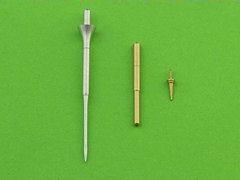
Master Model now has covered all the basses when it comes to turned aluminum pitot tubes for Hawker Hunter models by adding one for 1/32 scale kits (currently, that means Revell or Revell of Germany F.6 or FG.9 kits). In this larger scale, the addition of a more accurately proportioned metal pitot tube is almost a must if the builder is striving for accuracy. The photo below of the metal part compared to the injection molded kit part tells the story. Placing it next to the kit part clearly shows show how nicely the tapered Master Model metal looks by comparison.

The Master Model pitot tube can be attached with super glue or epoxy cement. Then, a little filler may be needed to blend the hole in the wing’s leading edge after anchoring the smaller diameter metal tube. The thin metal tube will likely survive an occasional bump or two but, because it is aluminum, it may bend if it is bumped too hard.

Book Author(s)
Przemyslaw Skulski
Review Author
Paul Mahoney
Published on
Company
Mushroom Model Publications - MMP Books
MSRP
$27.00

The latest issue in MMP’s ever-expanding “Yellow” series is specifically dedicated to the North American A-36A Apache.

The first 47 (out of 128) pages of this book are a mixture of text and photos describing the development and combat experiences of the A-36. The first few chapters cover the design and development of the A-36. The following chapters are each dedicated to an individual combat theater in which the “Apache” was deployed. Usage in North Africa, Sicily, Italy, and the Far East are covered. 2 pages are specifically dedicated to a history of the only A-36 ace, Captain Michael Russo. After this, there is a brief discussion of the British evaluation (and subsequent rejection) of the aircraft. The final portion of this section is a technical description of the A-36A-1-NA which includes several photos and technical drawings from the official Technical Manual for the aircraft.

Review Author
Greg Wise
Published on
Company
Great Wall Hobby
Scale
1/48
MSRP
$79.95

History Brief

The early 1930s US Navy needed a torpedo bomber and accepted the all-new monoplane design from the Douglas aircraft company. The TBD-1 Devastator was ordered on June 30, 1934, first flying in 1935 and entering service in 1937. The Devastator was, at that point in time, possibly the most advanced aircraft flying for the USN or any navy in the world. However, the fast pace of aircraft development caught up with it and, by the time of the Japanese attack on Pearl Harbor, the TBD was already outdated. However, it performed well in some of the early battles, such as Coral Sea, where they saw extensive action. But, during the Battle of Midway, six Devastators launched on their mission against the Japanese fleet were all slaughtered save one, and they did not score any direct hits. As a result, the remaining aircraft of the type were immediately withdrawn from front line service and replaced by the TBF Avenger (also ineffective at Midway).

Review Author
Tim Hortman
Published on
Company
Aviaeology
Scale
1/48
MSRP
$16.99

Aviaeology has re-released their Sunderland decals in 1/48 as “Updated and Expanded.” This package contains a single standard size decal sheet with markings for three aircraft and national markings for one.

All three aircraft are Sunderland GR.III models and are as follows:

  1. EK591: Aircraft 2*U of 422 Squadron RAF Coastal Command, Castle Archdale, Ireland early-mid 1944
  2. DD859: Aircraft 3*G of 423 Squadron RCAF, RAF Coastal Command, Castle Archdale, Ireland August 1943
  3. ML825: Aircraft AB*D of 423 Squadron RCAF, RAF Coastal Command, Castle Archdale, Ireland September 1944

Included with the decals is a very well done, four-page set of directions which includes the decal placement guide, color callouts, and some historical data for each aircraft included. All three of the aircraft included with this decal sheet are responsible for sinking German U-Boats in WWII.