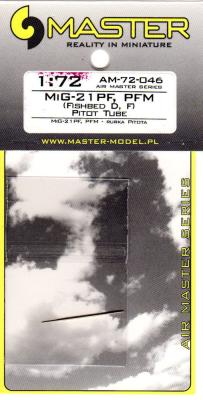
This is another of Master’s growing list of pitot tubes for specific 1/72 scale aircraft. This set continues in the tradition of excellent, quality products from this company. Master’s MiG-23MLD set includes a turned-metal pitot tube and photo etched brass vortex generators. These vortex generators direct air flow when the aircraft is at high angles of attack. If they are placed correctly, this might hold true for your model also. As you can see from the photos, these pieces are much more convincing than the pitot tube supplied in the kit. My only caution would be about gluing the photo etched parts to the sides of the brass pitot tube. I think a little patience will be required since there isn’t much surface area to work with.
I’ve reviewed a couple of these products before and was impressed with the quality of their workmanship. Master continues the trend with their latest release. The MiG-29 set includes the pitot tube itself and two small, photo etched strakes. On the real machine, the strakes are positioned on either side of the area where the pitot tube meets the nosecone to help direct airflow when the aircraft is at high angles of attack (AOA). As you can see from the photos, this little masterpiece is a definite improvement over the kit-supplied piece. In this case, the kit is the Italeri MiG-29. Master’s rendition accurately captures the multi-diameter shape of the original.
The pitot tube has a peg which fits neatly into the nose of the model. Though I haven’t done so, I think gluing the strakes to the pitot tube and nose will be a challenge. There just isn’t much surface area. Perhaps slicing a small groove on either side of the nosecone will offer more purchase.
As a Battle of Britain aficionado and avid reader of stories of the exploits of Allied pilots flying Hawker Hurricanes (and Spitfires of course!) on the Western Front and in the Mediterranean Theater of Operations, it was with keen interest that I delved into this story of the Hurricane on the Eastern Front ― a story with which I was totally unfamiliar. Thus, it was much to my surprise that I learned that the Hurricane was the most numerous Western Allied fighter aircraft serving in the Soviet Union’s army and naval air force units on the expansive Soviet-German front in 1942. Having suffered significant attrition of fighter aircraft during the start of Operation Barbarossa in June 1941, Soviet Premier Josef Stalin appealed to British Prime Minister Sir Winston Churchill for replacement aircraft.
I had been kicking around the idea of purchasing some sets of white metal landing gear from Scale Aircraft Conversions for a while to go with some of the kits that I have in my stash. The idea of being able to put a heavier model on sturdy gear is very appealing to me. So when the opportunity presented itself, I figured that I would give it a shot.
What you get with the replacement landing gear is one full set of main landing gear (right and left) and a tail wheel produced in white metal.
History Brief
Allied code-named “Kate,” the B5N2 was a highly maneuverable aircraft for its type, powered by one Nakajima Sakae 21, a twin-row 14-cylinder 1000 hp radial engine. With a top speed of 235 mph, it had a operational range of 610 miles. A three-man crew was standard. Its armament featured one 7.7mm machine gun for rearward defense and payload capacities of either one 800kg bomb, two 250kg bombs, six 60kg bombs, six 30kg bombs, or one 800kg torpedo. Officially adopted in December 1939 as a follow-up of the B5N1, the B5N2 Type 97 proved to be an accurate bombing and torpedo platform and easily found its way to all six IJN carriers in the Nagumo task force that attacked the U.S. Pacific Fleet in the Pearl Harbor raid. The type 97 became the Navy’s mainstay in the early stages of the war wherever it saw extensive action, including combat campaigns in the Solomons, Southwest Pacific, and Indian Ocean.
Once in a while, I like to build one of the older kits from the stash, adding additional details and such to bring it “up to modern standards”. One of these sitting in the to-do pile is the old AMT/ERTL F7F-3N Tigercat. This kit was recently re-boxed from Italeri, and is the only 1:48 plastic kit of this aircraft anywhere. Quickboost again provides a timely release with these replacement landing gear bay doors.
In the Box
The hanging bag with paper instruction insert comes with five resin parts on three casting blocks. All the bay doors are replaced with items in this set, including both pairs of main landing gear doors and the nose gear door. Casting is flawless in the familiar dark grey resin, and the attachments to the casting block is minimal.
Kit Contents
Scale Aircraft Conversion’s F.4/F-86 Landing Gear for the Airfix kit contains four pieces, three landing gear struts and a weighted replacement upper intake piece, sealed in a blister pack. The pieces were all nicely molded and detailed; however, they had a bit more grain than the original kit parts.
Construction
I started construction with the weighted upper intake. After weighing both parts on my (perhaps imprecise) kitchen scale, I found that the replacement intake weighed only one gram more than the original. The instructions called for a total of three grams to be placed above the intake. Therefore, I added a bit of additional weight to be on the safe side.
Quickboost is back again with a small accessory for an added finishing touch. They have been providing the modeling market with a whole series of useful aftermarket items that give a little extra detail or convenience at a very reasonable cost. These small sets tend to focus on one aspect of a model needing improvement – thus, the modeler can choose where to spend his energy, and money: on kit improvements. This small set from Quickboost provides some covers for the ALQ-99 ECM jamming pods found on the EA-6A, EA-6B, and EF/A-18G. Usually, these are seen on aircraft on static display at airshows, as I have yet to find some photos of them being used out in the fleet during operations, but I could be wrong.
Mark Buchler has been around for several years, making small run resin detail sets for a few kits. His product line is not extensive, but what he does offer is high quality and usually fits the ticket for what is needed. Under the Modelshack label, Mark had a P-61 update set for the Monogram kit that included new cowls and engines. It was taken out of production while new, more accurate, tooling was made using Computer Aided Design (CAD). During the retool, Great Wall Hobby released their new P-61 kit, but it was quickly discovered to have several shortcomings in the cowl and prop area. Modelshack released the updated correction set, which fits both the GWH and Monogram kits, and gives marked improvement to both!
History
The design of the P-51 Mustang was led by the North American design team of Ray Rice and Edgar Schmued. The first unit was rolled out of the North American factory at Mines Field (now L.A. Airport) in just 127 days; the plane, however, had no engine. The plane was initially given the name of Mustang by the British, who had purchased it from the United States.
At this time, an Allison V-1710 in-line 12-cylinder engine was installed. The first flight was in October, 1940. Many versions were made during World War II, with the D being the definitive version. It had six 50 caliber wing-mounted machine guns and a new bubble canopy.
The British Rolls Royce Merlin engine had been adapted to the D version and gave the fighter its high altitude performance and long range, required for bomber escort duties. The Mustang served throughout World War II and during the Korean conflict.