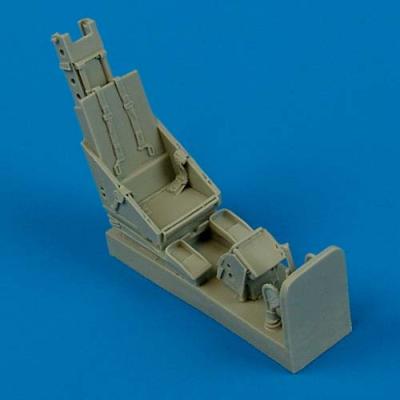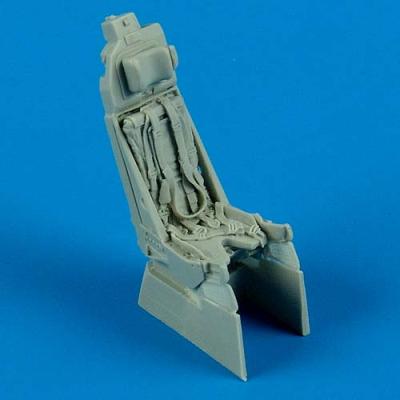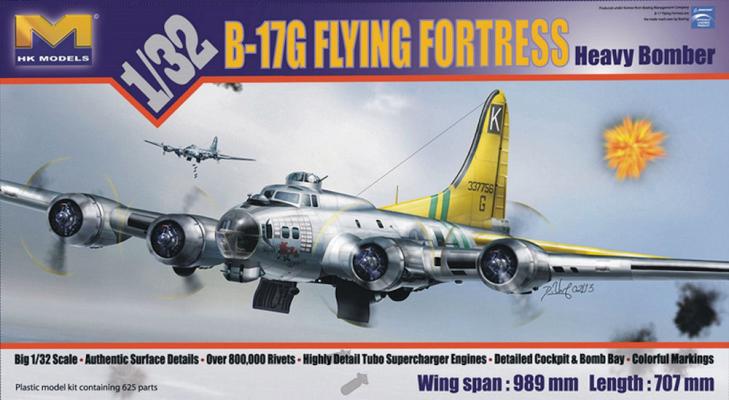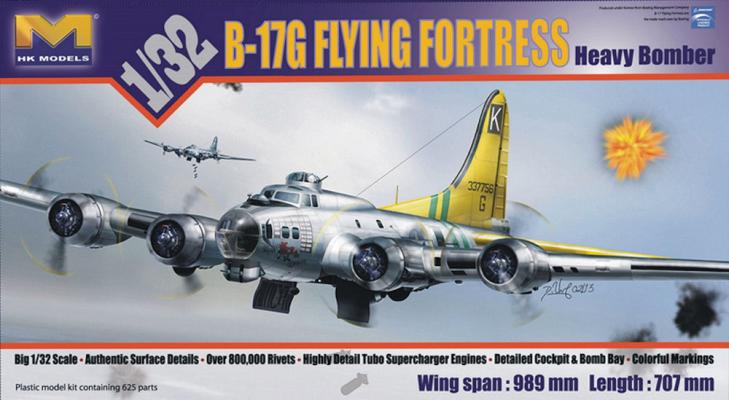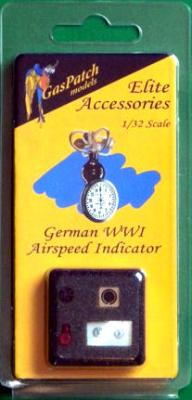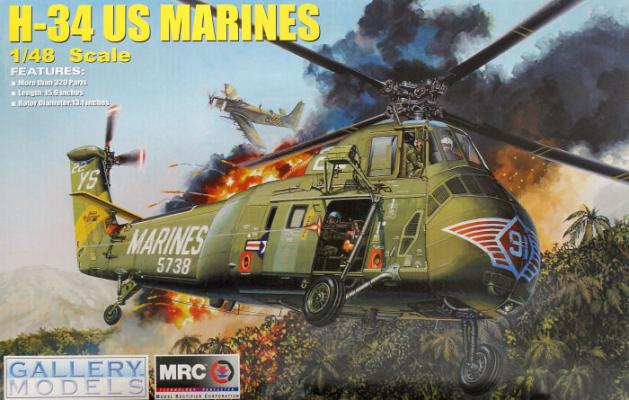
The kit comes in an attractive box with a profile of one of the marking options on the box top. This is a special limited edition and includes a very nice gold colored coin that is packed separately in a fancy red box similar to what you would get a piece of jewelry in. I am not sure what the parts count is, but I'm sure there are well over one hundred parts. The parts are molded in a medium blue-grey color and they have a slightly rough texture. The plastic is a little on the soft side, so care must be taken when sanding and cutting. There is a small photo etch fret with seatbelts and other detail parts. I did not use all of the PE parts because some of them were so thin that they came apart when I cut them from the fret. There is also a small bag of resin parts comprising oxygen bottles, various boxes, and some things that look like duffel bags. The molding on the resin parts is not up to the standards of Aires or CMK, but it is decent.
I’ve built most of the major Sea King versions out there; this kit is a new release, not a re-pop of some other company’s work. Earlier in 2012, Cyber Hobby released this kit as an HC.4 troop transport in their Falklands theme; that kit was reviewed by IPMS/USA by Ben Guenther, IPMS# 20101, on 22 Sep 2012, if you would like to read about it (http://web.ipmsusa3.org/content/sea-king-hc4-falklands-war). What you get in this version are the same parts, with the large radome as a major modification for the kit.
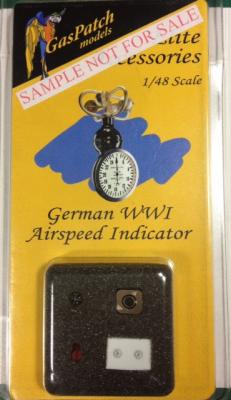
Airscale. You might know this company for their really fine instrument dial decals and cockpit placard decals. I have used these decals on every model I have built that included an instrument panel or dashboard since these products came out. Now, Airscale has included another great product which also works in conjunction with their own decals, as well as decals supplied with kits.
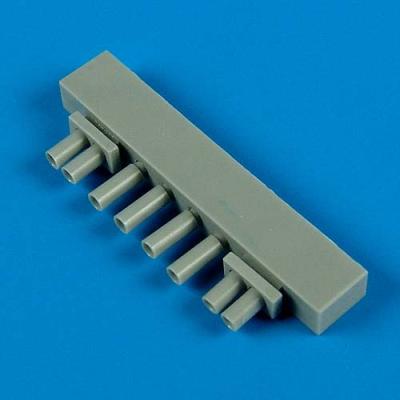
There is probably no more uniquely a Soviet/Russian weapons system than the unguided rocket – think Katyusha. Their use, on a smaller scale, extended to Soviet concepts of close air support with aerial unguided rockets. Whereas in Western air forces the unguided rocket is a thing of the past in favor of precision munitions, they remain a staple with most Soviet/Russian-influenced air forces. Such is their belief in the system that the Soviet Union produced a broad array of rocket pods to accommodate their principal unguided 55mm aerial rocket, the S-5. Provided in this set is the early UB-16 without the extension tubes for the 5 interior rockets. Later UB-16s have the extension tubes. They are listed for use with the MiG-17, MiG-19, and the MiG-21, but I have also seen them carried on Syrian L-39s.
The R-60 (AA-8 Aphid) is a Soviet/Russian short range infrared (IR) homing air-to-air missile. It has been fielded for 35 years and is widely used by a variety of Soviet/Russian manufacturer aircraft. For attack aircraft, it is their primary means of self-defense. The UZR-60 is the training variant of the R-60, distinguished by its lack of rear delta fins and the three black bands designating a training shape. It is a captive training shape that does not leave the missile rail. The UZR-60 has an active IR seeker, and interfaces with the aircraft’s weapons system to allow the pilot to determine when the missile has IR acquisition.
History Brief
The Seafang was essentially a Spiteful redesigned for the Royal Navy carrier use. Two prototype Seafang MK.32s were ordered on March 12, 1945, followed by an order for 150 Seafang MK.31s on 7 May 1945. To expedite entry into service, the interim Mk.31 was ordered, which was a navalised Spiteful with a tail hook, allowing the MK.32 to be developed. The Mk32 featured a contra-rotating propeller (eliminating engine torque), power folding outer wing tips, and a proper arrester hook.
The Product
Kit features very nice engraved panel lines, weak cockpit details, nice gear bays, reconnaissance camera, optional position flaps and wing tips, working prop, and 3 decal options. My sample was flash-free and well packaged in a sturdy box. Also included is a photo-etch fret for the radiators and an excellent color plate.
The Lockheed P-38 was one of the most recognizable and deadliest aircraft in World War II. It was originally conceived to meet a U.S. Army requirement in 1937 for a high-altitude fighter capable of 360 mph at 20,000 ft. and be capable of full-throttle endurance of one hour at this altitude. Lockheed’s winning design utilized a radical twin-engine, twin tail boom, tricycle landing gear configuration. Designed as a fighter that could fly faster and higher than any other fighter at the time, it was capable of carrying out several types of missions. It could perform as a bomber, a reconnaissance plane, and an escort. However, where it excelled was in the roll of a fighter. It had great success in the China-Burma-India and Pacific Theaters. It also played a vital role in the skies over North Africa and the European Theater. Many pilots became an ace flying the P-38.
Called the most famous aircraft ever produced by Japan, the Zero fighter first appeared in 1939 and was arguably the best fighter aircraft – land- or carrier-based – in the world. It had great range and maneuverability, and its firepower was at least equal to any of its rivals. It had a wingspan of 12 meters and carried an offensive firepower combination of two 7.7 mm machine guns and two 20 mm cannons.
Development of the aircraft started in May, 1937, and the prototype delivered a speed of 491 km/h with its 780 hp Zuisei engine. In 1940, the Japanese Navy adopted the Sakae engine for the aircraft – a 14-cylinder, 940 hp radial engine.
What you get in the large box from Hasegawa are two complete kits; they have recessed panel lines, and there are decals for four airplanes, two each from the 12th and 14th Naval Flying Groups.
There are four manufacturers of 1/48 scale kits of the Mirage 2000 – Airfix/Heller, Italeri, Kinetic, Monogram, and, of course, the re-boxing of the Heller kit by Eduard. All of these kits have poorly detailed exhaust nozzles, except the Eduard re-boxing which provides PE to overhaul the engine to a more convincing replica, the exterior exhaust petals being particularly noteworthy. Enter Aires with its offering of both an open and closed nozzle replacement engine. This is a review of the open nozzle set.
“Forget it, it’s a Frank.” This phrase from the old Famous Fighters series comes to my mind whenever I think about the Ki-84. It is attributed to allied airmen who watched radar screens to find Japanese aircraft that may be potential targets. It meant that the very high performance Frank would be equal or better than the allied aircraft and would not be an easy target. The Nakajima Ki-84 Hayate (Gale) was the culmination of a line of fighter aircraft initiated by Nakajima in 1935 with the Ki-27 Nate and followed by the Ki-43 Hayabusa. The Ki-84 possessed a more powerful engine and was extremely sturdy and possessed good firepower and protection for both the pilots and the fuel tanks. On the down side, the Hayate was beset with problems with hydraulic and fuel pressure systems, brakes, landing gear struts, and a slipping of quality control during manufacture. Fortunately for the allies, the Hayate was never produced in the quantities required by the Japanese Army.