Reviews of products for scale aircraft models.

Review Author
Brian R. Baker
Published on
Company
Hobby Boss
Scale
1/72
MSRP
$15.99

History

When Ernst Udet brought back two Curtiss Hawk biplanes to Germany in the middle thirties after witnessing dive bombing demonstrations by US Navy pilots, he started a trend that resulted in the development of dive bombing aircraft for the Luftwaffe that eventually resulted in the development of the Junkers JU-87. Capable of nearly vertical dives retarded by very effective dive brakes, bombing accuracy improved dramatically, and during World War II, the Germans, along with the Americans and Japanese, developed dive bombing to a fine art. The Ju-87 was an early attempt at a specialized dive bomber, and although progressively developed during the war, could never keep pace with or coexist in an environment with enemy fighters unless a strong friendly fighter escort was present, a luxury the Germans didn’t always have.

Review Author
Brian R. Baker
Published on
Company
Scale Aircraft Conversions
Scale
1/72
MSRP
$14.95

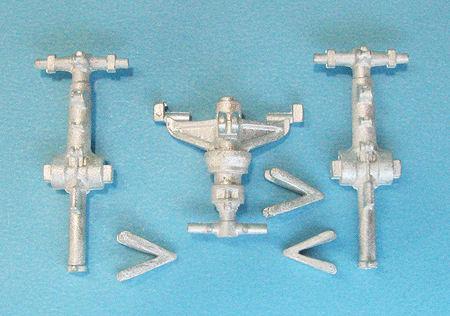
This is a set of white metal landing gear struts for the Eduard 1/72nd scale Bf-110E kit. The unit consists of two main gear legs, which are identical to those in the kit, two different sized tail wheels, and two sets of bracing struts. I think the smaller tail wheel would fit a Bf-109 quite nicely. No instructions were provided. There were attachment tabs on the main gear, but none for the struts, which need to be secured with superglue. In this case, I felt that the kit units were adequate, so I didn’t use these, although they might prove useful on that old Monogram kit I have been eyeing on my shelf. The larger tail wheel, however, is quite nice, and has better tire tread detail than the one in the kit. I used it on my Eduard review kit.

Recommended. My thanks to Scale Aircraft Conversions and IPMS/USA for the chance to review this item.

Review Author
Brian R. Baker
Published on
Company
Quickboost
Scale
1/72
MSRP
$6.50

This is a set of resin exhaust stacks for the new Eduard Bf-110E kit. The advantage in using these units is that they are drilled out, whereas the kit parts are not. They fit perfectly, and were a welcome addition to my model. They are to be installed after painting the basic structure, allowing for such detailing and weathering as you desire. These are worth getting to upgrade your model. Recommended.

My thanks to Quickboost and IPMS/USA for the opportunity to review this item.

Review Author
Charles Landrum
Published on
Company
Quickboost
Scale
1/48
MSRP
$3.25

Prominent on the nose of the Mig-23 Flogger is a pitot tube. From a modeling perspective a nose pitot presents several challenges. First you hope that the part is not bent, broken or molded out of round. Surviving that, you then need to remove the pitot from the sprue, remove the mold lines and ensure that the cross section is round. Lastly, a nose pitot tube becomes a transportation liability during model shows and displays. This Quickboost product provides a safety net to the modeler who has had difficulty with any of these issues with the Trumpeter Mig-23 kit (or for that matter the Italeri/ESCI or Hobby Craft kits).

Book Author(s)
Peter Davies
Review Author
Pablo Bauleo
Published on
Company
Osprey Publishing
MSRP
$18.95

Osprey Publishing continuous to expand the fledging series “Air Vanguard”. This new series is focused on a specific airframe, different versions/models and a brief detail of operational service of the aircraft under scrutiny. This volume (number 7 of the series) focuses on the USAF F-4 Phantom II.

Based on the premise of this series, there are sections devoted to the airframe, engine, fuel system and armament. Specifically there are sections devoted to the F-4C, F-4D, F-4E, F-4F, and F-4G. It also includes sections on the reconnaissance versions of the above marks and special sections for license build/modifications for the Israeli and Japanese air forces. There are also a few short sections on special prototypes and test-bed airframes.

Each section is well written and has plenty of color pictures. The author is very objective, emphasizing both the strengths and weaknesses of the airplane.

Review Author
Charles Landrum
Published on
Company
Quickboost
Scale
1/48
MSRP
$3.25

Prominent on the underside of the Mig-23 is the twin GSH-23 twin barrel 23mm cannon which can be used air to air or air to ground. The Trumpeter 1/48 Mig-23M and Mig-23MF kits provide multiple parts to create the cannon – the L34 for the fairing, PE parts 2 and 3 for the shell ejection chutes and part C2 which consists of the twin cannon barrel. Once covered by the fairing, the only portion of the GSH-23 are the muzzles of thee barrels with their distinctive finned shaped. This offering by Quickboost is a one for one drop in replacement for kit part C2, providing a more accurate pair of muzzles that are physically separated, unlike the kit part which has the muzzles connected. My guess is that the kit muzzles are that way for easy of injection molding. The resin replacement is not only separate provides smaller more realistically sized gun bores.

Review Author
Rob Booth
Published on
Company
Italeri
Scale
Multiple Scales

At the 2012 Orlando IPMS Nationals, Model Rectifier Corporation made a special decal sheet of multi-nationals roundel insignia available for giveaway at their show booth. I was lucky enough to receive one of those sheets from the IPMS Reviewer Corps.

This sheet contains national markings for USA modern aircraft (color stars & bars), Japan, Australia, Russia, Soviet Union, Germany, China, Italy and Canada, in various sizes and scales from relatively large to tiny.

I built an old Starfix 1/72 T-38 for my father’s career aircraft collection, and the decals were unusable. I found some USAF lettering in my spares box, but used the stars and bars from this sheet. They went down smoothly, and with a touch of Solvaset, nestled down into the re-scribed surface detailing I applied. They made a mediocre kit look good. I will keep this sheet on hand to use in similar situations.

Book Author(s)
Gaillard R. Peck, Jr.
Review Author
Rob Booth
Published on
Company
Osprey Publishing
MSRP
$25.95

One of the planned builds in my stash is the Mig-21 F-13 the USAF obtained from the Israelis that became the secret “Have Doughnut” project. I discovered this aircraft in an article in an old Air Force Association Magazine my Dad gave me. The photos of the ungainly looking natural metal beast with stars and bars markings were intriguing. When I saw this book offered up on the review list, I asked for it thinking it would contain all the reference photos I needed to supplement those in the magazine to complete that build. I was wrong. There were few photos of the aircraft in the book.

What I did find, though, was the fascinating story of the creation of one of our country’s greatest defense assets over the past few decades. Author, and former F-4 Phantom driver Gail Peck (Col., USAF, ret’d.) details the story of the USAF’s aggressor training squadron from inception to its’ current status as the opposing force team for the best trained pilots in the world.

Review Author
Brian R. Baker
Published on
Company
Hobby Boss
Scale
1/72
MSRP
$15.99

The Ilyushin Il-2 Sturmovik is perhaps one of the most famous aircraft of World War II, especially since more IL-2’s were produced, 36,163, than any other military combat aircraft of this era. Appearing in numerous versions, including single and two seaters, the IL-2 was probably the best close support and anti-tank aircraft used during the war. Any serious modeler should be aware of this plane’s history, so I won’t repeat it here. The model presents a rather unusual variant, the one with 37 mm. NS-37 cannons mounted in streamlined fairings underneath each wing. Flying characteristics suffered, caused by the CG shift rearward because of the cannon installations, but the aircraft was available in adequate numbers for the Kursk Battles, resulting in the destruction of many German tanks and other vehicles. Shortages of cannons kept production numbers small, and previous variants with the Way-23 mm. wing mounted cannons were by far the most common types.