Reviews of products for scale aircraft models.

Review Author
Jim Pearsall
Published on
Company
Eduard
Scale
1/72
MSRP
$22.95

The Eduard Weekend kits are designed for a fairly quick and easy build, but as I proceeded through this project it took me much longer than a single weekend. The build was more like four weeks, working an hour or so each day. When it was time to write this review, I checked the catalog at Eduard, and it says that the kit doesn’t include masks or PE. But the mask and PE were in the box when I opened it!! Dave Morrissette was patient with my query. I got the PE and mask in the box, but they are for separate reviews. So look for the reviews elsewhere on the IPMS/USA reviews page.

Review Author
Dave Morrissette
Published on
Company
Scale Aircraft Modelling
MSRP
$7.50

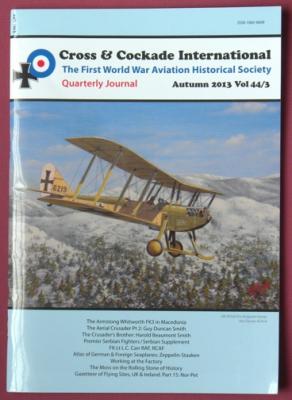
Each issue of Scale Aircraft Modelling follows a basic design and format. There are usually two feature articles, an “Aviation in Profile” piece, industry news and a series of “Compact Build Reviews.”

The feature articles for this issue cover the build of a Trumpeter 1/32 Mig-17 in Cuban markings and a 1/32 Revell Bf-109G-6. The Mig-17 build, by Brian Wakeman, covers the construction and painting of one of Trumpeter’s early efforts. He modifies the kit with five Profimodeller sets and one Eduard set. The kit is then finished with a bright Cuban paint scheme and great weathering.

The other feature article is from Jay Laverty, and covers building the Revell 1/32 Bf-109G-6 (early and late) kit. Mr. Laverty concentrates on painting and weathering with some aftermarket being used for both the cockpit and the decals used for adding Swastikas. Weathering is done with oils, and shows excellent methods of getting streaks and subtle weathering.

Review Author
Dave Morrissette
Published on
Company
Quickboost
Scale
1/32
MSRP
$12.00

Quickboost adds to its long line of ejection seats with a late model A-7E Corsair II ejection seat with molded in belts. The seat comes in four pieces with two being the side on the seat top and one a handle on the right side of the seat. All the parts are perfectly cast. Assembly is simple with the canopy breakers being removed and added to the top of the seats. The handle is added. One warning here, I added mine and it was broken off with the handling by the end of the photos.

The seat is designed for the Trumpeter kit so I built it for comparison. The Trumpeter seat isn't bad but in comparison to the Quickboost seat, it is lacking detail. The top of the seat is much better detailed in the Quickboost set. Quickboost is definitely an upgrade to the Trumpeter kit.

This seat is very recommended and very reasonable in price. My thanks to Aires, Quickboost, and IPMS/USA for the chance to review this great seat.

Review Author
Mike Van Schoonhoven
Published on
Company
Hasegawa
Scale
1/200
MSRP
$39.99

The Kawasaki C-1 began development in 1966 to replace the JASDF C-46 fleet. It went into service in 1974, and is still serving today.

Before we start, I’ll let you know that this is not a motorcycle kit. It is an aircraft. I am sorry to disappoint, but just wanted to clear the air before I went any farther.

This kit includes two complete aircraft, consisting of four sprues per plane, for a total of eight sprues in the box. On the decal sheet there are enough markings that you can build any two out 25 airframes. You will need to check your references as the instructions call out one airframe in three different schemes. One of the decal options is for a 50th anniversary of the JASDF scheme.

Review Author
Steve Collins
Published on
Company
Eduard
Scale
1/72
MSRP
$29.95

This product is a prepainted photoetched flight deck section from a US carrier between 1942 and 1944. It is made of a fairly heavy gauge brass. It partly includes one of the hangar deck lifts in the full up position. It has good texture showing the planking on the deck, the tiedown strips and the metal areas surrounding the lift, as well as some of the deck markings for the carrier. The painting gives a realistic replication of the wood grain on the deck planks and is of the early war natural wood coloring. The surface has a slight sheen, and to be more realistic, it should have a light coat of flat clear sprayed on. The deck section is big enough for a small naval aircraft, and would probably be okay with a Hellcat or a Corsair. It measures 4 3/8 x 5 1/4 inches or approximately 111 x 133 millimeters. It will make a very effective display that can be completed quickly by simply gluing it to an appropriately sized base. Highly recommended.

Review Author
Greg Wise
Published on
Company
Quickboost
Scale
1/48
MSRP
$14.50

The Product

These highly detailed engines are a great way to enhance your next build. They are a drop in replacement for the kit parts. My samples were beautifully cast, and flawless. The engine’s pushrod tubes are not included in the casting, but locating holes for the pushrod tubes are present for those modelers wishing to add them. I highly recommend these babies to anyone wanting to upgrade the Revell PV-1 Ventura.

Thanks to Aires and IPMS/USA for allowing me to present these samples.

Review Author
Roger Rasor
Published on
Company
Wingnut Wings, Ltd
Scale
1/32
MSRP
$79.00

The Build (Continued)

The assembled engine dropped in place with little drama…but, because of the rather complex way the engine, engine bay framing and multi-part cowling align with the fuselage, I first carefully dry-fitted everything (and temporarily taped parts in place) to make sure there were no gaps between panel lines. Doing this also ensured that the front of the engine was centered in the opening in the cowl front. I cemented the engine in place and removed the engine panels to make the necessary adjustments as called out in the instructions.

Review Author
Rob Benson
Published on
Company
Minicraft Model Kits
Scale
1/72
MSRP
$69.99

The wonderful folks at Minicraft Models deserve tremendous thanks for providing this review kit. I appreciate their work to bring new and unusual subjects to the scale modeling community. The IPMS/USA Reviewer Corps also deserves thanks for giving me the kit to review. I am only one member of a large staff in the Reviewer Corps, and I appreciate all the tireless team and individual work that goes into getting the material out to be reviewed and the finished write-ups published.

The Martin PBM-5A Mariner was a gull wing, twin-engine flying boat operated primarily by the U. S. Navy during WWII. The Mariner operated alongside its better known sister flying boat, the PBY Catalina. The PBM-5A was a tricycle amphibian, with prominent nose, dorsal and tail gun turrets, fixed wing floats, and twin tails. The Mariner had bomb bays nestled in the engine nacelles on the high wing and a distinctive dorsal radome just aft of the cockpit.

Review Author
Roger Rasor
Published on
Company
Albatros Productions, Ltd.
MSRP
$15.00

The Nov/Dec 2013 issue of Windsock Worldwide (now branded ‘WINDSOCK World War Centenary’) is the last issue of Volume 29 and it’s pages continue the publication’s tradition of delivering some of the most interesting, accurate and unique information about WWI aviation to be found anywhere.

As an example, this issue initiates a new mini-series titled 100 Great Warplanes, that promises to profile some of the lesser known and/or poorly chronicled WWI types. The first to be featured in an eleven-page article in this issue is the 1916 German two-seat Rumpler C.III. Eleven pages are devoted to this reconnaissance aircraft with a historical description, 27 period photographs (many previously unpublished), full 1/48 scale plans of all versions and an exclusive color profile of the prototype C.III by Ronny Bar.

Book Author(s)
Gregory Alegi
Review Author
Roger Rasor
Published on
Company
Albatros Productions, Ltd.
MSRP
$21.95

The name Macchi is often associated with flying boats and one of the reasons for that is the subject of Windsock Datafile No.162. The Macchi M.7 was one of the most successful biplane flying boat designs to come out of WWI and it enjoyed a phenomenally lengthy and active career from its introduction in 1918 well into the mid-1930s. Serving with other nations in the post-WWI years, examples of this speedy flying boat were also entered into Schneider Trophy races. Noted Italian aero historian and researcher Gregory Alegi presents the full story of this classic Italian Flying boat in this final Datafile for 2013.