When we left off at the end of part 1, the gun bays, cockpits and main airframe were done, and we needed to cover the engines and prepare the airframe for painting. Moving on to this round of the build, the sides and tops covering the engines are added. This is easier on the 1/48 kit as there are fewer parts, only 7 versus the 11 found on the 1/32 scale kit. In either case, hiding the engine below the covers is difficult, if only because it is so well done. The back is added along with the air scoops, top cover and a little putty, at which point we are done with the aft of the plane.
Retired from active service in 2006, The F-1 was the JASDF’s first Japanese-designed and -manufactured supersonic fighter, and was essentially the same airframe as the two-seat Mitsubishi T-2 trainer, but had a solid “hood” in place of the second canopy, along with assorted weapons capabilities and internal differences. The similarity in appearance to the SEPECAT Jaguar has some merit, though Mitsubishi’s official position states that the only items it has in common with the Jag are its engines.
Platz continues its line of JASDF and JMSDF subjects with this new release. I’ve never built a Platz kit which hasn’t been excellent with beautiful engraved detail and great fit, and this one’s recessed panel lines and thorough detailing throughout was no exception.
Scale Aircraft Conversions continues to release high quality aftermarket gear sets and this one is no exception. This is a 3 piece white metal kit that utilizes a few of the actual kit parts. Once removed from the blister pack one cannot help notice how “weighty” The SAC gear is. Additionally, one sees the added detail with the better relief and how it will be much more realistic upon painting.
The kit provided gear is actually not too bad. Biggest problem I see is that the main gear is molded in 2 parts and requires a supplied pre-formed wire insert to ensure it can hold the load of the kit. It construction suggestes the kit supplied gear is going to require considerable work to hide seams after being assembled. You will NOT have that problem with the high quality SAC white metal kit. With little trimming and polishing work it is ready to install.
Having a few of these kits on the shelf and recently reviewing the kits most recent release I thought I could provide a good perspective on this offering from SAC.
Scale Aircraft Conversions continues to release high quality aftermarket gear sets and this one is no exception. The 4 piece white metal kit is supplied in the standard blister pack and one can immediately see it is far superior to the kit supplied gear in detail. Upon removal, the gear is has some weight to it so it will be sturdy.
The kit supplied gear was adequate, but required considerable work as the halves are not properly aligned to one another. Additionally there are a number of sink holes and ejector pin marks that are quite time consuming to fix. The SAC gear kit is soooooooooo much better in quality and will require much less effort to present an accurate presentation.
History Brief
The dreaded Fokker E.1 was the first fighter aircraft to enter service with the German Luftwaffe in World War I. When it arrived at the front in mid-1915, it set in motion a time known as the "Fokker Scourge," in which the E.1 and its lineal Eindecker siblings achieved air superiority over the Western Front.
The Product
My sample arrived in a higher-end box, commonly associated with quality model kits. The box top features a beautiful color print with the famous Wingnut Wings name found in the upper, right-hand corner. Inside the box, I found the parts well protected in the typical poly bags. The parts themselves were flawless and flash-free, featuring delicate detailing. Also included is a photo-etch fret; an unbelievable color instruction booklet printed on glossy paper, featuring vintage photographs and five full-color plates; and finally, the beautiful decal sheet printed by Cartograf.
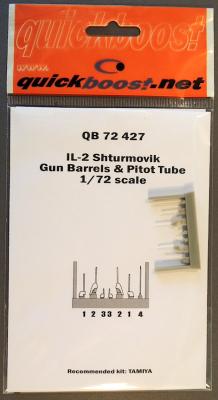
Upfront, I want to thank Aires and Quickboost for providing these fine aftermarket bits for our beloved models and to the IPMS USA a big thank you for allowing me to review this Quickboost product.
Admittedly I am proud of the fact I love the stubby World War II fighter. The Rita, Buffalo and certainly the Grumman Wildcat. I have several in my stash including the Hobby Boss 1/48 wildcat and it’s a good looking kit. I snagged the Quickboost exhaust stubs for the wildcat before even looking at the plastic parts. In all honesty, when I finally looked at the original parts, I didn’t think you could improve on them. I was wrong! The original parts are well molded and due to the large diameter exhaust, even the kit parts have an open exhaust. NO need to drill out the opening. Well, where I think the Quickboost parts shine, is the fact the wall thickness is more in line with a scale thickness. The original kit parts are certainly way too thick.
This nifty add on for the Eduard Weekend Bf-110G-4 is mostly for the cockpit, although there are a couple of other parts which made my life easier. The Bf-100G-4 is reviewed here: Eduard Bf-110g-4 weekend kit The ProfiPACK kit comes with the Photoetch.
The cockpit details include better rudder pedals, instrument panels for the front two positions, gun sights for the rear gunner’s position, a new woven seat for the radar operator, seat belts, and throttles. Additionally for outside the cockpit, there are little screens for the intake side of the exhausts, a loop for the antenna on the canopy, the L shaped scissors on the rear of the landing gear legs, and an antenna for under the fuselage.
This is the canopy mask for the Eduard 1/72 Bf-110G-4 Night fighter. It’s recommended for the Weekend kit, which is reviewed here: Eduard Bf-110g-4 weekend kit The ProfiPACK kit comes with the mask.
You get the mask and a very good set of instructions.
The mask is die cut on Kabuki tape, nice and thin and it sticks marvelously.
I have one trick. It’s very hard to see the edges of the mask items when they’re on the backing sheet. I slather on a tiny bit of acrylic black, like what’s used for weathering, and it picks out the edges nicely.
The Eduard Weekend kits are designed for a fairly quick and easy build, but as I proceeded through this project it took me much longer than a single weekend. The build was more like four weeks, working an hour or so each day. When it was time to write this review, I checked the catalog at Eduard, and it says that the kit doesn’t include masks or PE. But the mask and PE were in the box when I opened it!! Dave Morrissette was patient with my query. I got the PE and mask in the box, but they are for separate reviews. So look for the reviews elsewhere on the IPMS/USA reviews page.
Each issue of Scale Aircraft Modelling follows a basic design and format. There are usually two feature articles, an “Aviation in Profile” piece, industry news and a series of “Compact Build Reviews.”
The feature articles for this issue cover the build of a Trumpeter 1/32 Mig-17 in Cuban markings and a 1/32 Revell Bf-109G-6. The Mig-17 build, by Brian Wakeman, covers the construction and painting of one of Trumpeter’s early efforts. He modifies the kit with five Profimodeller sets and one Eduard set. The kit is then finished with a bright Cuban paint scheme and great weathering.
The other feature article is from Jay Laverty, and covers building the Revell 1/32 Bf-109G-6 (early and late) kit. Mr. Laverty concentrates on painting and weathering with some aftermarket being used for both the cockpit and the decals used for adding Swastikas. Weathering is done with oils, and shows excellent methods of getting streaks and subtle weathering.