Reviews of products for scale aircraft models.

Review Author
Paul Bradley
Published on
Company
Syhart Decal
Scale
1/48
MSRP
$15.00

Frenchman Sylvain Hautier founded Syhart Decals (SY (Sylvain) HA (Hautier) , ART (design)) in 2006 with the aim of recreating in model form the special aircraft paint schemes that have been developed to celebrate anniversaries, participate in Tiger Meets, and for last flights.

6 Squadron of Royal Australian Air Force (RAAF) was formed in 1917 in England as training unit during World War I. In 2017, 6 Squadron was converted to an Electronic Attack unit equipped with the EA-18G Growler. The squadron achieved Initial Operating Capability with Growler on 2019.

For the Centenary of 6 Squadron in 2017, one of these brand-new Growlers, A46-306, received a special scheme with night blue spine and fins, and with a large yellow boomerang, the insignia of the squadron for 100 years.

Review Author
Dave Morrissette
Published on
Company
Yahu Models
Scale
1/32
MSRP
$17.99

Yahu Models is a Polish producer making 3D photoetch replacement panels and parts for all sizes and types of models. In this instance, this is a instrument panel parts for the HK Model 1/32 A-20G Late configuration. The contents include a small card with a pictorial representation of the instructions and how to place and bend the parts. Also included are three colored, three dimensional photoetch frets and one clear set of dials for the instruments. The photoetch frets are amazing. If you scan them and zoom in, you can read the writing perfectly which in 1/32nd scale is awesome. I have included some scans from the kit showing location of the majority of the parts.

Review Author
Brett W Scholten
Published on
Company
Vertigo Miniatures
Scale
n/a
MSRP
$35.90

Taking my models to a show or competition is always a little nerve-wracking for me. Transporting the model so it does not break or lose pieces is a challenge. I tried many methods; shredded paper, bubble wrap, soft foam, hard foam with sections cut out; all with various degrees of success (and failure).

That is why I jumped at the chance to review Vertigo Miniatures Transport Jig.

Opening the box, I was surprised to find clear acrylic pieces. Another surprise is the jig only has three legs, where all my other jigs have four legs.

Assembly was easy. The “legs” on the stand needed to be glued together. I used CA glue to do this. There are lines engraved in the leg base that allow easy alignment and gluing. I had one leg fail, and believe I did not put enough CA glue on the parts. I reapplied the glue and have had no issues since then.

Review Author
Tomasz Menert
Published on
Company
Tamiya America
Scale
1:72
MSRP
$50.00

From the Manufacturer’s Website:

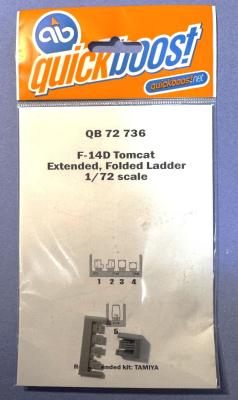
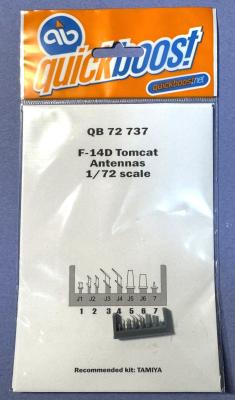
Our 1/48 scale F-14D Tomcat model kit is one of the most detailed modern plane kits we’ve produced. We’ve now taken what has been learned from its development and production to bring model builders the same level of detail to our popular 1/72 scale lineup while also providing a streamlined building experience!

The Tomcat enjoyed an active career from the early 1970s until 2006; initially given a fleet defense role, in the 1990s the Tomcat’s superb range saw that role expanded to include strike missions, and then later that decade the addition of the LANTIRN targeting pod meant it could undertake long-range bombing runs using laser-guided ordnance. The F-14D was the final variant, which inherited its F-14B predecessor’s General Electric F110-GE-400 engines and was given major upgrades to avionics. It reached units from 1992, serving in the skies over Iraq and Afghanistan. It finally retired from U.S. Navy service in 2006.

Review Author
Gino Dykstra
Published on
Company
ICM
Scale
1/32
MSRP
$103.49

The Henschel Hs123 was developed from a 1933 requirement for a dive bomber by the then-emerging Luftwaffe. This aircraft was fairly advanced for its day, featuring an all-metal construction powered by a 725 horsepower BMW 132A radial engine. This gave the Hs 123 a 200 mph top speed. Its sesquiplane design made it extremely maneuverable and its twin 7.92 mm machine guns gave it some teeth as well. Although many regard this as one of the best biplane fighters of World War 2, the Luftwaffe considered it mostly as a stop-gap measure until the Ju 87 Stuka could be put into full production.

Book Author(s)
Dilip Sarkar
Review Author
Chris Surber
Published on
Company
Pen & Sword
MSRP
$39.95

With 64 books to his credit, Dilip Sarkar is probably the most qualified individual in the world to write a book about the Battle of Britain as well as England’s premier fighter plane, the Supermarine Spitfire. He was honored in 2003 with England’s MBE (Member British Empire) for his “service to aviation history.” He has done extensive work researching and recording the history of the Battle of Britain. In 2006, he was elected to the Fellowship of the Royal Historical Society (FRHistS), and in 2024 he was made a Fellow of the Royal Aeronautical Society (FRAeS).

Review Author
Keenan Chittester
Published on
Company
Special Hobby
Scale
1/48
MSRP
$55.00

This was a kit I had been looking forward to and even had it in my shopping cart of one of the online retailers. So, I was pleasantly surprised to see this kit in the list of available review items. In my opinion, this is a really cool-looking aircraft. Unfortunately, according to the history on the first page of the instructions, it was a disappointment. It was originally designed as an interceptor, but was later modified for the fighter-bomber role. Only 60 were actually produced.

The 85 plastic parts come on three sprues. There are also 60 resin parts and 18 photo-etch parts. There is also a piece of film for the instrument panel. The parts were nicely molded with good panel lines and detail. Unfortunately, many of the smaller parts required extra cleanup because the sprue attachment points were heavy and ran into the part.

Review Author
Pablo Bauleo
Published on
Company
Kagero Publishing
MSRP
$15.26

Kagero has started a new series known as “References for Modelers”. This issue is devoted to the Kawasaki Ki-61 Hien

The references include several period pictures (black and white), some of which show the aircraft in the assembly line or during trials. Some pictures show details of the engine, air scoop, tail, etc., so you can treat them as a “walk-around”.

The line drawings in 1/48 and 1/72 scale show side views (port and starboard) and top and bottom views. The drawings specify if it corresponds to either Ki-60, Ki-61 first prototype, Ki-61-I Ko, Ki-61-I-Otsu, Ki-61-I Hien (early), Ki-61-I Tei, and Ki-61-II Kai. Some of the pictures, and drawings, include details on the Ki-60, the prototype for the Ki-61.

The booklet includes a small decal sheet (in 1/48 and 1/72) for a “Tony” in natural metal finish, and there are a handful of color profiles (and 4-view in some cases) for aircraft in Japanese Army service.

Review Author
Pablo Bauleo
Published on
Company
Kagero Publishing
MSRP
$15.26

Kagero has started a new series known as “References for Modelers”. This issue is devoted to the Nakajima Ki-43 I/II.

The booklet discloses that a lot of the material published in it, has already been published before in other publications of the same editorial. In my humble opinion, that is not an issue, as sometimes the modeler only needs a few references, and this book provides them all.

The references include several period pictures (black and white), some of which are of captured aircraft. Some of the pictures are similar to a “walk-around” type of image, as they show details of the engine, landing gear, air scoops, etc.

There is a handful of color profiles (and 4-view in some cases) for aircraft in Japanese Army service.

Review Author
Pablo Bauleo
Published on
Company
Syhart Decal
Scale
1:48
MSRP
$14.05

Shyhart Decals has released a decal sheet for a commemorative scheme flown by an F-4F and a Tornado in 2007, celebrating the 50 years of the aeronautical research institute of the German Air Force.

The aircraft were repainted in International Orange and had the German Flag in the nose, rudder and wing tips. The decal sheet provides decals for the German Flag around the nose of both aircraft, but you are directed to mask and paint the rudder and wing tips with the German national colors. There are instructions as to the size of each band and with straight lines, it should be easy to mask using tape.

These two aircraft also wore lots of physics equations in the fuselage and wings, representing all the fluid and aerodynamics research that goes into modern aviation.