
Polish Military Aircraft 1918-1939
The origin of Pen & Sword Books is closely linked with its sister company, the Barnsley Chronicle; one of the UK's oldest provincial newspapers, established in 1858, and one of the few weeklies still in private ownership. The first books published by the company were in response to public demand following of a series of articles published in the newspaper: Dark Peak Aircraft Wrecks told the story of crash sites in the Dark Peak area of the Peak District National Park, and a further weekly feature on the history of two Kitchener battalions, known as the Barnsley Pals, aroused a thirst for more information. Following on from the success of those books, a number of local history paperbacks were produced along with a series of battlefield guidebooks. Battleground Europe proved immediately successful, and the company made the decision to launch a book publishing arm of the group. Pen and Sword specializes in all areas of military history, naval and maritime, aviation, local history, genealogy, social history, transport, discovery and exploration, archaeology, nostalgia and true crime. With over 350 books published every year, Pen & Sword has established itself as a specialist book publisher.
Peter Sikora is an aviation researcher, historian and writer who specializes in the history of the Polish Air Force between 1918 and 1946, with the particular interest in the achievements of the Polish airmen during Second World War. Based in Berkshire, England, Peter has already had a number of books published in Poland, including Aces of the Polish Air Force, Battles of the Polish Air Force 1918-1945 and Polish Wings over Ireland. He also writes historical articles for the leading Polish aviation magazines and is a member of the Polish Air Force Memorial Committee at RAF Northolt. In his private life, he is married to Maggie, and together they run a non for profit organization that helps to reduce unemployment.
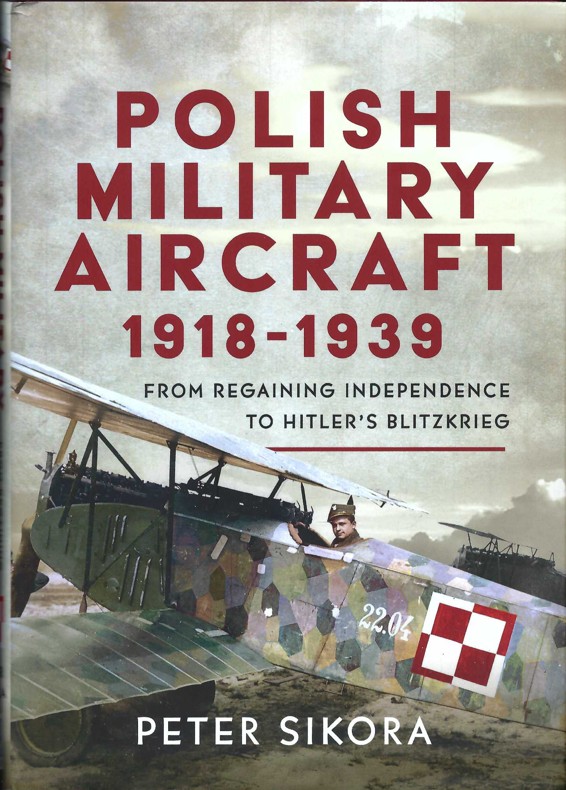
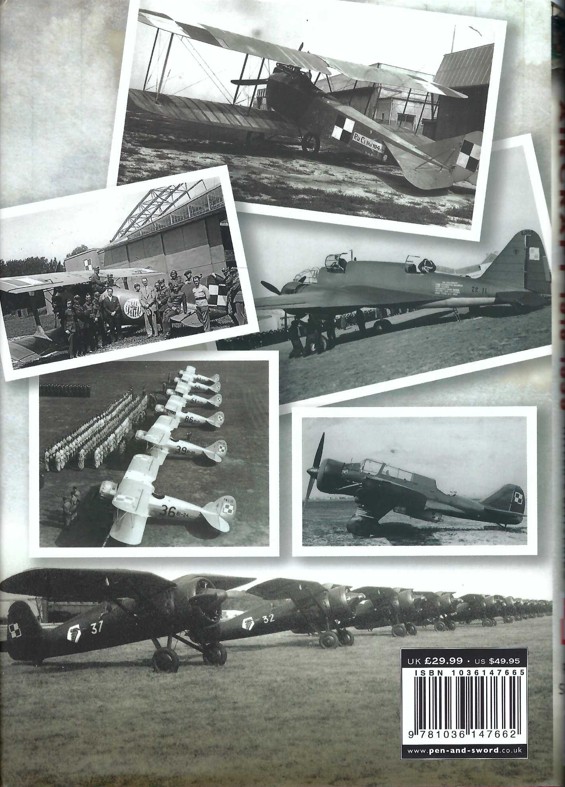
This 272-page English language hard Cover book was released in the United States on May 30, 2026. This is a 7.00” x 10.00” hard cover book with a separate glossy paper jacket. The first seven chapters are text only and cover the first seventeen pages. The remaining six chapters are in photographic essay format with detailed captions and cover the next 195 pages. The color [or colorized photograph on the front cover depicts 2nd Lieutenant Antoni Bartkowiak of the 15th Squadron Polish Air Force. Flying in his Fokker D.VII (OAW) coded 22.04 during the Russo-Polish war of 1920-1921, the D.VII is still wearing its original German lozenge fabric. Bartkowiak enjoyed success in the ground attack mode against Siemion Budionny’s Red Army Cavalry. After the war, he became the head of pilots at the Mechanical Plant in Lublin. Late in April of 1922, he crashed in an Ansaldo A.300 and later died of his injuries. This was one of some 50 Fokker D.VIIs obtained by Poland either through questionable purchases from OAW in Piła and flown by German pilots to Ławica, landing in “error”. The German pilots would be paid and return to Piła by train. I counted 309 black and white photographs and one color [or colorized] picture.
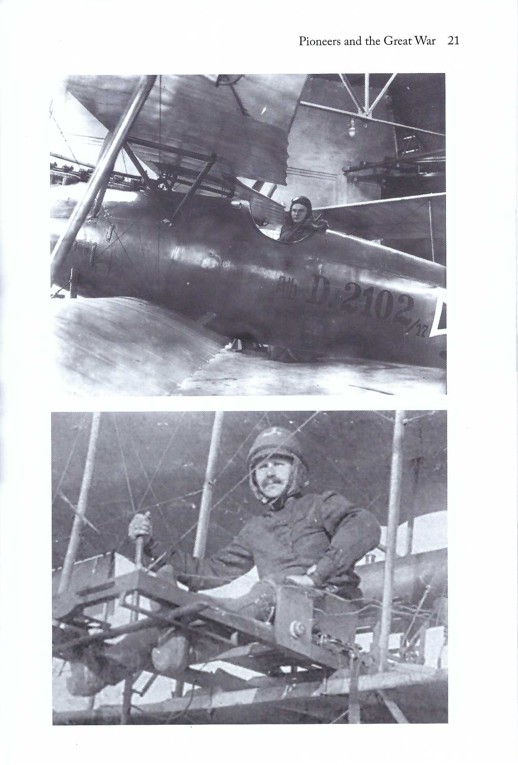
Peter Sikora initiates the presentation of photographs with Chapter 8 covering Pioneers and the Great War. The top of Page 21 depicts Uffz. Wieczorek sitting in his Albatros D.V, 2102/17, of the German Air Service. This is probably August Wieczorek who would be killed on October 25, 1918, flying over Turkey. Many Poles had no choice but to serve in a non-Polish service, since Poland was not a country during WWI. Lieutenant Wiktor Komorowski can be spotted at the bottom of the page sitting in his Farman IV. Originally an administrator in the 4th Siberian Air Detachment of the Imperial Russian Air Service, Komorowski had volunteered to fly operationally as an observer and photographer. Later he completed his pilot’s training and became an ace with six confirmed kills between 1914 and 1916. During the 1920 Kiev offensive he became commander of the 4th Escadrille and later that year command of the 36th Escadrille. He was imprisoned in Romania during WW2 before returning to Poland in 1946. He was arrested on April 16, 1951, for firearm possession and was jailed in the Wrocław city prison, a prison that dates back to the middle of the 14th century. He died in prison at the age of 65 on August 23, 1952, from unknown circumstances.
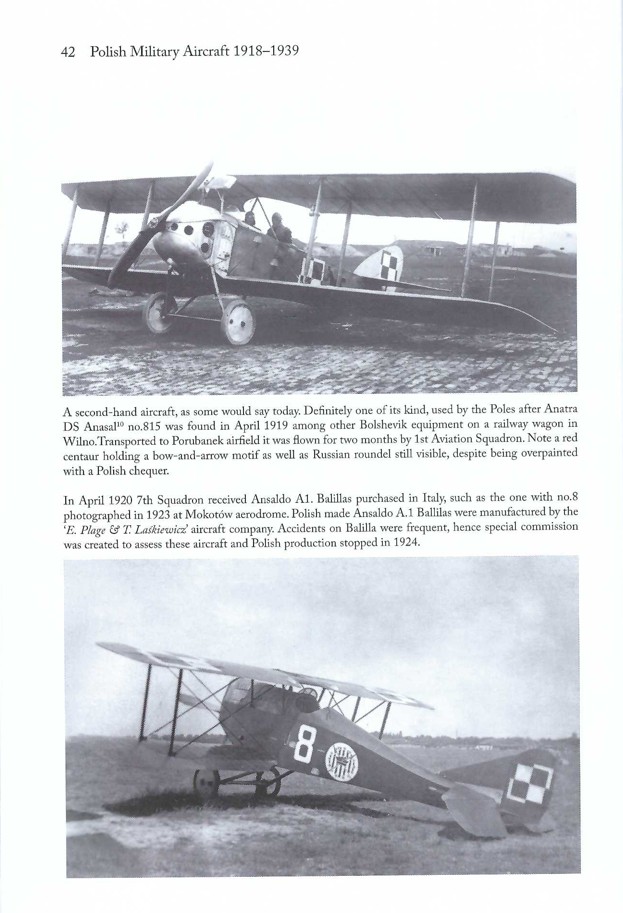
Post WWI follows next with Chapter 9, Salvage and First Purchases. One of many Polish purchases was the Italian Ansaldo A.1 as seen at the bottom of Page 042. This Italian manufactured A.1 here is seen at Mokotów airfield in 1923. Nicknamed the Balilla after a Genoan folk hero, the Ansaldo A.1 arrived late in WW1 and saw very little action. Adoption by both the Soviet Union and Poland made up for that as the Ansaldo A.1 saw action on both sides during the 1919-1921 Polish – Soviet War. Ansaldo would manufacture some 250 aircraft and Plage & Laśkiewicz of Lublin would produce another 57 under license. Where the Italians were less than happy with the A.1, the Polish flyers were thrilled, despite quality issues in the Polish built aircraft. The top of the page features an Anatra DS [or Anasal for Anatra Salmson], 815, that was found on a Bolshevik railway wagon in April 1919. The Anatra DS was built in Odessa and again was flown by both sides in the Russian Civil War. This one ended up flying for the 1st Intelligence Squadron at Porubanek airfield on the Northeastern (Lithuanian-Belarusian) front. Notable is the red centaur holding a bow-and-arrow on the fuselage just behind the Polish insignia. At the time, the 1st Intelligence Squadron was composed of seven aircraft: three Albatros C.IIIs, two Albatros C.Xs, a Roland Cl.II, and the Anatra DS.
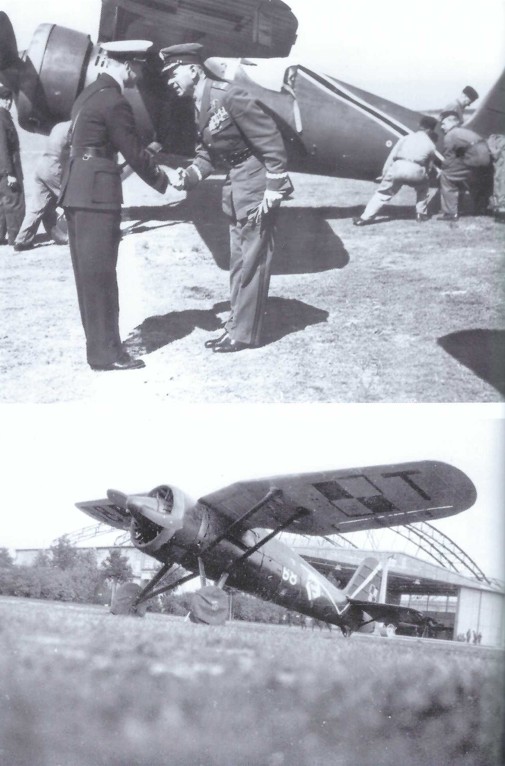
Chapter 11, Polish Own…, covers Polish manufactured aircraft. General Brygady Ludomił Rayski, Commander of Polish Military Aviation from 1926 to 1939, can be spotted at the top of Page 134. He is standing in front of his personal PZL. P.11c, 8.129, during a visit to Sweden. This was part of an International Air Show between May 15 and June 1, 1936. Rayski was a noted visionary of a modern Polish Air Force, expanding Polish airfields, the Polish aviation industry, and modernization of the Polish Air Force. PZL.P.11c, 8.10, is shown at the bottom of the page on August 6, 1936, at Warsaw Okęcie airport. This aircraft was Major Leopold Pamula’s personal mount as commander of III/4 Fighter Wing based in Torun. Pamula gained a measure of fame for being the first in WW2 to carry out a ‘taran’ attack after running out of ammunition on September 1, 1939, near Warsaw in his PZL. P.11c. This type of attack involves ramming the opponent aircraft and he somehow survived, bringing down the German bomber and then bailing out of his burning fighter. Pamula would finish with 22 aerial victories. He would later die on August 8, 1940, of blood infection at Nocton Hall Hospital in Lincolnshire.
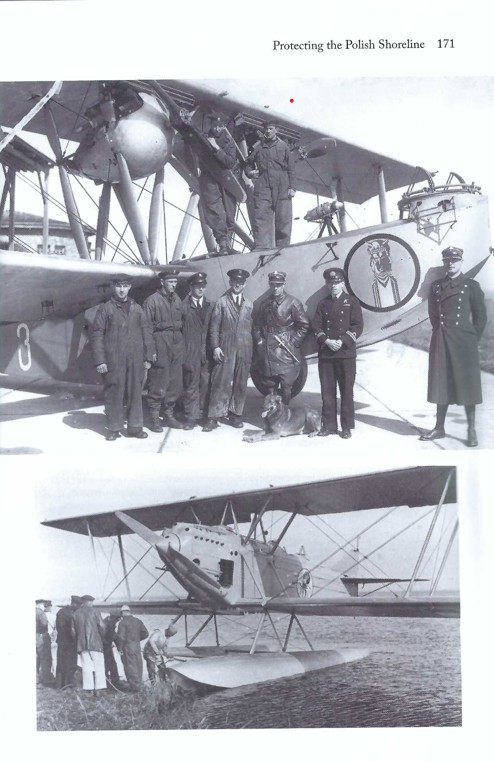
Poland established their Naval Aviation Base in July 1920 which leads to Chapter 12: Protecting the Polish Shoreline. Initially only captured German aircraft were utilized, but Poland soon began purchasing and manufacturing their own seaplanes. The purchase of seven Lioré et Olivier LeO H-135B3 amphibious flying boats between 1926 and 1927 with s/n 6-3 being displayed at the top of Page 171. These three-seat patrol aircraft were powered by two 180 hp Hispano-Suiza 8Ab engines. Noticeable is the IInd Squadron Badge of the four-headed Slavic God of War, Svetovid. Today, Svetovid is part of a pre-Christian belief of the Native Polish Church based in Warsaw. The Lublin R-VIII bis/hydro can be spotted at the bottom of the page. The Lublin R-VIII was the first internal design of Plage i Laśkiewicz and the first to bear the manufacturer’s name of Lublin. Six aircraft were manufactured as testing showed them to be underpowered. The initial prototype, 801, was refitted with a Lorraine-Dietrich engine and became the Lublin R-VIII bis. Fitted with floats, 801 was limited to a 300-kg bombload and could not carry torpedoes. Notable is the Octopus insignia on the fuselage underneath the observer’s gun ring. They saw limited service from 1933 through 1939 when they were destroyed by Junkers Ju 87 Stukas on September 8, 1939, at Puck Bay.
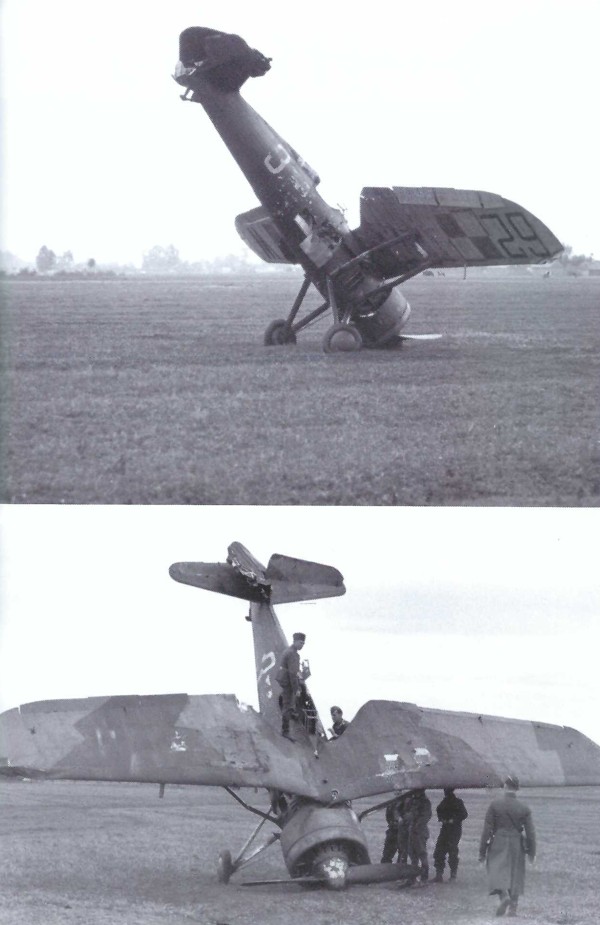
The German invasion of Poland in 1939 is addressed in Chapter 13, Fall Weis [Case White]. The PZL P.11 was the standard fighter of the Polish Military Aviation when the Germans and Soviets invaded Poland in 1939. Entering service in 1934 where it was the most advanced fighter in the world where its primary competitors were the Heinkel He 51 and the Gloster Gauntlet. Unfortunately, by 1939, it was considered obsolete due to the rapid advancement in aviation. The photographs of the PZL P.11c featured on Page 197 is courtesy of a German photographer. Sporting an unusual camouflage of khaki and olive green on the upper wing, this aircraft, serial number 8.138, landed near Zegrze in east-central Poland after experiencing engine trouble on landing after a sortie. Serving with the 152nd Fighter Squadron, it is believed to be the mount of Captain Antoni Joda of 3rd Flight. Joda was later assigned to 307 Night Fighter Squadron flying Boulton Paul Defiants. Sadly, he and his gunner were lost when they ran out of fuel and attempted to land on a beach. The landing saw them flip upside down and both drowned, locked inside the cockpit on January 10, 1941.
The sections include:
- Chapter 1 The Broken Eagles
- Chapter 2 Wings of Freedom
- Chapter 3 Mongolian Invaders and Flying Dragons
- Chapter 4 Hard Going Process
- Chapter 5 Red and White
- Chapter 6 Technicalities, Technicalities…
- Chapter 7 The Clearer Picture
- Chapter 8 Pioneers and the Great War [Page 021]
- Chapter 9 Salvage and First Purchases [Page 042]
- Chapter 10 Big Shopping
- Chapter 11 Polish Own… [Page 134]
- Chapter 12 Protecting the Polish Shoreline [Page 171]
- Chapter 13 Fall Weis [Page 197]
- Appendix I Polish Military Aircraft
- Appendix II Pre-Independence and Early Days Polish Aviation Units
- Appendix III Units of the Polish Air Service/Military Aviation During Securing the Borders
- Appendix IV Units of the Polish Air Service/Military Aviation/ Order of Battle, 1 September 1939
- Appendix V Polish Aircraft Military Numbers (Early Years)/Aircraft Without Polish Military Numbers
- Appendix VI Polish Aircraft Military Numbers/Interwar
- Appendix VII Polish Aircraft Military Numbers/Flying Boats-Air Naval Wing Aircraft
- Appendix VIII Polish Ranks 1918-1939
- Appendix IX Polish Air Service/Military Aviation Commanders
- Appendix X The Dęblin Issue…
- Abbreviations
- Notes
- Index
I found this an interesting introduction to Polish aviation from 1918 through 1939 with a great collection of 310 photographs. Along the way, one sees French, British, German, Austro-Hungarian, Russian, in addition to Polish manufactured aircraft. I was able to finish the book over four days, primarily spending my time on the well captioned photographs. I even got my Swedish fix on Page 134 with General Brygady Ludomił Rayski, Commander of Polish Military Aviation, visiting Sweden for a 1936 airshow. This Pen & Sword Books’ volume provides a great pictorial reference for historians and modelers. If you have any interest or are going to build any aircraft of the Polish Air Force, this is your book.
My thanks to Casemate Publications, Pen & Sword Books and IPMS/USA for the chance to review this great book.
Highly recommended!
Reviewer Bio
Frank Landrus

Frank retired from the Ophthalmic industry with over thirty-six years of Research and Development experience. Frank's first model kit was a 1959 Hawk 1/72 US Marines Vought AU-1 Corsair and has been building models for over sixty years. Frank's first encounter with IPMS was attending a North Central Texas ScaleFest show in 1984. Frank soon became more involved in Make-N-Take activities and became the IPMS Western Coordinator for Make-N-Takes [West of the Mississippi River]. Make-N-Takes quickly became a local model contest and airshow staple reaching a high of reaching over 1,300 children before the COVID shutdown. Frank has volunteered to assist in contest judging since 1985 and is currently the Nationals Head Figure Judge until he is dead or they find someone better.
Comments
Add new comment
This site is protected by reCAPTCHA and the Google Privacy Policy and Terms of Service apply.
Similar Reviews