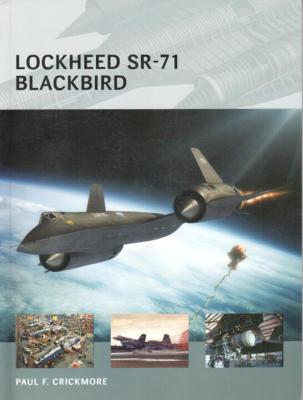
Thank you very much to the wonderful folks at Osprey Publishing for providing this new publication for review. Thanks are also due to the IPMS Reviewer Corps for allowing me the opportunity to explore a fascinating historical documentation and description of the enigmatic SR-71. The book was particularly interesting to me, since the time I stood nose-to-nose with a Blackbird at Beal AFB during IPMS Nationals in Sacramento in the 80’s. This volume follows previous Osprey releases describing the SR-71 and the A-12.
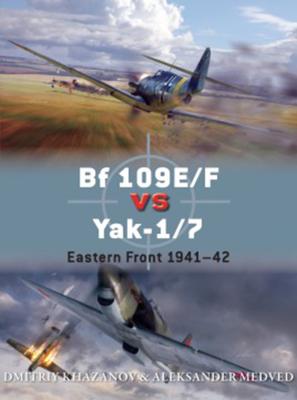
Dmitry Khazanov is a widely respected Russian researcher of Soviet aviation in World War 2. He is the author of more than 20 books and numerous articles about Soviet military aviation. Dmitry Khazanov, joined by co-author Aleksander Medved, and illustrators Jim Laurier, Gareth Hector, Andrey Yurgenson present a depiction of the each side’s aircraft and the environment they engaged each other in.
The Messerschmitt Bf 109 fighter inflicted a tremendous beating on the VVS’ early Yakolev fighters early on, taking full advantage of Germany’s combat hardened pilots. Many of Germany’s scoring aces benefited from the Messerschmitt’s technical superiority over the overweight and underpowered Yak-1. Eventually the tide turned as the VVS gained experience, improved their tactics and upgraded their aircraft. Dmitry Khazanov paints a detailed portrait for mastery over the frozen skies of the Eastern Front between the Bf 109 and the Yakolev fighters.
History
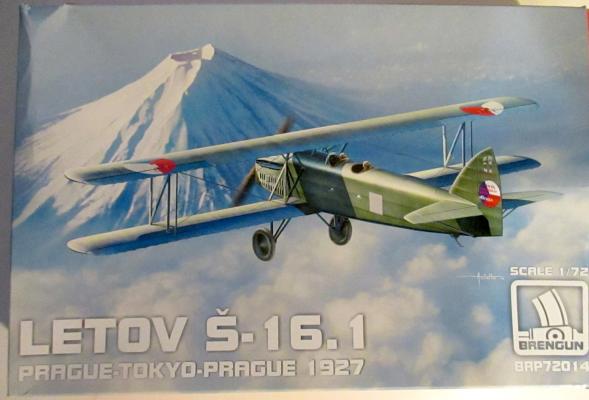
The Letov S-16 design work began in 1924 as an all metal replacement for earlier all-wood aircraft, and was intended as a two seat long range bomber and reconnaissance type. Powered by a 450 hp. Lorraine-Dietrich water-cooled engine, the prototype first flew in 1926, and the Czech Air Force ordered three test aircraft. In all, 89 S-16’s were built for the Czechs, and in addition, Latvia bought 21 and Turkey obtained 12. In addition, Yugoslavia bought one to test as a floatplane. The type served with distinction during the late twenties and early thirties, and a few were still operational in 1938 when the Germans occupied the country.
When the United States first started its bombing campaign in North Vietnam, it discovered that its ability to combat the sophisticated air defense system was very limited and early on it became apparent that the AGM-45 Shrike anti-radiation missile had a number of serious limitations, particularly in its range, small warhead and limited seeker. In effort to overcome some of these limitations, the Navy worked with General Dynamics to develop an air-launched version of the Navy’s RIM-66 Standard surface-to-air missile. By using an existing missile platform, development proceeded fairly quickly and the result was the AGM-78 Standard ARM (anti-radiation missile). Early versions of the AGM-78 were actually outfitted with the same seeker head as the Shrike, but as the Standard ARM had a much larger warhead, a larger engine and a gimbaled seeker head, it was more flexible and effective than the Shrike.
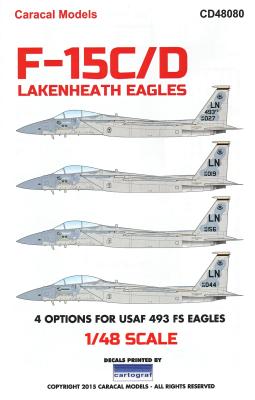
Lakenheath is host to the largest deployment of United States Air Force personnel in the United Kingdom and one of the most important planes in their inventory is the F-15 Eagle. The Eagle is becoming a venerable plane having first debuted in 1976 but is still very capable and Caracal has honored this by producing a sheet for four F-15C’s all with kills and one F-15D all from Lakenheath.
The set comes an excellent color cover showing all four options. Left and right profile shots of all four options are also included with stencil and markings placement. Color call outs are also included. There is also a note included that all aircraft depicted have had the MSIP II conversion so that is why the Great Wall Hobby kit is the recommended kit over the Hasegawa/Tamiya/Monogram offerings. Also, this group of planes is well documented and pictures can be found all over the Internet.
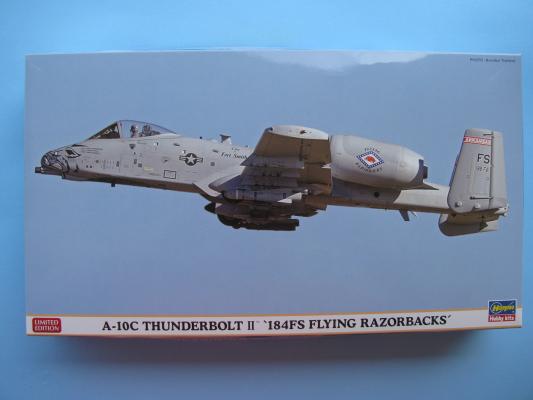
In one of the latest additions to the Hasegawa line of modern military jet aircraft comes the venerable A-10C in a special release that includes markings for Fighter Squadron 184, the “Flying Razorbacks” as depicted on the box top. Also included are markings for the 163rd Fighter Squadron, the “Blacksnakes”, who operate out of Fort Wayne, Indiana. The kit builds up reasonably well, as I have often found to be the case with Hasegawa products, and will make a fine addition for those wanting to add an updated Warthog to his or her collection.
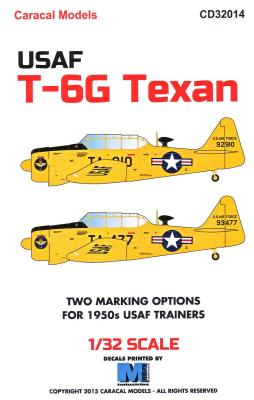
Kittyhawks 1/32 scale model of the T-6 Texan was very well received and the buildup models with the kit decals look great. The T-6 was widely used as a trainer and over 15,000 were built. Caracal Models has released a set of excellent markings which depict the T-6 as USAF trainers from the 1950’s. The markings cover:
- T-6G Texan 49-2910, Hondo AFB, Texas 1954
- T-6G Texan 49-3477, Columbus AFB, Mississippi 1955
Both planes are FS33538 Chrome yellow overall and are a nice change from the kit markings. Inside the package, there is a folded booklet of full color instructions showing all the needed plane views and profiles for each plane with decal placement and color call outs (chrome yellow and black). A standard size decal sheet is included and is printed by Microscale. Registration is excellent and all the stencils needed for one aircraft are included.
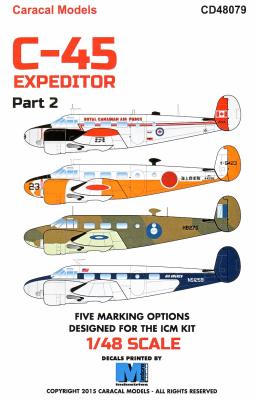
Caracal Models second release for the ICM 1/48 C-45 Expeditor covers this plane in service outside the United States with a total of five sets of markings. Inside the package, there is a seven page booklet which has full profiles of each plane (left and right as well as top and bottom), a page of color call outs and the cover showing all five variations.
The five options are:
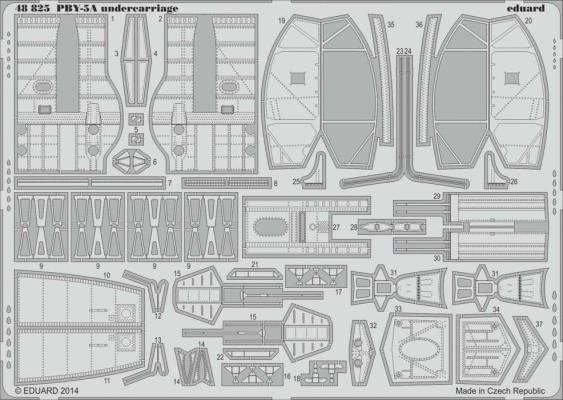
Revell’s PBY-5A Catalina has been around for 20 years now and I have seen quite a few built and it looks large and impressive when finished. The kit comes in two style- the “-5” who has no wheel wells and the “-5A” which does. Eduard has released sets for the PBY-5A which allow improvements to the entire airframe. This set (#48825) addresses the wheel bays which are only present in the “-5A” model and cannot be used on the initial “-5” release.
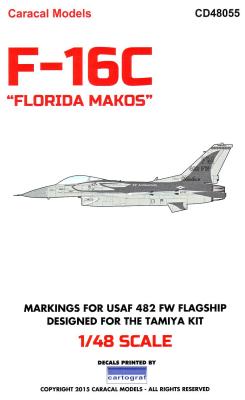
The F-16 Falcon has been around for quite a few years now and it never ceases to amaze me just how many new and interesting ways they have found to mark it. Caracal Models has produced decals for one very interesting and cool set of markings. This sheet provides markings for the specially decorated 2014 flagship F-16C (87-0247) belonging to the 482FW based at Homestead AFB. Complete markings for the spectacular shark decoration and stenciling is provided on the decal sheet. The toothy mouth even sits next to the intake!
Inside the package, you get an excellent reference-sheet indicating just which F-16C to use (Block 30 with GE Engine and a MCID big mouth intake), color call-outs and stencil locations, and the web site for location of the masking templates if you might prefer painting the markings.