Last year Airfix released a new kit of the B5N2 Kate, the Japanese Navy’s primary torpedo plane for the early part of World War II. The kit includes an option to depict the aircraft with the wings folded or with them fully spread. This set from Scale Aircraft Conversions includes nine drop-in replacements for the kit wing-folds and landing gear.
Earlier this year Airfix released this Dogfight Double set which combines it new Nakajima B5N2 “Kate” torpedo bomber and its new Grumman F4F-4 Wildcat kit. The Dogfight Double kits are designed to allow the modeler to depict aircraft from a specific historical incident by providing markings for two specific aircraft in the kit. This set is designed to commemorate a confrontation that occurred on June 4, 1942 when Wildcats of VF-3 intercepted Kate torpedo bombers during the second air attack on the USS Yorktown. The kit decals provide markings for the Wildcat flow by LCDR. Jimmy Thatch, the commanding officer of VF-3 during the afternoon raid and the B5N2 Kate flown by Lt. Jouchi Tomonaga of the Hiryu. The box art depicts Thatch’s shoot down of the Kate, but not before Tomonaga launched his torpedo towards the Yorktown.
I grew up with my Dad working for SAC (Strategic Air Command) but that has little to do with this item from SAC (Scale Aircraft Conversions) except that the last base we were at was Malmstrom AFB in Great Falls, MT and the Air Guard unit based at Gore Hill was flying F-106s at the time. And after that long lead in let’s see what we have.
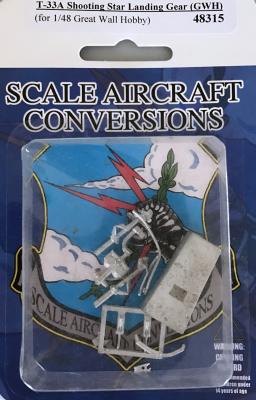
Scale Aircraft Conversions has been making replacement white metal landing gear since 1990. They started in the larger scales but have now released several items in my preferred scale of 1/72nd and even some in 1/144th.
History
The Lockheed U-2, nicknamed "Dragon Lady", is operated by the United States Air Force (USAF), National Aeronautics and Space Administration (NASA), the United States Navy, The Republic of China (Taiwan) Air Force and previously flown by the Central Intelligence Agency (CIA). It provides day and night, high-altitude (70,000 feet; 21,000 m), all-weather intelligence gathering. The U-2 has also been used for electronic sensor research, satellite calibration, and communications purposes, has been modified into the TR-1 (since redesignated U-2S) and ER-1 (NASA). The type was successfully adapted for operations on aircraft carriers (U-2G) , but the type was never officially operated from carriers.
Sometimes considered as the most effective variant, the Model 52 was developed to again shorten the wings to increase speed and dispense with the folding wing mechanism. In addition, ailerons, aileron trim tab and flaps were revised. Produced first by Mitsubishi, most Model 52s were made by Nakajima. The prototype was made in June 1943 by modifying an A6M3 and was first flown in August 1943. The first Model 52 is said in the handling manual to have 製造番号 (seizō bangō, or production number) 3904, which apparently refers to the prototype.
Research by Mr. Bunzo Komine published by Mr. Kenji Miyazaki states that aircraft 3904 through 4103 had the same exhaust system and cowl flaps as on the Model 22. This is partially corroborated by two wrecks researched by Mr. Stan Gajda and Mr. L. G. Halls, production number 4007 and 4043, respectively. (The upper cowling was slightly redesigned from that of the Model 22.)
Steve Ginter’s Martin PBM Mariner is one of more recent in his Naval Fighters series and was actually initiated after hearing that Minicraft was really, really, really going to finally put out their 1/72 PBM-5A kit. This edition is in their standard 8.5” x 11” format softbound publication that is 256 pages (excluding covers). I counted 760 photographs (5 in color) along with 61 drawings.
Author Steve Ginter is a noted military historian who publishes the Naval Fighter series that was founded in 1980. After graduating from California State University-Northridge, Steve Ginter became a US Navy pilot, serving from 1966 to 1972. Upon leaving the US Navy, Steve Ginter held a series of management positions within the Thrifty Drug chain for the next twenty-one years. In 1996 in became the CEO of Sentai Distributors where he directed company operations until 2011. The Air Force Legends series was initiated in 1998 with the publication of ‘The Martin XB-51’.
The Sea King has been a mainstay helicopter for many navy and army services around the world. The subject of this model is the British Navy HC.4 Commando. The scheme I chose was a bird from 848 Naval Air Squadron, Commando Helicopter Force, Yeovilton in England 2011. The British Sea Kings are in the process of being withdrawn from service, as of March 2016.
This kit is the new mold from Airfix, and the small box is packed full of sprues, decal sheet and instruction book. There are several options that include extended or stowed main rotor blades and tail assembly, open or closed doors, and two markings to choose from. A small electric motor (purchased separately from Airfix) can be installed. Some modification within the cabin is needed, but everything is clearly illustrated. I did consider the motor, but chose to fold everything up for something different. There are some spare parts left over, including a different sand filter.
The newest in Osprey's Combat Aircraft series is authored by Peter E. Davies. A noted author with over twenty-six aviation books published, Peter E. Davis' focus has been on Vietnam War era aircraft. He has had a long relationship with Osprey and has authored 13 titles and co-authored another two.
Illustrator Jim Laurier, a native of New England, provides the color profiles. Jim has been drawing since he could hold a pencil and throughout his life he has worked in many mediums creating artwork on a variety of subjects. He has worked on the Osprey Aviation list since 2000, and has been featured in hundreds of aviation books.
Gareth Hector is a digital artist of international standing as well as an aviation history enthusiast. Gareth Hector provides the cover artwork of pilot Lt. Grover Erickson and RIO Lt John Perry in their F-4B attacking Bach Long Vi island on the night of October 26, 1965.
This is the first Yellow-Wings product I have had the pleasure of reviewing, and my initial reactions were very positive.
The focus of this company is on USN, USMC and USAAC subjects from the 1930-42 era, and this one falls right in line. This particular set provides markings for one specific aircraft, SBD-2 Dauntless #2106, during 5 phases of its lifetime. The standard ziplock bag contents consist of a stiff cardboard, full-color “title board”, 5 double-sided instruction pages (printed in black & white and color), and 2 full pages of decal sheets printed by Microscale. This is the 1/48th scale set, and there is also one available in 1/32.
The five different schemes for Dauntless #2106 provided are:
Eduard has released a series of WWII-era seatbelts in the “steel” series. I think that Eduard Models call this product line “Steelbelts”.
This review covers the following items: