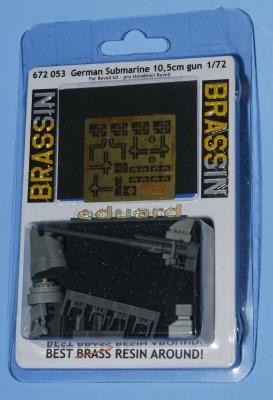
In this BRASSIN detail set, Eduard provides modelers with a quick and easy way to add a quartet of highly realistic SC-250 (Sprengbombe Cylindrisch 250) bombs to a 1:48 scale German aircraft model. The set includes resin and photo-etched brass parts and a small decal sheet for the stenciled identification. Four resin parts and four photo-etched parts make up each bomb and the decals add all markings needed for finishing the assembled and painted models. This multi-media combination makes into realistic looking miniatures of the real thing.
Welcome to IPMS/USA Reviews
Introduction: The primary organization of the IPMS/USA Review website is by IPMS/USA National Contest Class. Within each Class there are sub-menus by kits, decals, books, etc. The Miscellaneous Class is for items that are not class specific or that cross two or more classes.
IPMS/USA Members: We encourage you to submit reviews, both here and to the Journal. To volunteer for membership in the IPMS/USA "Reviewers Corps" and submit your own reviews, please read the Guidelines For Submitting Product Reviews.
Manufacturers, publishers, and other industry members: IPMS/USA is pleased to offer your company the opportunity for product reviews. All product reviews are performed by IPMS/USA members, and are posted in the publicly-accessible section of our website. With very few exceptions, we perform full build reviews of new kit releases, aftermarket products, and supplies. If you would care to provide product samples for review, please contact John Noack, IPMS/USA 1st VP.
To learn more about IPMS/USA, please see our About Us page.
History
The LST (Landing Ship Tank) was developed during World War II. Despite its size, the LST had a very shallow draft allowing it to load and unload on shore and at low tide without docking which was essential during the D-Day invasion. The power was provided by diesel engines driving two shafts and propellers. Speed was around 9 knots.
Kit
The kit is produced by Round 2 Models, a well-known company who bought the Lindberg Line and is re-issuing the kits in very colorful packaging. The box art work in outstanding! The scene depicts marines landing on a pacific island under fire while in the air Corsairs are shooting down Japanese Aircraft. Great art work worth framing but these ships were used mostly in the European Theater of Operation.
First, welcome to FLY models and thanks very much for sending us this great kit to review… and to the IPMS USA review corps leadership for sending this kit and the landing gear accessory to the crazy builder in Oklahoma…
I purposely did not open any other review commentary on the new Fly Arado 234B-2/B-2N kit… my impression was to be that of someone who just invested in a new company and wondered how it was going to come out.
To the people at FLY… You need not worry; this is one magnificent effort and I’m VERY impressed!
I want to start by saying I don’t model much armor, this is only my third armor model completed, but I definitely will be building more.
Eduard has come up with a great kit which uses the Tasca molds for the Sherman tank and made it better with its Profi-pack. The basic kit is molded in olive drab green and comes on 14 parts trees plus a small clear parts tree and four sections of rubber tracks. It also has a nice set of photo etch parts and decals for four different subjects. The instruction booklet is pretty clear and concise and the illustrations are sharp.
History
The Lavochkin La-7 was a logical development of the highly successful radial engine fighter, the La-5, which was itself an improved LaGG-3 all wood fighter which, while having reasonable performance, was not satisfactory as a first line fighter at the beginning of the “Great Patriotic War”, as the Russians designated World War II. While the LA-5 went through numerous changes during its production life, it became obvious that the 1820 hp. Ash-82FN radial engine had reached its development peak, and that there was no suitable replacement for this engine, as the Ash-71F radial of 2200 hp. was unreliable and unsuitable for service use. Therefore, the Lavochkin Design Bureau decided to upgrade the basic La-5 design, making aerodynamic refinements on a prototype designated La-5 (206) which included a new cowling, oil cooler location, supercharger intake, exhaust cover outlet, and radio mast shape.