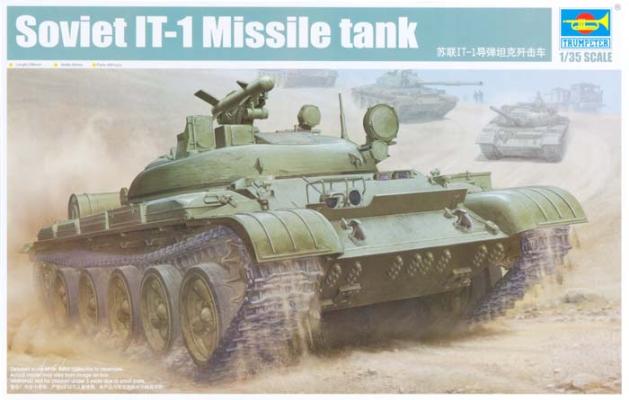
Let me start this out as saying this is my first IPMS review and I hope you find it informative and interesting. The IT-1 was a Soviet Cold War missile tank based on the chassis of a T-62. Instead of a main gun, the tank fires specially designed 3M7 Drakon missiles from a pop-up launcher atop the turret. The vehicle saw very limited usage from 1968-1970. The tank became unpopular with the military due to the limited amount of ammunition and a large dead zone around the vehicle which was created by the missiles minimum range. Eventually the IT-1s were converted to recovery vehicles.
What's New
Thank you to Gary Newman of Squadron Products, for providing a very timely improvement to an excellent recent kit release. Thank you to the IPMS/USA Reviewer Corps for once again allowing me to evaluate a cool new product!
Thank you Lone Star Models for providing a very timely improvement to an excellent recent kit release. Thank you IPMS/USA Reviewer Corps for once again allowing me to evaluate a cool new product!
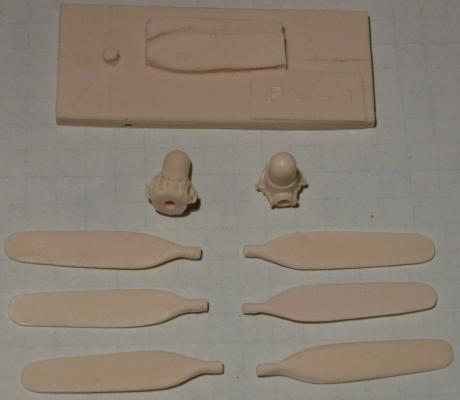
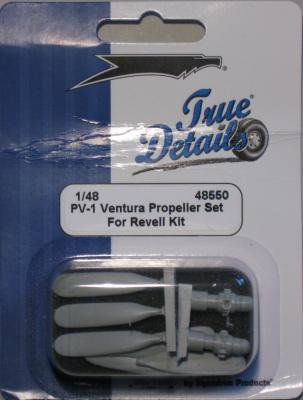
This replacement propeller set addresses the incorrectly shaped kit parts that come with the new Revell PV-1 Ventura. The Revell kit is otherwise excellent, but appears to have incorrect propellers. The replacement parts are molded in tan resin requiring little cleanup and prep, and arrived in a small plastic bag with a sheet of instructions.
The detail on the replacement parts is more finely done than the kit parts and the blades have the correct paddle shape I observed in USN photos of the PV-1. The blades are very thin and sharp on the trailing edges. This sharpness is an accurate feature, but requires careful prep. The resulting parts look great, but my clumsy sanding broke one of the blades. CA easily fixed the part and my patience.
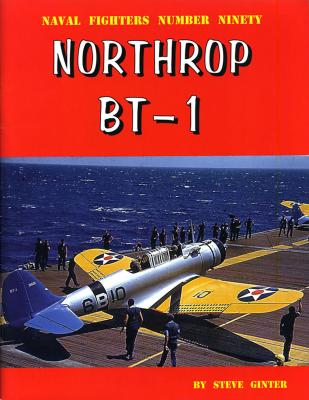
Coming at a time of rapid technical development in the aviation industry as the United States began to ramp up for its entry into the Second World War, the Northrop BT-1 was truly a transitional and transformative aircraft. Dive bombing was seen as the most potent anti-ship weapon in the arsenal of carrier aviation, and the BT-1 gave the U.S. Navy a sleek new dive bomber that held the promise of more potent things to come. It was the direct predecessor of the enormously successful Douglas SBD Dauntless, with a family resemblance so close that, from certain viewpoints, it was difficult to tell the two apart.
Before I dive into this model in detail, let me first state that these 62 grey plastic parts, four clear parts (three if you close the canopy), two poly caps, and decals for three options will produce perhaps the very BEST 1/72 A6M Zero MODEL today’s money can buy, and is possibly today’s very BEST 1/72 WWII fighter kit!
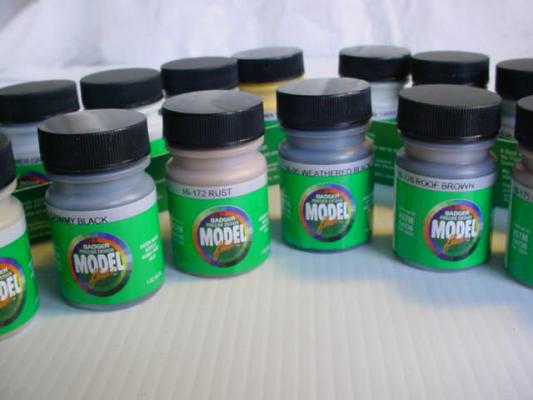
After receiving them for review from Badger, I was very pleasantly surprised at the ease of use and quality of these paint sets. For years, I was a Gunze Guy but the supply of Gunze dried up. I transferred to Tamiya and have used it since the Gunze sunset. I had never used Badger paint until I was given the opportunity to review some of Badger’s paint contained in some of their color sets.
Being an HO scale model railroader, I was very interested in Badger’s “RAILROAD ROLLING STOCK #1701,” which contains Engine Black, Reefer White, Reefer Gray, Reefer Yellow, Reefer Orange, Dark Tuscan Oxide Red, and Light Tuscan Oxide Red. I am now a fan of this particular set of paints and, in particular, like the Engine Black and Tuscan Oxide Red. Both are easily airbrushed and give that wonderful flat and aged color that I treasure when working on a piece of rolling stock or motive power.
Badger also provides several other Railroad related paint sets. They are:
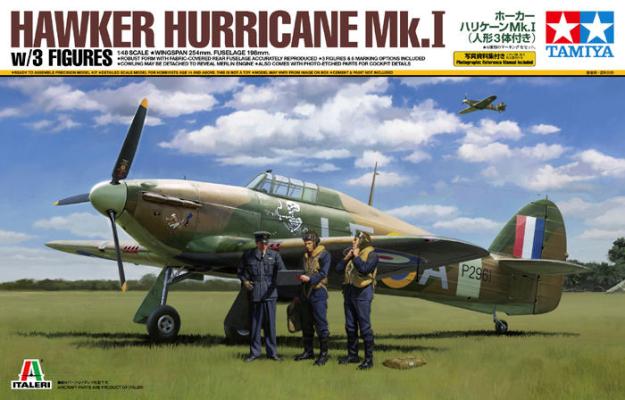
Conceived in 1934 to fulfill a requirement for a monoplane interceptor with a top speed exceeding 300 miles per hour in level flight, the Hawker Hurricane became one of the most significant Allied fighter aircraft in the opening years of the Second World War, and served worldwide throughout the conflict with great distinction. Most famously known for its pivotal role in the Battle of Britain, the Mk I variant of the Hurricane served as the numerical mainstay for the Royal Air Force in its defeat of the Luftwaffe during England’s “Finest Hour.”
Tamiya’s recent release of the Hurricane Mk I is a repackaging of the new Italeri kit. Although a nice kit, it is not thoroughbred Tamiya, so modelers should temper their “shake the box and out pops a great build” expectations a bit before diving in.
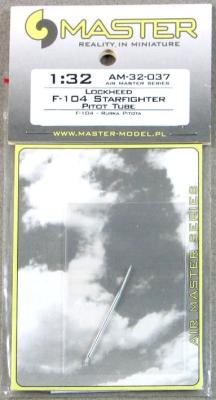
Master has a whole range of turned and photo etched metal details for aircraft and ships, in all scales. From gun barrels to radar masts, the details are not only more in scale, but stronger than anything in resin or PE, thus resistant to the occasional bump or clumsy hands. This item provides a turned metal pitot tube for the 1/32 F-104.
In the Bag and Installation:
The single-piece turned aluminum part comes in a bag with card hanger. The part is perfect, the correct length, and has the proper shape. A small protruding rod at the aft end is used to insert it into the nose cone of the kit after drilling the correct size hole.
All new from the elves at Alclad II, a new line of finishes (this time, enamels with a mineral spirits base) primarily for automobiles, and trust me when I say, you need to try these for yourself. First up, a bright silver base has been created that may be sprayed DIRECTLY on to the plastic, without primer. I must admit that I was somewhat skeptical until I tried it, and it is, without a doubt, exactly as advertised. Images show not only the various colors as painted on a series of 34 Ford Coupes, but also an effort of my own on an old “Snaptite” Monogram Corvette, further referred to as the “Candy Dish Corvette.”
Bottom Line
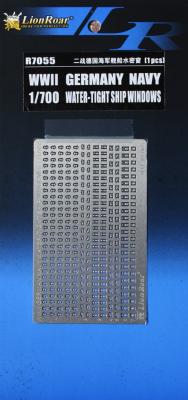
Provides seven types of round and square windows (not portholes) with covers for 1/700 WW2 German Navy warship models. 336 very small pieces.
Lion Roar expands its 1/700 warship photoetch set lineup with German Navy (DKM) windows. These are not portholes, but are windows used on above-the-hull superstructures. A small instruction sheet only has pictures of each porthole showing proper orientation. There are no guides as to which windows go where on what ship – you are on your own to determine how to use them.