What's New

Review Author
Jim Coatney
Published on
Company
Albatros Productions, Ltd.
MSRP
$11.90

Albatros Productions publications, particularly their Winsdsock Worldwide and Datafiles, are indispensable reference materials for any serious modeler of World War One aircraft, and also for anyone with a deep interest in the history of aviation history.

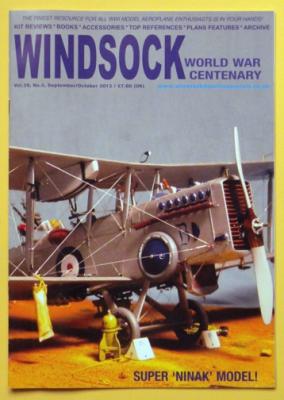
The May/June 2013 (Vol.29, No.3) issue is their latest release of the Windsock Datafile line. The magazine consists of thirty-four pages (including covers) in medium thickness glossy paper. Other than the back cover and inside back cover, there is no advertising. The rest is all wonderful content. Production quality is excellent.

The cover shows pictures that hints towards the content inside; TVAL’s beautiful new Albatros D.II, a screen shot from the flight simulator Rise of Flight, an image of a 1/24 LVG C.VI, and a newly released resin figure.

Contents include:

Review Author
Paul Mahoney
Published on
Company
Eduard
Scale
1/32
MSRP
$14.95

This is the second product in Eduard’s FABRIC line of seatbelts I have had the pleasure of reviewing. Earlier. I reviewed the 1/32 WWII USAAF fabric seatbelts at http://web.ipmsusa3.org/content/wwii-usaaf-fabric-seatbelts

This set is very similar to the USAAF one, with additional detail to reflect the higher complexity of Luftwaffe belts. As with the USAAF set, the belts themselves are made out of some sort of fine gauze-type material, and have only small attachment points keeping them on their fret. The material is pre-colored, with the belts in a light tan, pads for under the buckles in a slightly darker color, and one leather tab in a brown color. Very faint stitching lines and fabric weave details are evident as well. There is even stenciling and data plate info printed onto the fabric.

Review Author
Dick Montgomery
Published on
Company
Scale Aircraft Modelling
MSRP
$7.00

Each issue of SAM follows a basic design and format. There are usually two Feature Articles, an Aviation in Profile piece, and a series of Compact Build Reviews. In this issue, the first Feature Article is by Marco Preto, who builds and reviews Meng’s Me-410B-2/U4 in 1/48th scale. This article is a must-read for anyone who is going to tackle the Meng kit, a kit that Mr. Preto highly recommends. Along with an outstanding set of images showing Marco’s kit in progress (and completed), he also provides a list of paints and weathering supplies that he used to the outstanding results one sees in the article.

The second Feature Article, on the Supermarine Attacker, was written by Assistant Editor Karl Robinson. Karl’s article highlights the paint selections he made to produce this tail dragger. Karl also indicates that the incredible results he obtained on the panel lines and seams were accomplished with MIG Productions Neutral Wash.

Review Author
Rod Lees
Published on
Company
Hasegawa
Scale
1/48
MSRP
$65.00

The usual sincere appreciation goes out to our friends at Hobbico (Hasegawa USA) for supplying IPMS USA yet another sample of their manufacturer’s prolific output. I am constantly amazed at what they deliver!

I really like the Arado series of aircraft, so when the opportunity to build this one came up, I raised my hand. Having built a few of these in the past, I must comment on the condition of the kit. I did NOT notice any creeping mold-failures, excess flash, or other blemishes that identify what used to be known as an “old” model (anything over 10 years). The kit looked as if it were a brand-new design. Fit and construction confirmed the same. The basic model from Hasegawa is now a decade old, and what is in the box hides its age well. Engineering at its finest, ‘tis true.

Review Author
Rob Benson
Published on
Company
Zoukei-Mura
Scale
1/32
MSRP
$191.00

Many, many thanks to Mr. Hideyuki Shigeta for honoring me with the privilege of building the Super Wing Series He-219 Uhu (Eagle Owl) model kit for public review as an IPMS Reviewer Corps representative. I am deeply appreciative of the trust and confidence shown in me by both Mr. Shigeta and the IPMS Reviewer staff.

The Heinkel 219 Uhu was a highly effective but under-used Luftwaffe night fighter with a variety of innovations including obliquely firing guns and the first operational ejection seats. An excellent summary of the Uhu’s history may be found on the Smithsonian National Air and Space Museum’s webpage, along with restoration photographs of the Uhu in the Museum’s collection.

Review Author
Phil Pignataro
Published on
Company
Quickboost
Scale
1/72
MSRP
$3.95

The newly released Spitfire F.Mk.22 by Airfix in 1/72 scale is an excellent kit right out of the box. Of course, there is always room for improvement. Quickboost has already given us replacement cannons, correcting the only real deficiency in the kit. Here they offer resin, drop-in replacements for the exhaust stacks. What's the advantage of these? These resin exhausts closely mimic the shape of the kit parts, which look accurate to me. However, the Quickboost replacement parts have the holes already in them, saving the modeler the task of trying to place a dozen symmetrical holes in very small rods. The thickness of the exhaust stack walls appears to be in scale. Also, there are no seam lines to deal with in the resin parts, but they are present on the kit parts. Basically, the Quickboost exhaust will save you time and present a more realistic appearance than the kit parts. Moreover, these benefits come at a very reasonable price.

Review Author
Phil Pignataro
Published on
Company
Quickboost
Scale
1/72
MSRP
$3.95

One of the criticisms I've read about the 1/72 scale Airfix Spitfire Mk.22 is the cannons are not quite the right shape or length. Apart from this deficiency, the Airfix Spitfire is an excellent kit and a great value for your money.

If you want to improve this model's looks and accuracy, however, Quickboost has a remedy. Their replacement resin cannons are drop-ins for the original kit pieces. Based on photos I saw, they capture the shape and size of the real thing. The kit's outboard cannons are too short, both barrels seem too bulbous, and both have an out of scale extension on the tip. Also, the resin replacements have no seam lines to eliminate – a definite plus, since the kit parts have large sprue gates. Smoothing out these sprue attachment points presents the possibility of deforming the circular barrels. Overall, the Quickboost cannon barrels look more refined and in scale. Check out the photos to see what I mean.

Review Author
Dave Morrissette
Published on
Company
Tamiya
Scale
1/32
MSRP
$199.99

After the last segment, the kit was ready for paint. There are three marking options included in the kit. I chose a tri-color screen from VF-17 aboard the USS Bunker Hill in 1943. To start painting, I wanted the bottom white to be hard and take some weathering. For this, I used decanted Tamiya lacquer from a spray can. This is just one of the many tricks I learned from Ed Kinney. I masked off the exhausts with Silly Putty and used a little red brown (just a couple drops) to tint the white away from pure white. This was sprayed in three coats and left to dry. The lacquer dried very quickly and very hard. At this time, the landing gear and the gear doors, the main flaps, and a bunch of miscellaneous parts were sprayed.

Review Author
Mike Van Schoonhoven
Published on
Company
Eduard
Scale
1/4
MSRP
$39.95

The Bf-109E instrument panel is the second instrument panel released by Eduard, the first being the Bf-110 panel. The kit consists of eighty five plastic parts on two grey-colored sprues, one clear sprue, two photo etch frets (one colored), and one decal sheet.

The construction sequence starts off with the Revi C/12D gunsight. Let me tell you, this is a kit in itself. The build is pretty straightforward. You just have to pay attention to the instructions. I put one PE piece on upside down and had to remove it and reattach it.

Book Author(s)
David Doyle
Review Author
Mike Van Schoonhoven
Published on
Company
Squadron Signal Publications
MSRP
$59.95

This is the second book to be released by Squadron Signal Publications under the "Historical Reference" series. As explained in the front of the book, this series is written by using in-depth research of primary documents, giving a very detailed look at the subject matter. It appears that there may other books in the works covering aircraft and vessels. As I have said before, in my opinion this book is like a Walk Around or In Action series book on steroids.

The book starts with the origins of the CCKW. This began in 1928 when the U.S. Army Quartermaster Corps started developing its standard fleet. What came from this were two 2-1/2 ton 6x6 vehicles. One of the interesting names involved in its development is a major player – John D. Hertz. Yes, of the rental car company, but he first owned Yellow Cab, and then Yellow Coach Manufacturing Company, which ended up merging with GM. They were instrumental in the development of the CCKW.