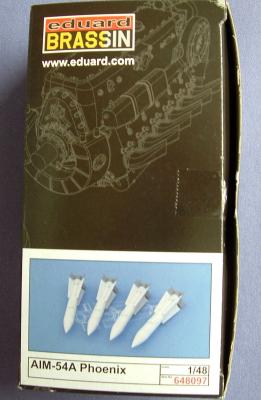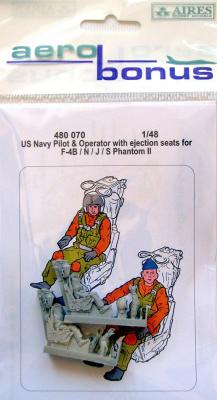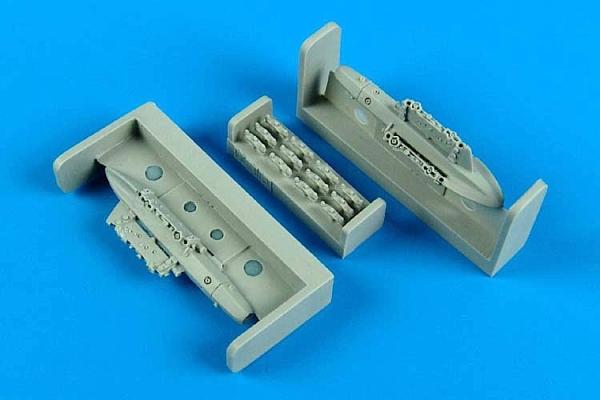
Quickboost now offers a 1/48 scale three-piece resin ejection seat to replace the nine-part injection-molded seat found in the Trumpeter Sea Hawk kit, or the resin one found in the Classic Airframes kit. The multi-part ejection seat found on the sprues in Trumpeter’s kit builds into a nice, but somewhat unconvincing, replica of what you would see in the prototype. The resin seat in the Classic Airframes kit is much nicer, but requires the modeler to add PE belts to the seat, and the kit is now out of production. The Quickboost seat offers superior detail than what’s provided in either detail set, plus it includes nicely molded safety belts (the photos below show the level of delicate detail molded into the parts). The Quickboost seat also appears to be better proportioned. In the comparison photo below, the Quickboost seat (on the right) exhibits superior detail over that found in the Trumpeter kit’s seat (on the left).
What's New
Although the He-111 was designed supposedly as a civil transport prototype capable of carrying 10 passengers and mail, its main purpose was of a military nature. It first flew in 1935. Several modifications were made to improve performance. A major change was replacing the two 660-hp BMW engines with the 1,000 hp Daimler Benz DB 600A engines, which significantly improved performance. The He-111 cut its fighting teeth in the Spanish Civil War, serving with the Condor Legion where it was very successful. That success continued in the early days of World War II. Germany overran several countries with its Blitzkrieg tactics, staring the Ju-87 and the He-111. Its success faded with the onset of the Battle of Britain when the lightly armed He 111 encountered the fast Spitfires and Hurricanes. By the time Hitler lost this battle, he was already planning Operation Barbarossa, the invasion of the Soviet Union. The He 111 again found success on the Russian Front.
Thank you to the wonderful folks at Casemate Publishers and to the IPMS Reviewer Corps for allowing me to review these two very timely detailed volumes describing the He-219. The Heinkel 219 Uhu was a highly effective but under-utilized Luftwaffe night fighter, with a variety of innovations including obliquely firing guns and the first operational ejection seats. The two Kagero monographs described here provide an excellent resource for any modeler constructing and replicating this extraordinary aircraft.
Quickboost now offers a resin 1/48 scale three-piece resin ejection seat to replace the injection molded seat found in the various F-86F kits marketed by Hasegawa (also should fit Academy kits). The Quickboost seat offers a more correctly proportioned seat with superior detail than provided in the kits, plus it includes nicely molded safety belts (the photos below show the level of delicate detail molded into the parts). See the comparison photo below to determine the difference in the Quickboost seat (on the right) to the Hasegawa kit’s rather basic seat part (on the left).
Squadron is one of the mainstay companies in the United States for our hobby, and they have been making great strides in providing customers great items at reasonable prices. In this case, their release of the Avionix-range of resin accessories is proving quite valuable. We cannot thank Squadron enough for their support of the hobby, and IPMS USA in particular by providing us new releases. On to the subject of this review: The Avionix front cockpit for Hobby Boss’ 1/32 P-61!
I’m a bit tardy on this review; I received the Avionix review item a month or so ago, but the reason is I needed to purchase a kit to use it on, (I thought the backorder would arrive before the review item) and they keep selling out! Once I had it, I could use it to review the upgrade while meeting the reviewer corps requirement of “Use the set if you can…” I thought it would be an easy to find one, but no… I finally got one about two weeks ago, and here we are.
Trumpeter’s 1/32 scale MiG-3 kit is quite nice and needs only a few changes to improve it. Some kit reviews have pointed out that number one on the list is enhancing cockpit details, and the seat is the most conspicuous item noted. Quickboost has now addressed that issue by offering a two-piece resin replacement that includes a high level of detail and nicely molded safety belts (the photos below show the level of detail on the front and back of each part). The two-piece seat is designed to fit in place of the kit’s three-piece seat parts. In the comparison photo below, the Quickboost seat (on the right) exhibits superior detail and avoids the ejector pin repair issue found in the kit’s seat back (on the left).
One of the only complaints I have seen regarding the superlative 1/48 F6F Hellcat released by Eduard a few years ago was with respect to the wheels provided in the kit. The kit parts are considered to be too thin, most likely representing the wheels/tires fitted to the prototype and very early Hellcats.
Ironically, Eduard themselves have now release a Brassin wheel set for the F6F that fixes this problem with their own kit. This resin accessory comes with a pair of crisply molded wheels/tires, with a separate pair of hubs and a set of Eduard kabuki masks to ease with painting. The tires have a diamond tread pattern (as opposed to the smooth tires of the kit-provided pieces), and the detail is extremely crisp.
Scale Aircraft Conversions makes various landing gear sets from lead-free white metal. Some come with the wheels attached, if needed. Others might have the wheel bay included to help with added weight, but most only come with the new landing gear struts.
The detail of the metal parts is much crisper and looks flawless. The advantage to these parts is their strength, and that they won’t warp under the kit’s weight over time. They will also hold up well while you work with them – no accidentally snapping them apart. To attach the new landing gear, you will need to use CA glue. On SAC’s website, they recommend a gap-filling CA glue so the gear can be positioned the way you want it, and then using an accelerator to bond the parts instantly.
1/72 scale builders should be happy to hear that Iliad Design has reduced their 1/48 ANG Mustang decal sheet to 1/72 scale...and added one more option! ANG Mustangs are interesting subjects that, in my opinion, have not been covered very well by domestic decal companies. There are five subjects on the sheet provided in this set. These options provide builders a choice of National Guard Mustangs in a somewhat dulled natural metal finish with Olive Drab anti-glare panels, colorful unit emblems, and prominent code numbers and serials. The aircraft served in units in five Midwestern and Western states in the four years following WWII. Some may have gone on to serve in the Korean War.
The five options are:
History Brief
The Pegasus is either a Mercury class Battlestar or a Pegasus class Battlestar, depending on where you source your information; she is newer, larger, and more powerful than Galactica. In the re-imagined series, the Beast, as she known by her crew, is a survivor unexpectedly found by Galactica in the 10th episode of the 2nd season. She’s almost twice the size of Galactica but only needs about half the support crew, relying on more advanced automation systems. Utilizing these automation systems, the Pegasus could manufacture her own Vipers and Raptors, plus replenish stocks for the Galactica.
Her Captain, Admiral Helena Cain, and her crew were battle-tested and wanted payback after escaping the Cylon invasion. They were entirely motivated by bloodthirsty revenge and didn’t want to be tied up aiding the Colonial survivors, and, yes, this made great television entertainment. Sadly, the Pegasus was destroyed a few episodes later… or was she?